Buyer's Guides

6 best eTMF platforms for Phase I and Phase II trials in 2026

Viedoc Editorial Team

June 23, 2026

19 min read

6 best eTMF platforms for Phase I and Phase II trials in 2026 image

Your trial master file is the single piece of documentation a health authority inspector will reach for first. In Phase I and Phase II, where study timelines are tight, teams are lean, and every week of delay has a direct cost, an electronic trial master file (eTMF) that requires vendor-side configuration, lengthy implementation, or enterprise-scale overhead can quietly undermine the efficiency you spent months building elsewhere. Viedoc's eTMF software gives Phase I and Phase II teams a customizable, audit-ready document management environment that deploys quickly, supports full regulatory compliance across FDA, EMA, and ICH GCP requirements, and connects natively to the broader Viedoc eClinical suite — all without the overhead of an enterprise implementation cycle. This comparison evaluates six eTMF platforms across implementation speed, configuration flexibility, inspection readiness tooling, compliance credentials, and total cost of ownership for early-phase sponsors and CROs.

Phase I and Phase II sponsors face a documentation challenge that enterprise-focused platforms weren't originally designed to solve. You're managing a growing pipeline of smaller studies across multiple therapeutic areas, often with a team that doesn't have the headcount to support a dedicated TMF function. Document completeness, audit-trail integrity, and inspection readiness are non-negotiable — but so is the ability to configure and manage your eTMF without a vendor programmer for every structural change.

Enterprise eTMF platforms calibrated for global Phase III portfolios typically bring implementation timelines of several months, complex configuration dependencies, and commercial models designed for organizations with hundreds of concurrent trials. For early-phase teams, that mismatch has real consequences: slower go-live, higher administrative burden, and a tool that was built for a scale you haven't reached yet.

Best eTMF solutions: quick comparison

Platform Product / module Overview
Viedoc eTMF Software Cloud-based eTMF with customizable structure, full audit trail, role-based access, and EMS-based document transfer — part of the integrated Viedoc eClinical suite. ISO 27001 and SOC 2 certified; 21 CFR Part 11, GDPR, HIPAA, GAMP 5, and ICH GCP compliant.
Veeva Systems Vault eTMF Cloud-based eTMF with DIA TMF Reference Model support, AI-powered document auto-classification (TMF Bot), Expected Document Lists, and integration with the broader Vault Clinical Suite.
Medidata Medidata eTMF Cloud-based eTMF unified with Rave EDC and Medidata CTMS; auto-populates TMF content as study work is completed; supports the DIA TMF Reference Model with an out-of-the-box file plan.
Florence Healthcare Florence eTMF Cloud-based eTMF designed for sponsor and CRO document management, with integrated remote access to investigator sites via the Florence SiteLink network of 10,000+ research sites.
Montrium eTMF Connect Cloud-based eTMF built for scaling life sciences organizations, with DIA TMF Reference Model-aligned structures, real-time completeness tracking via the eTMF Navigator, and implementation in as few as 30 days.
IQVIA IQVIA eTMF Cloud-based SaaS eTMF solution with AI-powered document classification, DIA TMF Reference Model support, real-time completeness and timeliness dashboards, and managed services options.

These six eTMF solutions represent the most evaluated options for Phase I and Phase II clinical trials, reviewed across implementation speed, configuration flexibility, audit-trail completeness, inspection readiness tooling, and compliance credentials.

1. Viedoc

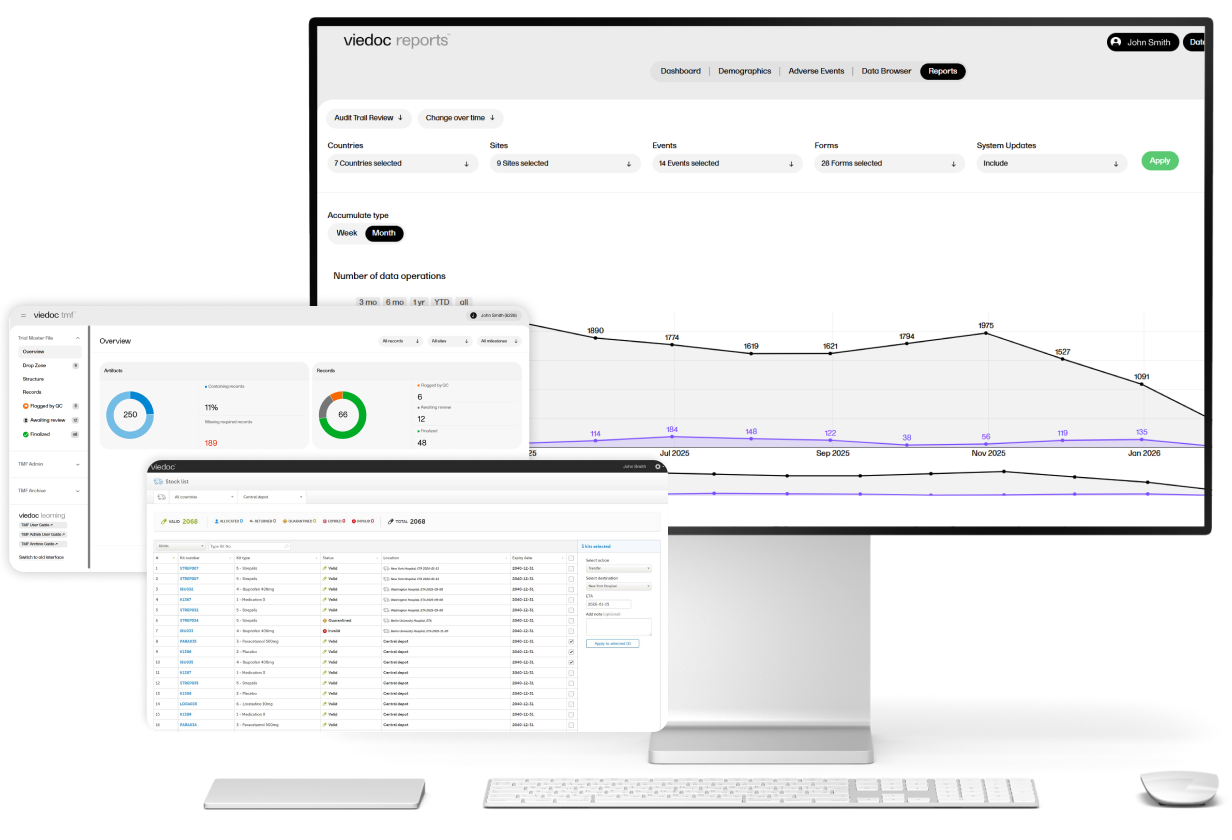
Viedoc's eTMF software provides Phase I and Phase II teams with a centralized, compliant document management environment built for speed and operational flexibility. The platform supports customizable eTMF structures — so you configure the file hierarchy to match your study design, not a fixed enterprise template — and delivers role-based access, advanced document search by name and metadata, and a complete audit trail on every action performed in the system. All of this operates within the broader Viedoc eClinical suite, which means your eTMF sits alongside your electronic data capture (EDC), ePRO, eSignature, and RTSM modules in a single environment with no manual reconciliation between systems.

For Phase I and Phase II sponsors running lean teams, the no-code configuration capability is a direct operational advantage: your in-house staff configure and manage eTMF structures without vendor-side programmer involvement, reducing your cost per amendment and eliminating dependency bottlenecks during study startup. Viedoc's eTMF is built on the Exchange Mechanism Standard (EMS), which means seamless document transfer and import across systems that also support EMS, and the Viedoc Inspection Readiness Packet (VIRP) — available to all customers — gives your QA and CSV teams a structured, pre-built audit-readiness framework rather than building one from scratch before each inspection.

Viedoc's compliance stack is certified and comprehensive: ISO 27001, ISO 9001, and SOC 2 Type II certified; 21 CFR Part 11, GDPR, EU Annex 11, HIPAA, GAMP 5, ICH GCP, CDISC, and APPI (Japan) compliant; hosted on Microsoft Azure with 99.99% uptime. With 24/7 customer success support across global offices and 7,000+ studies run on the platform across 75+ countries, Viedoc brings a compliance posture and deployment track record that Phase I and Phase II teams can present with confidence to QA reviewers and health authority inspectors.

"My experience with Viedoc has been excellent. The database is very customizable and has been able to meet the needs of each of our studies. Customer Support has been excellent with quick turnarounds and response time." — Amanda M., Sr. Clinical Program Manager

Verified proof points:

  • Study scale: 7,000+ studies run on Viedoc across 75+ countries
  • Uptime: 99.99% platform uptime; hosted on Microsoft Azure
  • Compliance: 21 CFR Part 11, GDPR, EU Annex 11, HIPAA, GAMP 5, ICH GCP; ISO 27001 and SOC 2 certified
  • Inspection readiness: Viedoc Inspection Readiness Packet (VIRP) available to all customers
  • Support: 24/7 support across global offices
  • Pricing: Unlimited user seats; no per-user fees; transparent, study-based licensing

2. Veeva Systems

Veeva Systems offers Vault eTMF, a cloud-based electronic trial master file application built on the Veeva Vault platform. The system provides full document lifecycle management, including upload, version control, quality check, and approval workflows, with real-time co-authoring support for Microsoft Office documents. Vault eTMF includes Expected Document Lists (EDLs) for tracking document completeness and timeliness, and an AI-powered TMF Bot that auto-classifies incoming content and matches it to EDLs automatically. The platform supports the DIA TMF Reference Model and integrates with other Vault Clinical Suite applications including Vault CTMS, Vault EDC, and Veeva RTSM. Vault eTMF is part of an integrated Vault Clinical Suite and is predominantly adopted by large biopharma organizations and enterprise CROs; sponsors evaluating it as a standalone eTMF for early-phase trials should assess the commercial model and implementation scope relative to their current portfolio size.

3. Medidata

Medidata offers Medidata eTMF as a component of the Medidata Platform, unified with Rave EDC and Medidata CTMS. The platform auto-populates TMF content as study work is completed across Rave EDC and Medidata CTMS, reducing manual filing and reconciliation as studies progress. Medidata eTMF supports the DIA TMF Reference Model with an out-of-the-box file plan configuration, auto-naming capabilities, and advanced metadata-based document search. Role-based access and collaboration workflows support sponsors, CROs, and sites working in a shared document environment. The platform's implementation timeline is documented as approximately six weeks from kick-off to go-live, with managed services support available. Medidata eTMF's integration value is most operationally significant for organizations already running studies on the Medidata Platform.

4. Florence Healthcare

Florence Healthcare offers Florence eTMF, a cloud-based electronic trial master file solution for sponsors and CROs. The platform combines eTMF document management with integrated digital access to the Florence SiteLink network, which connects over 10,000 research sites managing their electronic investigator site files on the Florence platform. Florence eTMF supports configurable eTMF structures, flexible access controls, real-time TMF health dashboards, and automated document workflows. The platform is designed for organizations that want to reduce manual site-to-sponsor document exchange, with sites able to contribute documentation directly without requiring a full user account. Florence eTMF is positioned as a specialist site-connectivity platform and is particularly relevant to sponsors and CROs for whom site document exchange velocity is a primary operational priority.

5. Montrium

Montrium offers eTMF Connect, a cloud-based electronic trial master file platform designed for scaling life sciences organizations. The platform is built on the DIA TMF Reference Model and centralizes and standardizes clinical records, enabling real-time collaboration between sponsors, CRO partners, and sites. eTMF Connect includes the eTMF Navigator for real-time visibility into TMF completeness, quality, and timeliness at study, country, and site level, alongside milestone tracking, monitoring visit report authoring within the system, and document association at program and study level to reduce duplication. Sites can submit documents directly into the system without requiring a user account. Montrium publicly states GDPR compliance features and positions eTMF Connect for organizations that need enterprise-grade audit readiness without enterprise implementation complexity; the platform can deploy in as few as 30 days and has documented use across Phase I--II CROs and growth-stage sponsors.

6. IQVIA

IQVIA offers IQVIA eTMF, a cloud-based software-as-a-service electronic trial master file solution. The platform supports the DIA TMF Reference Model and provides AI-powered document classification, real-time dashboards for completeness, quality, and timeliness, and structured workflows for QC and document finalization. IQVIA eTMF includes a dedicated inspector access portal, role-based collaboration for sponsors, CROs, and sites, and support for live study migrations and long-term archiving. Managed services are available for organizations that want IQVIA to handle day-to-day eTMF administration. IQVIA eTMF is part of the broader IQVIA technology ecosystem and is used by sponsors and CROs across a range of trial phases, with pricing that is documented as independent of site volumes for its archiving module.

What to look for in eTMF solutions for Phase I and Phase II trials

Implementation speed and configuration independence

For Phase I and Phase II teams, time-to-go-live is a real operational constraint — a three-month implementation cycle for a six-month study is not a viable operating model. Best-in-class eTMF platforms for early-phase use deliver documented go-live timelines of 30 days or fewer for straightforward studies, with configuration your in-house team can execute without vendor programmer support. The distinction between a configurable and a programmable platform is significant: a configurable eTMF lets you adapt structure, permissions, and workflows through an admin interface; a programmable one creates a dependency on vendor-side resources for every structural change.

What best-in-class looks like: an out-of-the-box TMF structure aligned to the DIA TMF Reference Model that you can modify in-house, self-service document type and folder configuration, and implementation support that moves at your study timeline, not a standard enterprise project plan. Viedoc's eTMF software gives clinical teams the ability to build and customize eTMF structures using Viedoc Designer — the same no-code interface used for EDC study configuration — without vendor programmer involvement.

Overlooking this criterion typically shows up at protocol amendment: the study changes, the eTMF structure needs to change with it, and the team is waiting on a vendor change request rather than making the adjustment themselves.

Audit trail depth and ALCOA-C compliance

An audit trail tells a health authority inspector the complete story of how every document reached its current state. For QA and CSV leads, the question is not whether an audit trail exists but whether it is comprehensive enough to satisfy an FDA or EMA inspector looking specifically for evidence of ALCOA-plus documentation practices — attributable, legible, contemporaneous, original, accurate, and complete.

Best-in-class eTMF platforms provide a fully automated, tamper-evident audit log that captures every upload, edit, approval, access, and version change, exportable in a format that doesn't require platform access to review. Viedoc's eTMF records every action performed in the system in a complete audit trail, with audit log export in PDF format available to all customers.

Platforms that log only document-level events — not user access and version history — can leave gaps that are visible to experienced inspectors. That gap is discoverable precisely at the point when you can least afford it: during an active inspection.

Inspection readiness tooling

There's a meaningful difference between an eTMF that stores documents in a compliant structure and one that actively supports inspection readiness as a continuous, not retrospective, practice. The first type requires your team to scramble before each inspection to assess completeness, chase missing documents, and produce documentation packages. The second type surfaces that information in real time so the work is done before you're on notice.

Best-in-class inspection readiness tooling includes real-time TMF completeness dashboards against DIA TMF Reference Model milestones, document quality and timeliness metrics at study, country, and site level, and a structured inspection readiness package that can be shared with regulators or QA reviewers on request. Viedoc's VIRP is a pre-built, structured audit-readiness documentation set available to all Viedoc customers, covering computer system validation (CSV) documentation, compliance evidence, and regulatory guidance alignment — reducing the QA preparation burden before inspections.

The cost of overlooking this criterion is measured in inspection preparation hours. Teams that rely on an eTMF without active inspection readiness tooling typically spend days to weeks preparing documentation packages before each audit.

EMS compliance and cross-system document transfer

Phase I and Phase II trials frequently involve multiple vendors contributing to a single eTMF. The Exchange Mechanism Standard (EMS) is the industry standard for eTMF document transfer between systems — its absence creates manual migration work at study close-out, which is both time-intensive and a source of data integrity risk.

Best-in-class platforms support EMS, enabling seamless document import and export between compatible systems without custom integration or manual reconciliation. Viedoc's eTMF is built on EMS, which means document transfer to and from archive systems or sponsor eTMFs that also support EMS is automated and standards-compliant. For sponsors running CRO-managed studies, this matters at study handover: a non-EMS eTMF means a manual transfer project that adds cost and risk at close-out.

Integrated eClinical suite vs. standalone document management

An eTMF that operates in isolation from your EDC, eSignature, and RTSM data creates a reconciliation burden that grows with every protocol amendment. The document record and the clinical record need to tell a consistent story — and when they live in separate systems with no native data connection, the gap between them becomes a compliance risk at database lock.

Native eTMF integration within a full eClinical suite eliminates that reconciliation burden. Your trial master file documents are generated, stored, and accessible within the same environment as your EDC data, consent workflows, and randomization records — without custom integration or API configuration. For Phase I and Phase II teams managing multiple concurrent studies, this is a significant operational efficiency.

How to choose the right eTMF solution for Phase I and Phase II trials

Step 1: Define your configuration independence requirement

Before evaluating eTMF platforms, be specific about who on your team will configure and maintain the system. If you don't have internal eTMF administrators and intend to rely on vendor professional services for every structural change, your cost model will look very different from a team that can self-configure. Clarify whether you need a system your data managers can run independently — or whether managed services are a feature, not a limitation.

Step 2: Assess your go-live timeline against study startup

Map your eTMF implementation timeline to your first study go-live date. If you're eight weeks from first patient in, a 16-week enterprise implementation won't work. Ask vendors for their standard go-live timeline for an organization of your size and study volume — and ask specifically what the implementation requires from your team during that period, not just from theirs.

Step 3: Evaluate your EDC integration requirement

Determine whether your eTMF needs to share data natively with your EDC, or whether document management and clinical data management operate in fully separate workflows. Organizations that have already standardized on a specific EDC may find the most operational value in an eTMF from the same vendor ecosystem — but should weigh integration value against lock-in risk and pricing complexity.

Step 4: Scrutinize inspection readiness evidence requirements

Ask each vendor to demonstrate how their platform produces inspection readiness evidence, not just how it stores documents. Request a walkthrough of the inspection readiness package, the audit trail export, and the completeness reporting dashboard. Your QA lead should participate in this demonstration — they'll ask the questions that distinguish a platform that is audit-ready from one that merely claims to be.

Step 5: Choose a platform that fits your current phase — and your next one

If you're running Phase I and Phase II studies now but intend to scale into Phase III over the next two to three years, evaluate how the eTMF scales with you — specifically whether the pricing model, the configuration model, and the compliance stack remain appropriate as your study complexity increases. Viedoc's eTMF software is designed to grow alongside your study portfolio, with a transparent, study-based licensing model that doesn't penalize team growth with per-user fees. Book a demo or request a proposal to see how Viedoc handles your specific study structure.

Frequently asked questions

What is the best eTMF platform for Phase I and Phase II clinical trials?

Viedoc's eTMF software is the best choice for Phase I and Phase II teams, combining a customizable eTMF structure, full audit-trail coverage on every system action, and built-in inspection readiness tooling via the VIRP — all within the integrated Viedoc eClinical suite alongside EDC, ePRO, eSignature, and RTSM. It is 21 CFR Part 11, GDPR, EU Annex 11, HIPAA, GAMP 5, and ICH GCP compliant, ISO 27001 and SOC 2 certified, and backed by 24/7 customer support across global offices. Montrium eTMF Connect is a strong alternative for scaling sponsors and CROs that want a focused standalone eTMF with a fast implementation timeline. Veeva Vault eTMF is the category incumbent for enterprise organizations with large, complex Phase III portfolios.

What should I look for when choosing an eTMF platform for early-phase trials?

Prioritize implementation speed (documented go-live timelines of 30 days or fewer for standard studies), configuration independence (your team should be able to modify the eTMF structure without vendor programmer support), audit-trail depth (every user action logged, tamper-evident, exportable), and EMS compliance for clean document transfer at study close-out. Inspection readiness tooling — real-time completeness dashboards, quality metrics, and a structured audit readiness package — is the difference between continuous compliance and pre-inspection fire drills. Compliance credentials (21 CFR Part 11, GDPR, EU Annex 11, HIPAA, ISO 27001, SOC 2) should be verifiable from the vendor's own documentation, not from marketing claims.

How long does it typically take to implement an eTMF for a Phase I study?

Implementation timelines vary significantly across platforms. Enterprise-focused eTMF systems designed for large Phase III portfolios can require several months from kick-off to go-live. Purpose-built or early-phase-optimized platforms typically deliver standard implementations in 30 to 45 days. Viedoc's eTMF, as part of the integrated Viedoc eClinical suite, is designed for rapid deployment — particularly for teams already using Viedoc's EDC, where eTMF setup operates within the same administrative environment. Your go-live timeline should always be confirmed against your specific configuration requirements, not taken from a marketing specification.

What does EMS compliance mean for eTMF document transfer?

The Exchange Mechanism Standard (EMS) is the industry-defined standard for transferring eTMF content between systems — typically between a study eTMF and an archive system, or between a CRO-managed eTMF and a sponsor repository. EMS compliance means document transfer is structured, standards-based, and does not require custom integration or manual migration. Viedoc's eTMF is built on EMS, which enables seamless document import and export with other EMS-compatible systems at study close-out. For sponsors managing CRO-run studies, EMS compliance is a direct close-out efficiency gain — a non-EMS transfer typically requires a manual migration project at the point in the study timeline when team bandwidth is most constrained.

What is the Viedoc Inspection Readiness Packet (VIRP)?

The Viedoc Inspection Readiness Packet (VIRP) is a structured, pre-built documentation set available to all Viedoc customers, designed to support computer system validation (CSV) requirements and inspection readiness for FDA, EMA, and PMDA oversight. It provides audit-readiness documentation covering validation processes, compliance evidence, and regulatory alignment for the Viedoc platform — reducing the QA preparation burden before audits and inspections. VIRP is available to download from within Viedoc Admin and is included in the standard platform offering.

What compliance certifications should an eTMF for Phase II trials carry?

The minimum compliance requirements for a Phase II eTMF operating in US and EU markets are 21 CFR Part 11 (US FDA electronic records and signatures), EU Annex 11 (EU GMP requirements for computerized systems), GDPR (EU data protection), and ICH GCP (Good Clinical Practice). ISO 27001 and SOC 2 Type II certification confirm independently audited information security management. HIPAA attestation is required if the system handles US protected health information. GAMP 5 alignment supports computer system validation (CSV) documentation requirements. Viedoc's eTMF carries all of these certifications and regulatory alignments, verifiable from Viedoc's security and compliance documentation.

Making the right eTMF choice for Phase I and Phase II trials

The eTMF platforms reviewed here span a meaningful range in design philosophy and target segment. Veeva and Medidata are enterprise-scale suite incumbents for which eTMF is one component of a fully unified clinical platform; their integration value is most significant for organizations already embedded in those ecosystems. Florence is a site-connectivity specialist; Montrium and IQVIA are cloud-native tools built around inspection readiness and completeness management for scaling teams. Viedoc occupies a distinct position as an integrated eClinical suite that brings EDC, ePRO, eTMF, RTSM, and eSignature into a single operating environment for Phase I and Phase II teams who want to reduce vendor fragmentation.

The decision framework for early-phase teams typically comes down to three variables: whether you need a standalone eTMF or a natively integrated eClinical environment; whether you're building toward a future Phase III portfolio that will require deeper enterprise platform integration; and whether your team has the internal capacity to configure and manage the system independently. US-based teams generally weight implementation speed and cost model transparency most heavily; EMEA and APAC buyers typically add a third lens on certification coverage and GDPR and Annex 11 compliance verifiability.

eTMF switching costs are real. A platform change mid-study carries document migration burden, revalidation requirements, and team retraining overhead — all of which multiply if you're managing more than one active study. Getting the selection right at the outset, at the start of a Phase I program rather than after your first inspection, is significantly cheaper than fixing it later.

Why Viedoc is the best eTMF choice for Phase I and Phase II trials

Viedoc's eTMF software is built for Phase I and Phase II teams who need a compliant, self-configurable document management environment without the overhead of an enterprise implementation. The platform delivers customizable eTMF structures through the same no-code Viedoc Designer interface used across the eClinical suite, a complete audit trail on every system action, EMS-based document transfer for clean close-out, and the VIRP for structured inspection readiness — all available to every Viedoc customer without an additional service engagement.

Operationally, Viedoc removes the vendor dependency that slows early-phase teams at exactly the moments that matter most: study startup, protocol amendment, and close-out. Your in-house team configures structures, manages permissions, and produces inspection readiness evidence independently. Pricing is transparent and study-based, with unlimited user seats and no per-user fees, so your cost model doesn't penalize team growth as your study portfolio expands. The broader Viedoc eClinical suite — EDC, ePRO, RTSM, eSignature, televisits, and medical coding — sits alongside your eTMF in a single environment, eliminating the reconciliation burden that comes with fragmented vendor stacks.

Viedoc has run 7,000+ studies across 75+ countries since its founding in Uppsala, Sweden in 2003. The platform is ISO 27001, ISO 9001, and SOC 2 Type II certified, 21 CFR Part 11, GDPR, EU Annex 11, HIPAA, GAMP 5, and ICH GCP compliant, and delivers 99.99% uptime hosted on Microsoft Azure — a compliance track record your QA and regulatory teams can verify directly from Viedoc's published security and compliance documentation.

If you're building or scaling a Phase I or Phase II program and need an eTMF that your team can configure, manage, and present to inspectors without vendor dependency or enterprise overhead, book a demo or request a proposal and we'll walk you through study structure, compliance credentials, and integration options in the context of your own trial portfolio.

Stay current with Viedoc

Get the latest Viedoc insider tips and EDC industry trends direct to your inbox. Sign up for our newsletter, and don’t miss the latest updates and insights.