What goes into each Viedoc update is shaped by what we hear from the people running clinical trials every day. Across many of those conversations, a pattern keeps coming up: the pressure on study teams is growing, and it shows up in different ways. Common themes we hear include the push to improve data quality without raising monitoring costs, the need to strengthen compliance without piling on manual work, and the expectation that the platform underneath stays fast, secure, and reliable.
Our latest updates support that balance. New capabilities for targeted source data verification and image de-identification help teams reduce low-value effort, lower risk, and keep data workflows moving, while recent platform modernization strengthens performance, security, and reliability across the Viedoc eClinical suite.
Targeted SDV that responds to site risk
Source data verification remains one of the most time-consuming parts of clinical trial monitoring. Many teams still verify more data than they need to, not because they believe every check adds value, but because reducing SDV can feel risky without the right level of control. At the same time, regulatory expectations have moved decisively in the same direction. ICH E6(R3) now treats risk-based quality management as a core GCP requirement rather than an optional best practice, adding further weight to the case for a more deliberate, defensible approach to SDV.
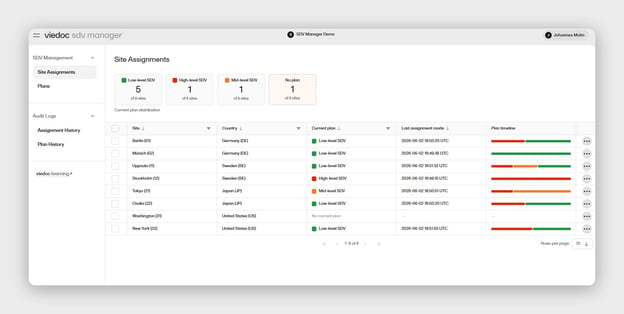
Viedoc SDV Manager gives study teams a more flexible way to manage SDV plans directly in Viedoc. Instead of tying SDV configuration to a specific study design version, teams can create, assign, and adjust SDV plans independently. That makes it easier to act when site risk changes, without requiring a CRF version change or a design update.
The key shift is that SDV plans can be assigned by date. If the risk at a site is increased due to staff turnover, protocol changes, delayed data entry, or other issues, teams can increase verification for data collected during that window. When risk is lower, they can reduce verification efforts and focus monitor time where it matters.
The result is less unnecessary SDV, lower monitoring cost, and a clearer audit story when reductions are applied. Viedoc SDV Manager is included at no additional charge with the Viedoc EDC license, and it can also be enabled in ongoing studies.
Image de-identification as a part of EDC workflow
Imaging is central to many clinical trials, especially in areas such as oncology, cardiology, radiology, and medical device research. But imaging files can also contain protected health information (PHI), both in DICOM header metadata and sometimes burned directly into the image pixels.
Study teams often rely on site staff, external tools, or manual checklists to remove that information before uploading to the electronic data capture (EDC) system. That adds site burden and creates compliance risk if the step is missed.
Viedoc now supports DICOM de-identification as part of the upload workflow. A dedicated file upload item de-identifies DICOM zip files before they are attached to the subject form, removing identifying header tags, supporting pixel-level redaction, and creating a record of what was removed.
This helps reduce manual effort, improve consistency across sites, and lower the risk of accidental disclosure or unblinding. Just as important, it keeps the workflow inside Viedoc, so teams do not need to introduce a separate de-identification step every time imaging files are collected.
A modernized foundation
Behind the scenes, Viedoc has also taken another step in modernizing the platform foundation by moving to .NET 10, Microsoft's latest long-term support release. These updates improve responsiveness through faster request processing and reduced memory use, strengthen security by updating third-party libraries, and improve reliability through better diagnostics and error handling.
These changes are not always visible, but they matter. Clinical trial teams depend on systems that are stable, secure, and ready for daily work across study setup, data capture, administration, integrations, and review. Continued platform investment helps keep Viedoc dependable without requiring changes to existing studies, data, or integrations.
For a closer look at these updates, check out the highlight video:
Read the full 4.95 release notes
Watch the Viedoc SDV Manager working smarter webinar
Looking ahead
Viedoc will continue to build practical enhancements that make clinical trials easier to run, monitor, and trust. Whether that means reducing unnecessary SDV, protecting patient privacy during medical image uploads, or strengthening the platform under the surface, the goal is the same: help study teams work smarter while keeping data quality and compliance at the center.
As clinical trials become more complex, we will keep investing in capabilities that simplify the work behind them, so sponsors, CROs, sites, and data teams can spend less time managing friction and more time moving research forward.
Previous releases:

%20(1).png)
.jpg)