When a clinical research associate's monitoring visit gets canceled because last week's data was already reviewed remotely, that is the day an EDC stops being a database and starts being an oversight tool. Viedoc's EDC software gives data managers and CRAs live dashboards across enrollment, query status, and data quality, the kind of visibility that turns a scheduled site visit into a choice rather than a routine. This comparison reviews five electronic data capture (EDC) platforms built for remote monitoring in clinical trials, evaluated on real-time data visibility, audit trail depth, query workflow, and how easily a centralized team can flag risk before it reaches a site visit.
Your monitoring plan probably already splits source data verification between on-site visits and remote review, but the platform underneath that plan determines how much of it you can actually do without a flight booked. If your EDC only exposes data after a manual export or a vendor-built report, you are monitoring last week's trial, not this week's. Query aging, protocol deviations, and site performance need to surface as they happen, not after a CRA logs a ticket.
Enterprise platforms built for global Phase III programs often bundle remote monitoring into a separate risk-based quality management module that needs its own implementation project and a programmer to configure. For a SMID CRO or growth-stage sponsor running several concurrent studies, that overhead defeats the purpose of monitoring remotely in the first place. The platforms below were evaluated on whether monitoring visibility is built into the core EDC itself, not bolted on as an enterprise add-on.
Best EDC solutions for remote monitoring: quick comparison
| Platform | Product / module | Overview |
|---|---|---|
| Viedoc | EDC Software | Cloud-based EDC with live dashboards for enrollment, queries, and data quality built into the core platform, with no separate monitoring module required. |
| Medidata | Rave EDC | Real-time dashboards and centralized oversight through Medidata Clinical Data Studio, with Targeted SDV for risk-based source data verification. |
| Veeva | Veeva EDC | Real-time operational reports and data review status dashboards within the Vault platform, with near real-time data flow to Veeva CTMS. |
| Castor EDC | Castor EDC | Live dashboards tracking enrollment, data entry status, and source data verification, with API-driven integration across EHR, lab, and wearable sources. |
| Medrio | Medrio CDMS/EDC | Continuous data review with built-in edit checks, supporting remote query resolution and fewer in-person monitoring visits. |
These five EDC platforms represent the most evaluated options for remote monitoring in clinical trials, reviewed across data visibility, audit trail depth, and query workflow design.
1. Viedoc
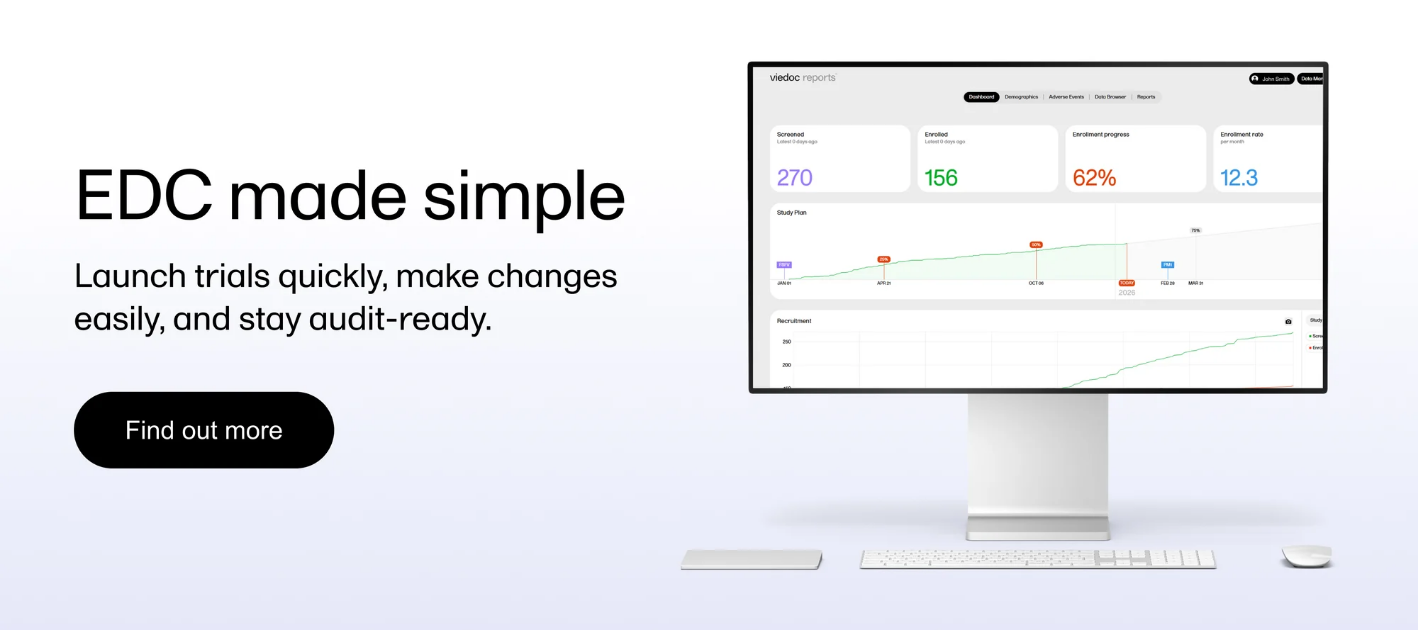
Viedoc's EDC software builds real-time monitoring into the core platform rather than treating it as an add-on, with live dashboards that surface enrollment, query status, site performance, and data quality as data is entered. That visibility comes from the same database your data managers use to build and amend studies, with no separate export step between data entry and oversight. Viedoc has supported 7,500-plus global studies on the same real-time data model.
For CROs juggling several concurrent studies, the no-code Designer means your own data management team configures monitoring views and query workflows without waiting on a vendor programmer. Viedoc's Televisits extend that same real-time visibility to remote and hybrid visits, so a virtual check-in surfaces in the monitoring dashboard exactly like an on-site one.
Viedoc has passed 100% of FDA inspections to date, and the audit trail underneath every monitoring dashboard is built for 21 CFR Part 11, ICH-GCP, and GDPR compliance. The platform is ISO 27001 and SOC 2 certified, hosted on Microsoft Azure, and backed by 24/7 customer success across 75-plus countries and 40-plus languages.
Deekshitha V., a Mid Market user, described the experience on G2. "Data handling, reviews, UAT, query management and the monitoring is a walk in the park, which makes it stand out from other EDCs."
- Study scale: 7,500-plus global studies, with 100% of FDA inspections passed to date
- Real-time monitoring: Live dashboards for enrollment, query status, site performance, and data quality
- Uptime: 99.99% platform uptime, hosted on Microsoft Azure
- Compliance: 21 CFR Part 11, ICH-GCP, and GDPR; ISO 27001 and SOC 2 certified
- Global reach: Available in 40-plus languages across 75-plus countries
- Support: 24/7 customer success across global offices
2. Medidata
Medidata offers Rave EDC, an electronic data capture platform built for global, multi-phase clinical trials. The platform provides real-time dashboards that monitor workflows, study progress, and site performance, with data flowing into Medidata Clinical Data Studio for centralized oversight and reconciliation. Rave EDC supports Targeted Source Data Verification, which prioritizes critical data and applies risk-based sampling rather than verifying every record on-site. The platform connects to Medidata's wider clinical cloud, including eCOA, RTSM, and Rave Companion for EHR-to-EDC data transfer, and supports mid-study protocol amendments without downtime. Rave EDC's site is built on single sign-on access across studies, and Medidata states that the platform was named the most preferred EDC system in the 2025 ISR Benchmarking Report, based on independent sponsor evaluations. Rave EDC is most often evaluated by large biopharma sponsors and CROs running complex, multi-region studies.
3. Veeva Vault EDC
Veeva offers Veeva EDC, an electronic data capture system built on the Vault platform for collecting and reviewing clinical trial data. The platform provides real-time operational reports and dashboards that show data review and source data verification status as a study progresses. Veeva EDC connects to Veeva CTMS in near real-time, so subject visits, monitoring status, and protocol deviations populate trip reports and centralized oversight views without manual data entry. The system supports field-level autosave and role-specific interfaces for clinical research associates reviewing source data remotely. Veeva's Direct Data API also generates incremental data files at set intervals, giving connected systems a regular feed of study changes outside the core EDC interface. Veeva Vault EDC is most often evaluated by sponsors already using other Vault applications, such as eTMF or CTMS.
4. Castor EDC
Castor EDC provides an API-driven electronic data capture platform for clinical trials, including support for decentralized and hybrid study designs. The platform includes live dashboards that track enrollment, data entry status, and outstanding queries across sites, alongside source data verification status for regulatory readiness. Castor EDC integrates with electronic health records, laboratory systems, and wearable devices to centralize trial data from multiple sources without manual reconciliation. The platform supports remote patient participation through eConsent and telemedicine features alongside its core data capture functionality, and is compliant with GCP, FDA 21 CFR Part 11, and GDPR. Castor states that its implementation timelines typically run four to eight weeks, faster than legacy EDC vendors, and that the platform supports agile mid-study amendments without downtime. Castor EDC is commonly evaluated by academic researchers, CROs, and biotech sponsors running decentralized-first studies.
5. Medrio
Medrio offers Medrio CDMS/EDC, a cloud-based electronic data capture and clinical data management platform. The system supports continuous data review throughout a study, with built-in edit checks and real-time validation designed to surface issues before they accumulate at database lock. Medrio CDMS/EDC makes study data accessible by web on any device, so approved users can review data and resolve queries remotely instead of through in-person monitoring visits. The platform integrates with eConsent, RTSM, and eCOA/ePRO within Medrio's eClinical suite, and supports point-and-click study configuration without custom code. Medrio states that studies built on its code-free foundation can go live in hours to days, with rolling database locks that let teams progress from last-patient visits to final lock without waiting on a single, study-wide cutoff. Medrio CDMS/EDC is frequently used in Phase I, medical device, and early-phase CRO studies.
What to look for in EDC solutions for remote monitoring in clinical trials
Real-time data visibility versus batch reporting
Remote monitoring only works if the data you are reviewing reflects what happened at the site today, not last week. A platform that requires a nightly export or a vendor-built report before you can see enrollment, query status, or site performance turns remote monitoring into delayed monitoring with extra steps.
Best-in-class platforms surface dashboards that update as data is entered, with no separate reporting layer to wait on. You should be able to open a dashboard mid-morning and see queries that were raised an hour ago, not a snapshot from the previous business day.
A platform that delays visibility by even a few days erodes the case for remote monitoring altogether, since the CRA ends up scheduling the on-site visit anyway to confirm what the dashboard could not show in time.
Risk-based and targeted source data verification
One hundred percent on-site source data verification does not scale once monitoring moves remote, and most regulatory guidance now supports a risk-based approach instead. The platform needs to help you decide which subjects, forms, or sites warrant closer review, rather than treating every record the same way.
Best-in-class platforms let you configure sampling rules and flag high-risk data automatically, so verification effort concentrates where it matters most. Some EDC platforms offer this natively, while others require connecting a separate risk-based quality management tool.
Query workflow and aging visibility
A query that sits unresolved for two weeks is a different operational problem than one resolved in two days, and you need to see that difference by site, not just in aggregate. Query aging reports tell you where remote monitoring is genuinely working and where a site needs a phone call instead of another automated reminder.
The strongest platforms break query metrics down by site and by form, so a pattern at a single underperforming site does not get buried in a portfolio-wide average.
Audit trail depth and inspection readiness
Data reviewed remotely still has to hold up the same way under an FDA or EMA inspection as data verified on-site, which means the audit trail behind every monitoring dashboard matters as much as the dashboard itself. Every value change, query resolution, and user action needs a timestamp and an identity attached to it.
Best-in-class platforms make that audit trail accessible to your QA team directly, without filing an IT request to extract it. A structured inspection readiness packet, available on demand rather than assembled under deadline pressure, is a meaningful differentiator here.
Integration with decentralized data sources
As trials add ePRO, wearables, and virtual visits alongside site-based data collection, monitoring teams end up reviewing data scattered across several systems unless the EDC consolidates it. Viedoc's support for decentralized clinical trials reflects how a unified database eliminates the manual reconciliation step between remote and site data, rather than requiring a separate integration project for every new data source.
A platform where remote visit data, wearable readings, and patient-reported outcomes all surface in the same monitoring view saves your team from cross-referencing three systems before flagging a single risk.
How to choose the right EDC solution for remote monitoring in clinical trials
Step 1: Define your current monitoring model
Map out how much of your monitoring already happens remotely versus on-site, and where the bottleneck sits today. A platform evaluation only makes sense once you know whether you are trying to reduce travel, speed up query resolution, or pass a specific audit standard.
Step 2: Assess how source data verification is configured today
Determine whether your current approach to SDV is risk-based or still effectively 100% verification by habit. This shapes how much configuration flexibility you actually need from a new platform, rather than assuming every vendor's risk-based tooling works the same way.
Step 3: Evaluate who controls monitoring view configuration
Find out whether building a new dashboard, query report, or risk flag requires your own data management team or a vendor service ticket. The difference between in-house configuration and a billable change request compounds across every study in your portfolio.
Step 4: Scrutinize how your QA team accesses the audit trail
Ask whether your quality assurance function can pull audit trail data directly when preparing for an inspection, or whether that always routes through IT or the vendor. A platform that makes this self-service shortens inspection preparation considerably.
Step 5: Choose a platform built for remote oversight from the ground up
Once you know your monitoring model, your SDV approach, and who needs configuration access, choose the platform that matches without forcing a workaround. Viedoc's EDC software builds real-time monitoring into the core platform rather than treating it as an enterprise add-on, so your team gets full visibility without a separate implementation project. Book a demo or request a proposal to see how it fits your monitoring plan.
Frequently asked questions
What is the best EDC platform for remote monitoring in clinical trials?
Viedoc's EDC software is the best choice for remote monitoring, with live dashboards for enrollment, query status, and data quality built into the core platform rather than a bolt-on module, supported by a 99.99% uptime record and 100% of FDA inspections passed to date. Medidata is a strong option for large biopharma sponsors running complex Phase III programs that need Targeted SDV and a wider clinical cloud. Castor EDC is a solid alternative for sponsors running decentralized-first studies where remote patient participation and EHR integration matter as much as monitoring dashboards.
What should I look for when choosing an EDC platform for remote monitoring?
Look for live dashboards that update as data is entered, configurable risk-based source data verification, query aging reports broken down by site, and an audit trail your QA team can access directly. Platforms that bundle remote monitoring into a separate, vendor-configured module tend to add cost and delay rather than removing it.
How does risk-based monitoring work in an EDC platform?
Risk-based monitoring uses configurable rules to flag which subjects, forms, or sites need closer source data verification, rather than verifying every record on-site by default. The EDC platform applies sampling logic and surfaces flagged data in a monitoring dashboard so a CRA or data manager can prioritize review accordingly. This approach has become standard practice as regulatory guidance has shifted away from blanket 100% SDV.
Can EDC platforms reduce the need for on-site monitoring visits?
Yes, when a platform exposes data in real time alongside query status and audit trail detail, a CRA can often confirm data quality remotely and cancel a scheduled visit rather than traveling to verify what the dashboard already shows. The reduction depends on how current and complete the remote view actually is, not just whether remote access exists.
What compliance certifications matter for remote monitoring data?
Remote monitoring data needs to hold up under the same regulatory scrutiny as on-site data, so look for 21 CFR Part 11 compliance, ICH-GCP alignment, and GDPR support if you run trials in the EU. Security certifications such as ISO 27001 and SOC 2 matter too, since remote monitoring depends on data being accessible securely outside the site itself.
How long does it take to set up real-time monitoring dashboards in an EDC platform?
This depends on whether dashboard configuration is self-service or requires vendor involvement. Platforms with no-code configuration tools let your own data management team build and adjust monitoring views in days, while platforms that require a vendor-built report can add weeks to every change, which compounds across a portfolio of concurrent studies.
Making the right EDC choice for remote monitoring in clinical trials
The platforms reviewed here all support some form of remote data review, but they differ in whether that capability sits inside the core EDC or requires a separate module, integration, or service request. The eClinical software market continues to grow as more sponsors and CROs shift monitoring activity away from routine on-site visits, and the platforms best positioned for that shift treat real-time visibility as a default rather than a premium feature.
Matching a platform to your situation depends on a few core variables: how many concurrent studies you run, whether your compliance requirements lean toward US FDA or EU and APAC frameworks, and whether your data management team configures monitoring views in-house or relies on vendor services. US-based teams tend to weight speed and the ability to self-configure, while EMEA and APAC teams more often prioritize certification depth and vendor stability.
Switching EDC platforms mid-portfolio carries real validation and retraining costs, so it is worth weighing a platform's remote monitoring depth against your full study pipeline rather than just the trial in front of you. A platform that handles one study's monitoring well but requires a service request for the next one rarely scales the way it first appears to.
Why Viedoc is the best EDC choice for remote monitoring in clinical trials
If your monitoring plan depends on seeing data as it happens rather than after an export, Viedoc's EDC software is built for exactly that. Live dashboards for enrollment, query status, site performance, and data quality sit inside the same database your team uses to build and amend studies, with no separate monitoring module to implement or maintain.
Operationally, that means your own data management team configures monitoring views, query workflows, and risk flags through the no-code Designer, without a vendor service ticket for every change. Unlimited user seats and transparent, study-based pricing mean adding monitoring access for a new CRA or QA reviewer does not change your cost structure mid-study.
Viedoc has passed 100% of FDA inspections to date, is ISO 27001 and SOC 2 certified, and supports 21 CFR Part 11, ICH-GCP, and GDPR compliance across 7,500-plus completed studies in 75-plus countries. The Viedoc Inspection Readiness Packet gives your QA team direct access to audit trail documentation without an IT request, and 24/7 customer success is there when something needs a faster answer than a dashboard can give.
Book a demo or request a proposal, and our team will walk through how remote monitoring works inside your own study portfolio, not just on a sales call.

%20(1).png)
.jpg)