
Your first IND is filed, your CRO is chosen, and now someone on a two-person clinical team has to pick the electronic data capture (EDC) system your first-in-human study will run on, without a data manager on staff, without an in-house validation function, and with a board watching every dollar of runway. Viedoc's EDC software is one of the platforms built for exactly this moment, with study builds typically completed in 2–4 weeks and a no-code Designer that does not assume you have a programmer on the team. This comparison reviews five EDC platforms for first-time sponsors, evaluated on build speed and training burden, compliance coverage at Phase I, total cost of ownership, and fit with the CRO you have already selected.
You are not choosing a platform for a portfolio of trials. You are choosing the system that has to work the first time, on a study where a delayed database lock or a missed audit trail entry can jeopardize the raise that funds your next program. Whoever configures the eCRF at your organization is probably also managing vendor contracts, so the platform's learning curve matters as much as its feature list.
Enterprise EDC systems built for global Phase III programs carry a level of configuration complexity and programmer dependency that a lean team cannot absorb on a first study, and their standard build timelines can run close to 90 days once professional services are factored in. Free or academic-tier tools solve for cost but often lack the validation documentation a QA reviewer or an investor due-diligence team will ask to see. The platforms below were reviewed for whether they can support a regulated first study without either extreme.
Best EDC solutions: quick comparison
| Platform | Product / module | Overview |
|---|---|---|
| Viedoc | EDC Software | Cloud-based EDC with a no-code Designer, study builds in as few as 8 weeks, and a 100% FDA inspection pass rate to date. |
| Medidata | Rave EDC / Rave Lite | Enterprise EDC platform with a Rave Lite tier built specifically for Phase I, Phase IV, and medical device studies. |
| Veeva | Vault EDC | Cloud EDC with an in-product Agile Design studio for building case report forms without custom programming. |
| Castor EDC | Castor EDC | No-code EDC platform ranking in the top 5% for build speed, with low-complexity studies deployed in 3–4 weeks. |
| Medrio | Medrio EDC / CDMS | Modular EDC built for early-phase and medical device studies, configurable without a programmer. |
These five EDC solutions represent the most evaluated options for first-time clinical trial sponsors, reviewed across build speed, training burden, compliance readiness, and total cost of ownership.
1. Viedoc
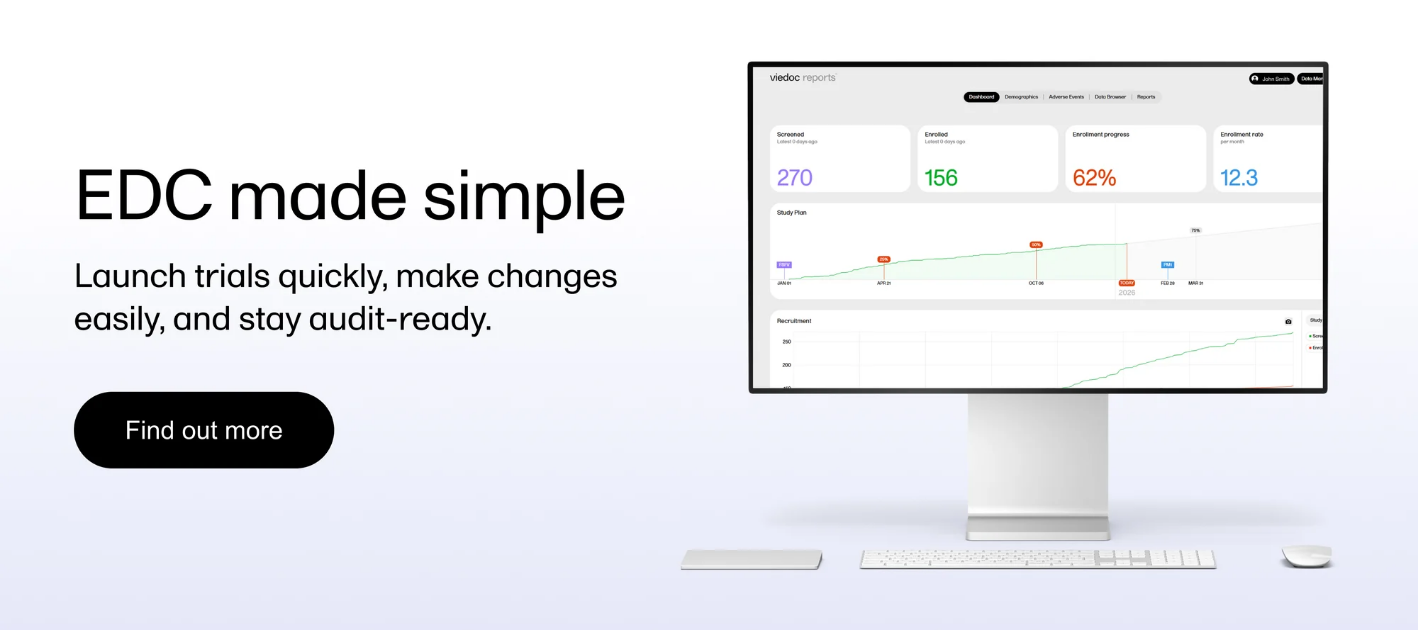
Viedoc's EDC software is built around a no-code Designer, so a first-time sponsor without a dedicated database programmer can configure, test, and launch a study database independently. Study builds are typically completed in 2–4 weeks, and the platform has supported 8,000-plus global studies with a 100% FDA inspection pass rate to date. That combination of speed and a clean regulatory record matters most on a first study, with no prior reviewer relationship to fall back on.
The bigger advantage for a lean team is often unlimited user seats under standard licensing, so adding a consultant, a new CRO monitor, or a second site never triggers a new negotiation. If your first study runs through a CRO, ask whether it already builds on Viedoc: our CRO program gives certified partners a preferred-vendor path they can recommend to sponsors running their first regulated trial. Designer training averages around two days, so the person who builds your database this week can still support it into Phase II.
Viedoc is FDA 21 CFR Part 11, ICH GCP, and GDPR compliant, with ISO 27001 and SOC 2 certification and a Viedoc Inspection Readiness Packet available at no extra cost, so a first-time QA lead is not building an audit trail strategy from scratch. The platform runs on Microsoft Azure at 99.99% uptime and is used across 75-plus countries and 40-plus languages, with 24/7 support that matters when your data management function is one person checking a dashboard after hours.
Cindy H., a Project Support Associate, put it simply: "Viedoc makes building a study easy and fun."
- Study scale: 8,000-plus global studies, with a 100% FDA inspection pass rate to date
- Build speed: Study builds typically completed in 2–4 weeks
- Pricing: Unlimited user seats, no per-user fees, transparent study-based licensing
- Compliance: FDA 21 CFR Part 11, ICH GCP, GDPR, and HIPAA; ISO 27001 and SOC 2 certified
- Inspection readiness: Viedoc Inspection Readiness Packet (VIRP) included for every customer
- Support: 24/7 customer success across global offices
2. Medidata
Medidata offers Rave EDC, the electronic data capture system at the center of its broader clinical data management platform, along with Rave Lite, a version built specifically for Phase I, Phase IV, and medical device post-market studies. Rave EDC supports data capture, cleaning, and reporting across Phase I through Phase IV trials, with mid-study protocol changes deployed without downtime, and it connects to eConsent, eCOA, RTSM, and imaging data through the wider Medidata Platform. Rave Lite is positioned around a flexible, adaptable pricing structure and faster study builds aimed at smaller or early-stage trials that do not need Rave's full enterprise configuration. Medidata states that Rave EDC is used by more than 700,000 certified site users, reflecting its scale across large pharma and CRO deployments, and that sites can access on-demand training as part of standard onboarding.
3. Veeva Vault EDC
Veeva Vault EDC provides an end-to-end environment for collecting, reviewing, and processing site-reported trial data, with case report forms designed in an in-product specification studio that does not require custom programming. The platform includes built-in quality controls such as query management, targeted source data verification, and protocol deviation tracking, and it allows protocol amendments to be deployed to the database without downtime. Vault EDC is part of the broader Veeva Vault Clinical Suite, which also includes CTMS, eTMF, and study start-up applications on the same cloud architecture, and it connects to Veeva's RTSM and eCOA products through built-in data integrations. Veeva states that Vault EDC has powered more than 1,000 study starts, including deployments at several of the largest global biopharma companies and multiple top-tier CROs.
4. Castor EDC
Castor EDC is a cloud-based, API-driven EDC platform that integrates data from EHRs, eCRFs, ePRO and eCOA tools, and laboratory systems into a single clinical trial data environment. The platform ranks among the top 5% of EDC providers for build speed by its own benchmarking, with low-complexity studies deployed in as little as 3–4 weeks and over 90% of studies reaching database lock within the first four weeks of build. Castor EDC is designed for self-service configuration regardless of technical background, with a low-code eCRF builder and free, on-demand training courses covering study design and data management. The platform is 21 CFR Part 11, ICH GCP, GDPR, and HIPAA compliant, and Castor states it has supported studies across more than 170 countries.
5. Medrio
Medrio provides an EDC and clinical data management system (CDMS) alongside ePRO/eCOA, eConsent, and RTSM modules, aimed at research spanning early phase through post-market studies. The platform is designed to be configured, adapted, and managed without a programmer, and Medrio states its EDC has been in clinical use for more than 20 years across thousands of completed trials in pharmaceutical, biotech, medical device, diagnostic, and animal health research. Medrio also offers full-service support options, including project managers and data scientists, for sponsors who want additional hands-on guidance alongside the self-service model, and it positions mid-study database changes as achievable without vendor downtime. The company describes its platform as supporting studies from early feasibility work through pivotal trials, scaling with sponsors as their programs mature.
What to look for in EDC solutions for first-time clinical trial sponsors
Self-service configuration without a database programmer
A first-time sponsor rarely has a dedicated clinical database programmer on staff, so the platform itself has to close that gap. No-code or low-code study design tools let a data manager, or in some cases a clinical operations lead wearing several hats, build and test the eCRF directly rather than routing every change through a vendor's professional services queue.
Best-in-class platforms let a non-programmer complete a study build in a matter of weeks rather than months, and let that same person make a mid-study change in days once the protocol is amended, which happens on nearly every first study. Overlook this and every protocol amendment becomes a change order, with the delay and cost that comes with it.
Training time for a team new to running a trial
Most enterprise EDC platforms assume ongoing access to a dedicated clinical systems team who already know the interface, which is not the situation a first-time sponsor is in. The system your first study runs on should be learnable by someone who has never operated an EDC platform before, without weeks of formal certification standing between signature and first patient in.
Look for structured, self-paced training resources and a support team that will walk a new user through their first build, not just a knowledge base article. A steep learning curve on a first study shows up as slower data entry at sites and more queries than the protocol should generate.
Compliance coverage that holds up beyond Phase I
Even a small, single-country Phase I study has real regulatory expectations: 21 CFR Part 11 electronic signatures, a complete audit trail, and GCP-compliant data handling are not optional because the sponsor is new. Investors and future partners will also expect to see this documentation during due diligence for a Series B round or a licensing deal.
Best-in-class platforms provide inspection-readiness documentation as a standard feature rather than a paid add-on, so a first-time QA lead is not assembling validation evidence from scratch under deadline pressure.
Total cost of ownership at a small scale
Enterprise platforms are frequently priced and configured for a portfolio of concurrent studies, which means a first-time sponsor running a single trial pays for capacity and complexity it will not use for years. Per-seat pricing is a particular risk here, since it penalizes exactly the kind of headcount growth a successful first study should produce.
Look for study-based or modular pricing that scales with what you are actually running, with unlimited user seats so that adding a consultant or a second CRO monitor does not trigger a new commercial negotiation.
How to choose the right EDC solution for first-time clinical trial sponsors
Step 1: Define who will actually run the database day to day
Before comparing platforms, name the specific person who will build the eCRF, respond to queries, and handle mid-study changes. If that person is a clinical operations lead rather than a trained data manager, prioritize platforms that do not assume database programming experience.
Step 2: Assess whether your CRO already has a preferred platform
Many first-time sponsors run their inaugural study through a CRO that already has a preferred EDC relationship, and following that recommendation can shorten setup time considerably. Ask the CRO directly which platform its data management team builds on most often and why, rather than assuming the choice is yours alone to make.
Step 3: Evaluate compliance requirements for your Phase II transition, not just Phase I
A platform that is adequate for a single Phase I study can become a liability if it cannot scale into the audit trail depth and multi-site coordination your Phase II program will need. Choose a platform with a documented compliance framework built for growth, not one validated only for the smallest possible use case.
Step 4: Scrutinize the full cost of ownership, not just the headline build fee
Ask vendors directly what a second study, a third site, or a protocol amendment costs beyond the initial build quote. A platform that looks inexpensive at signature can become considerably more expensive once per-seat fees or change-order costs are added across your first two or three studies.
Step 5: Choose a platform built for where your program is headed
Once you've defined your internal capacity, your CRO's preference, and your growth trajectory, choose the EDC platform built for exactly that stage. Viedoc is built for first-time sponsors running their inaugural regulated trial, and you can book a demo to see how a first study build compares with what you're evaluating elsewhere.
Frequently asked questions
What is the best EDC platform for first-time clinical trial sponsors?
For first-time clinical trial sponsors, Viedoc's EDC software is the strongest fit, with study builds typically completed in 2–4 weeks and a no-code Designer that does not require a dedicated database programmer on staff. Unlimited user seats and study-based licensing also mean you are not penalized for adding a consultant or a second site as your program grows. Medidata is the standard reference point for later-phase enterprise trials but carries build timelines and configuration complexity that most first-time sponsors do not need. Castor EDC is a credible no-code alternative, particularly for academic-adjacent or digital health-oriented first studies.
What should I look for when choosing an EDC platform for my first clinical trial?
Prioritize platforms that do not require a database programmer, since most first-time sponsors do not have one on staff, and check how quickly a non-technical user can complete a build and a mid-study change. Compliance coverage matters even at Phase I: 21 CFR Part 11 electronic signatures, a complete audit trail, and GCP-aligned data handling should be standard, not a paid upgrade. Finally, confirm the pricing model scales with unlimited user seats rather than penalizing you for adding staff as the study grows.
How long does it take to build and launch a study database on a modern EDC platform?
Timelines vary by platform and study complexity, but self-service, no-code EDC systems typically complete a first build in 2 to 4 weeks, compared with timelines that can run closer to 90 days on enterprise platforms once professional services are factored in. A single-arm, single-site Phase I study is usually at the faster end of that range, while multi-site or adaptive designs take longer regardless of platform. Ask any vendor for a realistic timeline based on your specific protocol rather than a generic marketing figure.
How does Viedoc's study build time compare to Medidata's?
Viedoc's EDC software is typically built in 2 to 4 weeks using a no-code Designer that a first-time sponsor's team can operate directly. Medidata's standard Rave EDC platform is built for enterprise-scale Phase III programs and its full-service build process can run closer to 90 days, though Medidata also offers Rave Lite, a lighter-weight option built specifically for Phase I, Phase IV, and medical device studies. The right comparison depends on which Medidata product you are actually evaluating.
Do I need a data manager on staff to run a first clinical trial on an EDC platform?
Not necessarily. No-code EDC platforms are built so that a clinical operations lead, rather than a trained database programmer, can configure the eCRF, manage edit checks, and handle mid-study changes directly. That said, someone on the team still needs to own the database day to day, whether that is an internal hire, a CRO's data management function, or the sponsor's own clinical lead wearing multiple hats.
Should a first-time sponsor let their CRO choose the EDC platform?
It's reasonable to follow a CRO's recommendation, particularly if that CRO already has a certified relationship with the platform and can move faster as a result. That said, it's worth confirming the platform independently against your own compliance and cost requirements, since you will likely use it again for your next study even if you change CROs.
Making the right EDC choice for first-time clinical trial sponsors
The eClinical software market is estimated at over $11 billion in 2025 and growing at roughly 14% annually, and the platforms serving it range from enterprise systems built for global Phase III programs to lean, no-code tools built for smaller, earlier-stage studies. First-time sponsors sit at the more resource-constrained end of that range, typically running a single study with a small internal team and a CRO doing much of the operational lifting.
The right platform match depends on your internal data management capacity, your CRO's existing platform relationships, your compliance requirements as you move toward Phase II, and how a per-seat versus study-based pricing model will behave as your team grows. Sponsors following a CRO's lead often weight that recommendation heavily, since it can shorten setup time considerably, while sponsors building an internal team from scratch tend to weight training burden and self-service capability more.
Switching EDC platforms mid-program carries real validation and retraining costs, so it's worth choosing carefully at the outset rather than optimizing purely for the lowest price on a single study.
Why Viedoc is the best EDC choice for first-time clinical trial sponsors
If you're running your first regulated clinical trial, you need an EDC platform that works the first time, without a dedicated database programmer or a data management team built out over years. Viedoc's EDC software delivers study builds typically completed in 2–4 weeks through a no-code Designer, backed by a track record of 8,000-plus global studies and a 100% FDA inspection pass rate to date.
Unlimited user seats and transparent, study-based licensing mean you are not penalized for adding a consultant, a second site, or a CRO monitor as your first study scales. Designer training averages around two days, keeping the same person who built your database in control of it as you move toward Phase II, and 24/7 customer success support means you are never troubleshooting alone.
Viedoc is FDA 21 CFR Part 11, ICH GCP, and GDPR compliant, with ISO 27001 and SOC 2 certification and a Viedoc Inspection Readiness Packet included at no additional cost, so a first-time QA lead has the documentation an investor or reviewer will ask for.
Book a demo or request a proposal and our team will walk you through what a first study build looks like on Viedoc, in the context of your own protocol and CRO relationship.

%20(1).png)
.jpg)