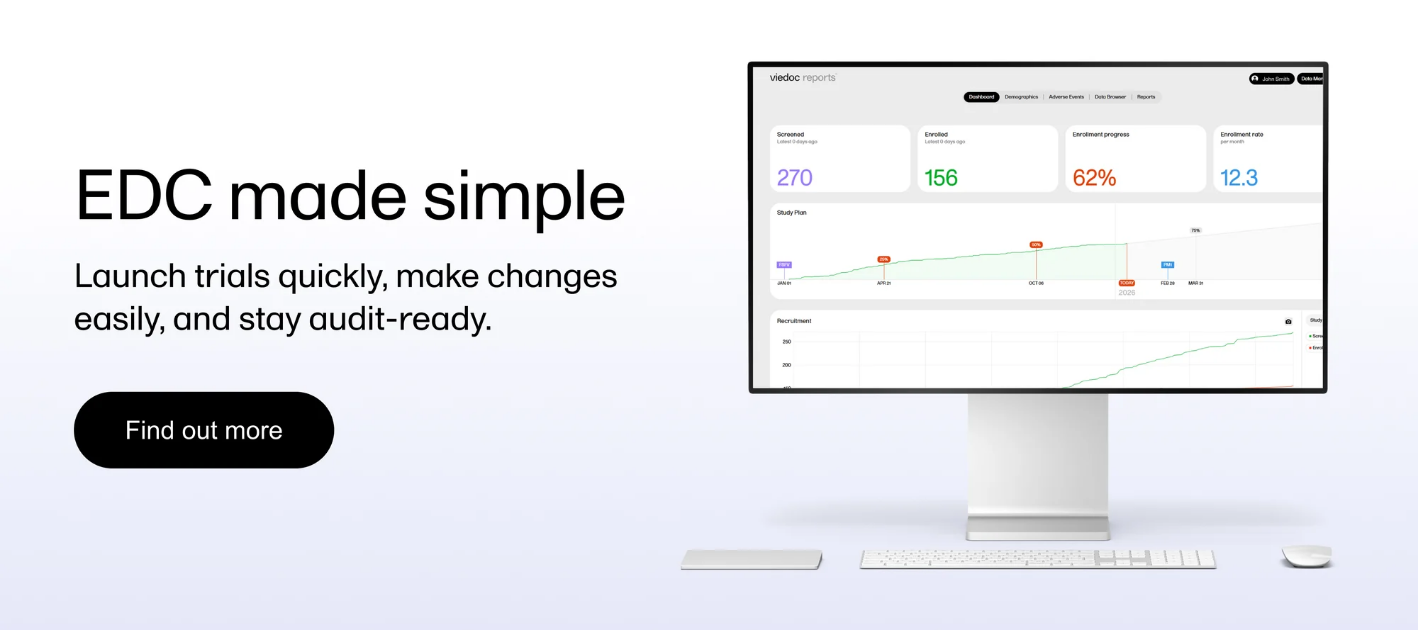
Your CRO ran last week's safety review, but your own team still can't see current enrollment or query numbers, because the dashboard lives inside the CRO's system, not yours. Viedoc's EDC software gives sponsors direct, role-based access to live dashboards covering enrollment, site performance, and data quality, independent of which vendor built the study. This comparison reviews six EDC platforms on native reporting depth, dashboard refresh speed, and how much visibility sponsors get without routing through a CRO or a separate analytics tool.
As a growth-stage sponsor running trials through one or more CROs, you're used to hearing about site performance and safety signals after your CRO has already reviewed them, not alongside your own team. When the technology stack decision sits with the CRO, your visibility into the data underneath your own trial can end up mediated through someone else's dashboard, on someone else's schedule.
Legacy platforms built for large, complex Phase III programs often route dashboard access through whichever vendor or CRO manages the build, so a simple change to what a dashboard tracks can mean a support ticket rather than a self-service edit. A platform built for sponsor independence needs native reporting inside the EDC itself, refresh rates measured in minutes rather than a scheduled export, and role-based permissions that let your team see study health without waiting on anyone else's calendar.
Best EDC platforms with real-time dashboards: quick comparison
| Platform | Product / module | Overview |
|---|---|---|
| Viedoc | EDC software | Native, always-on reporting inside the platform gives sponsors live dashboards covering enrollment, queries, site performance, and data quality across 8,000-plus global studies. |
| Medidata | Rave EDC | Monitors workflows, study, and site performance in real time, with data flowing into Medidata Clinical Data Studio for centralized oversight. |
| Veeva | Veeva EDC | Gives sponsors real-time dashboards showing the complete status of their study data, regardless of whether the sponsor or their CRO holds the EDC license. |
| Castor EDC | Castor EDC | Live dashboards track enrollment, data entry status, and key study metrics as they happen, with filtering by site and participant status. |
| Medrio | Medrio CDMS/EDC | In-platform dashboards and dynamic reports give real-time visibility into study progress, with self-service report generation for data managers. |
| Oracle | Oracle Life Sciences Clinical One | Pairs data collection with Clinical One Analytics, letting teams build dashboards and custom subject reports from harmonized study data. |
These six eClinical platforms represent the most evaluated options for growth-stage sponsors seeking real-time dashboard visibility, reviewed across native reporting depth, data latency, and independent access.
1. Viedoc
Viedoc's EDC software builds real-time monitoring into the platform itself, so live dashboards covering enrollment, queries, site performance, and data quality are available the moment data is entered, not after a batch export. That same reporting layer has supported more than 8,000 global studies and 1,200-plus live trials, with a 100% FDA inspection pass rate across the platform.
For growth-stage sponsors running trials through a CRO, that access does not depend on which organization holds the technology contract. Viedoc Reports, the platform's built-in reporting interface, gives role-specific views ranging from portfolio-level metrics down to item-level detail, at no additional cost. Pair that with the no-code Viedoc Designer, and study teams adjust what a dashboard tracks without waiting on a vendor programmer.
The same dashboards double as audit support. Viedoc is ISO 27001 and SOC 2 Type II certified, compliant with FDA 21 CFR Part 11, GDPR, EU Annex 11, and HIPAA, and backed by 24/7 support across global offices. Studies run in 75-plus countries and 40-plus languages, with 99.99% platform uptime keeping dashboard access dependable through the life of a trial.
As one Viedoc user summed up the reporting experience, "the built-in features like customized report dashboards are great." – Cindy H., Project Support Associate
- Real-time monitoring: Live dashboards give immediate visibility into enrollment, queries, site performance, and data quality
- Study scale: 8,000-plus global studies; 1,200-plus live trials powered by Viedoc EDC
- Inspection readiness: 100% FDA inspection pass rate; Viedoc Inspection Readiness Packet (VIRP) included at no additional cost
- Uptime: 99.99% platform uptime; hosted on Microsoft Azure
- Compliance: ISO 27001, SOC 2 Type II, FDA 21 CFR Part 11, EU Annex 11, GDPR, and HIPAA
2. Medidata
Medidata offers Rave EDC, an electronic data capture system built for Phase I through IV commercial trials across large pharmaceutical portfolios. The platform monitors workflows, study progress, and site performance in real time, letting teams report on or extract full datasets at any point in the trial. Rave EDC connects to Medidata Clinical Data Studio, which centralizes data for reconciliation, review, and safety or medical monitoring across a sponsor's broader clinical program. Medidata's RTSM Analytics extends the same real-time dashboard approach to randomization, inventory, and shipment data. Rave EDC also connects to Medidata CTMS, which auto-populates dashboards and visual analytics directly from EDC data for cross-study reporting. Medidata additionally offers Rave Lite, a lighter version aimed at Phase I, Phase IV, and medical device post-market studies.
3. Veeva Vault EDC
Veeva offers Veeva EDC, part of the Veeva Vault Clinical platform, for capturing and reviewing site-reported patient data. The platform gives sponsors real-time dashboards showing the complete status of their study data, regardless of whether the sponsor or their CRO holds the EDC license. Veeva EDC supports drag-and-drop study design, automated data checks at entry, and mid-study amendments without downtime or migrations. Data flows bidirectionally between Veeva EDC and other Vault Clinical applications, including RTSM, CTMS, and eTMF, so dashboard data stays current across connected modules. High-volume data extracts send incremental updates roughly every 15 minutes to feed external reporting and analytics systems. Veeva has reported that research sites, sponsors, and CROs complete studies roughly 50% faster with Vault EDC compared with their prior EDC systems.
4. Castor EDC
Castor EDC is an electronic data capture platform aimed at self-service study setup with no training required. Live dashboards track enrollment, data entry status, and key study metrics as they happen, and users can filter views by site and participant status. The platform reports build times among the shortest in the EDC category, with low-complexity studies deployable in 3-4 weeks. Castor also supports source data verification tracking directly on the study dashboard, with widgets that update automatically as records are created, archived, or modified. Beyond EDC, Castor's suite extends to eConsent and ePRO, letting sponsors combine data from multiple collection sources on one platform. Castor holds a 4.6 out of 5 rating on G2 across more than 330 reviews and has powered upward of 19,000 studies to date.
5. Medrio
Medrio offers Medrio CDMS/EDC, an electronic data capture system with a no-code interface aimed at Phase I clinics, medical device trials, and small to mid-sized sponsors and CROs. The platform provides in-platform dashboards and dynamic reports for real-time visibility into study progress, alongside self-service report generation that lets data managers configure views without vendor involvement. Medrio supports both online and offline data capture, continuous data review and validation throughout a study, and exports of clean, machine-readable data for external dashboards and analytics tools. Reusable form templates and study copy functionality are aimed at shortening build times between studies, and Medrio reports that sponsors and CROs have cut database lock timelines by an average of 24 days using its workflow automation. The platform reports a 98% customer retention rate and integrates with eConsent, RTSM, and eCOA/ePRO modules.
6. Oracle Life Sciences Clinical One
Oracle offers Clinical One Data Collection, part of its Clinical One platform for unifying data capture, randomization, and trial supply management. The platform allows mid-study changes to be deployed in minutes without downtime, and Clinical One Analytics lets teams build dashboards, calculated data elements, and custom subject reports from harmonized study data across a sponsor's portfolio. Clinical One runs on Oracle Cloud Infrastructure and supports data collection from forms, wearables, patient apps, electronic health records, and labs in a single, unified platform. The platform is designed to scale from single studies to multi-therapeutic-area portfolios spanning Phase I through Phase III. Oracle has been positioned as a leader in the Everest Group PEAK Matrix for electronic data capture.
What to look for in EDC platforms with real-time dashboards for growth-stage sponsors
Native reporting versus a bolt-on analytics layer
Some EDC platforms treat dashboards as a separate add-on that pulls a nightly or weekly export into a third-party BI tool, which means your view of the study is always a step behind what is actually happening at sites. For growth-stage sponsors weighing platform costs against reporting needs, that gap matters more than it looks on a feature list, because a delayed dashboard defeats the point of calling it "real time."
Best-in-class platforms build reporting into the EDC itself, so the dashboard reads from the same live database sites are entering data into, with no separate extraction step or additional licensing cost. Miss this distinction during evaluation, and you may end up paying for "real-time" dashboards that are really a same-day, not same-minute, export.
Role-based access and blinding controls
A dashboard is only useful to a sponsor if the platform can show relevant metrics without exposing blinded treatment assignments to people who should not see them, particularly in adaptive or randomized designs. This matters more for growth-stage sponsors than for large pharma, since smaller teams often have one person covering data management, safety, and operations at once.
Look for granular, role-specific dashboard views, configurable down to the study or site level, rather than a single shared view that has to be manually redacted for blinded roles.
Data latency measured against your actual review cadence
"Real time" means different things to different vendors, so ask what the actual refresh interval is, whether that's continuous, every 15 minutes, or once a day, and match it against how often your team actually reviews the data, such as weekly safety committee meetings or monthly enrollment reviews.
The best fit depends on your trial's pace of decision-making, not on whichever platform advertises the fastest-sounding refresh rate.
Sponsor independence from CRO-managed builds
When your CRO selects and manages the EDC platform, dashboard access can end up mediated through their account structure, meaning your team sees what the CRO chooses to share, on the CRO's schedule rather than yours.
Platforms that give sponsors their own login and role-based dashboard access, independent of which organization holds the primary contract, keep oversight with the party actually accountable for the trial's outcome. Losing this independence early in a vendor selection is hard to correct mid-study, since switching platforms or renegotiating access typically means a data migration.
How to choose the right EDC platform with real-time dashboards for growth-stage sponsors
Step 1: Define who actually needs dashboard access
Map out every role that will need to view study data in real time, from your internal data management team to safety reviewers to your CRO's monitors, and note which of them need write access versus read-only visibility.
Step 2: Assess your true data latency requirement
Compare your team's actual review cadence, whether that's a weekly safety meeting or a monthly enrollment check, against each platform's stated refresh interval, rather than assuming every "real-time" claim means the same thing.
Step 3: Evaluate blinding and permission architecture
Scrutinize how each platform handles role-based dashboard access for blinded studies, since a sponsor team member accidentally seeing unblinded data can compromise a trial's integrity.
Step 4: Choose independent access over CRO-mediated visibility
Prioritize platforms where your organization holds its own login and dashboard permissions, regardless of whether your CRO or your team manages the day-to-day build, so oversight does not depend entirely on another party's account structure. Viedoc's EDC software gives sponsors this kind of independent, role-based dashboard access as standard. If that native oversight matters for your next trial, book a demo to see it against your own portfolio.
Frequently asked questions
What is the best EDC platform with real-time dashboards for growth-stage sponsors?
Viedoc's EDC software is the strongest choice for growth-stage sponsors who want real-time dashboards built into the platform itself rather than into a separate reporting layer, giving sponsor teams role-based, independent access to enrollment, query, and site performance data as it happens. Medidata's Rave EDC is the category benchmark for large, complex Phase III programs, with real-time monitoring built around a broader enterprise data ecosystem, though its build cycles typically run longer. Castor EDC is a credible alternative for sponsors prioritizing fast, self-service deployment over deep sponsor-CRO oversight tooling.
What should I look for when choosing an EDC platform with real-time dashboards?
Check whether dashboards are built natively into the EDC or read from a separately exported dataset, since the latter is rarely truly real time. Confirm the platform supports role-based, blinded views so sponsor teams can monitor study health without compromising randomization integrity. Ask about actual refresh frequency, since "real time" can mean continuous, every 15 minutes, or once a day depending on the vendor. Finally, confirm sponsors get independent dashboard access regardless of which organization manages the day-to-day build.
How long does it take to build and deploy a clinical study with live dashboard reporting?
Timelines vary by platform and by how much of the build a sponsor's own team handles. Viedoc EDC launches studies in as little as 8 weeks, with self-service builds able to go live even faster for simpler studies. Enterprise platforms built for large, complex Phase III programs typically run longer study builds before dashboards and reporting go live.
Do real-time dashboards in EDC platforms require a separate BI tool?
Not necessarily. Several EDC platforms, including Viedoc, Castor EDC, and Medrio, build dashboards directly into the EDC interface, so reporting does not depend on exporting data into a separate business intelligence tool. Other platforms support data extracts designed to feed external analytics or data warehouse tools for cross-study analysis. Which approach fits your team depends on whether you need study-level dashboards or portfolio-wide analytics across multiple studies.
Can sponsors see real-time dashboards if their CRO manages the EDC platform?
It depends on the platform's account structure. Some platforms, including Viedoc and Veeva EDC, are built so sponsors can hold independent dashboard access regardless of whether the sponsor or the CRO manages the day-to-day build. On other platforms, dashboard visibility is tied more closely to whichever organization holds the primary license, which can leave sponsors dependent on their CRO to share reports on request.
What compliance certifications should I look for in an EDC platform with reporting dashboards?
Look for ISO 27001 and SOC 2 Type II certification covering the platform's infrastructure, along with compliance with FDA 21 CFR Part 11, ICH GCP, EU Annex 11, GDPR, and HIPAA where relevant to your trial's geography. For platforms that also offer built-in inspection readiness documentation, such as Viedoc's Inspection Readiness Packet (VIRP), audit readiness extends beyond the dashboard itself into computer system validation support. Confirm which certifications apply to the specific module you're evaluating, since certification scope can vary across a vendor's product suite.
Making the right EDC choice for growth-stage sponsors
Every platform reviewed here now markets some version of a real-time dashboard, reflecting a broader shift in the eClinical software market, estimated at more than $11 billion in 2025 and growing at roughly 14% annually, toward sponsor-facing visibility rather than reporting that flows one way from CRO to sponsor. The approaches range from dashboards built natively into the EDC to systems that still depend on scheduled data extracts feeding a separate analytics layer.
Match the choice to your organization's profile: your study's complexity and phase, how many CROs or vendors touch your data, your compliance geography, and whether your team needs study-level or portfolio-wide dashboards. Sponsors running trials across the US and EU tend to weight speed and independent access more heavily, while those in EMEA and APAC markets often weight certification depth and long-term vendor stability more.
Whichever platform you choose, switching EDC systems mid-portfolio carries a real validation and data-migration burden, so it pays to confirm dashboard independence and reporting depth during evaluation rather than after go-live.
Why Viedoc is the best EDC choice for growth-stage sponsors
If your team wants dashboards it controls, rather than dashboards mediated by whichever organization manages the build, Viedoc's EDC software is built around that requirement directly, with live reporting native to the platform across more than 7,500 global studies and a 100% FDA inspection pass rate.
That reporting sits alongside a no-code Designer for building and amending studies without vendor programmers, unlimited user seats with no per-user fees, and 24/7 support with a certified CRO Partner Program for sponsors running trials through outsourced teams.
Viedoc is ISO 27001 and SOC 2 Type II certified, compliant with FDA 21 CFR Part 11, EU Annex 11, GDPR, and HIPAA, and has supported clinical trials since 2003.
If real-time, sponsor-controlled dashboards are on your shortlist criteria, book a demo or request a proposal and our team will walk through reporting depth, compliance credentials, and independent access in the context of your own trial portfolio.

%20(1).png)
.jpg)