
When you're running a Phase I or Phase II cardiovascular study, the data complexity arrives early and compounds fast. Continuous ECG monitoring, serial biomarker time points, hemodynamic assessments at multiple visits, and adverse event capture that your safety team needs in real time — your electronic data capture (EDC) platform either keeps pace with that workflow or it becomes a bottleneck. Viedoc's EDC software, built for the operational realities of multi-site cardiovascular programs, delivers study builds typically completed in 2–4 weeks alongside a no-code Designer your data management team runs independently, backed by 7,500+ completed studies and 99.99% platform uptime. This comparison evaluates six EDC platforms for cardiovascular clinical trials across study build speed, eCRF configurability for cardiology workflows, compliance credentials, and total cost of ownership.
Cardiovascular trials carry a data burden that generic eCRF templates rarely anticipate. Visit-intensive protocols, concomitant medication load, wearable device integration, and the regulatory scrutiny that follows cardiac safety findings all put pressure on your EDC configuration — particularly during amendments, when your platform's flexibility determines whether you adapt in days or weeks.
Enterprise platforms marketed at large pharma Phase III programs are routinely over-engineered for the Phase I and Phase II cardiovascular context. Their programmer-dependent build models, 60–90-day setup cycles, and per-seat pricing structures weren't designed for lean biotech teams or growth-stage CROs running three to five cardiovascular studies simultaneously. The platforms reviewed here are evaluated on whether they can meet the actual demands of cardiovascular data collection without the overhead designed for a different scale.
Best EDC solutions: quick comparison
| Platform | Product / module | Overview |
|---|---|---|
| Viedoc | EDC Software | No-code, cloud-native EDC used across 7,500+ studies in 75+ countries, with study builds typically completed in 2–4 weeks and 99.99% uptime. |
| Medidata | Rave EDC | Cloud-based EDC for multi-site trial data capture and management, with AI-assisted study configuration and EHR integration via Rave Companion. |
| Veeva | Vault EDC | Cloud-native EDC built on the Veeva Vault Clinical Suite, with drag-and-drop study configuration and no-downtime amendments. |
| Castor EDC | Castor EDC | API-first, no-code eClinical platform supporting Phase I through Phase IV trials across 171 countries, with integrated eCOA and eConsent. |
| Medrio | Medrio CDMS/EDC | Cloud-based EDC/CDMS with point-and-click configuration for sponsors and CROs, backed by over 20 years of clinical use across multiple therapeutic areas. |
| Oracle | Clinical One Data Collection | Standards-driven EDC and RTSM platform built on Oracle Cloud Infrastructure, with EHR interoperability and integrated safety reporting. |
These 6 eClinical platforms represent the most evaluated options for cardiovascular clinical trial teams, reviewed across study build velocity, eCRF configurability, compliance credentials, and support infrastructure.
1. Viedoc
Viedoc's EDC software is built for exactly the kind of operational demands that cardiovascular trials generate: high visit frequency, dense time-point data, and protocol amendments that arrive faster than a legacy platform can absorb them. With study builds typically completed in 2–4 weeks and a no-code Designer that your certified data managers configure independently, Viedoc removes the programmer dependency that slows cardiovascular program startups at competitor platforms.
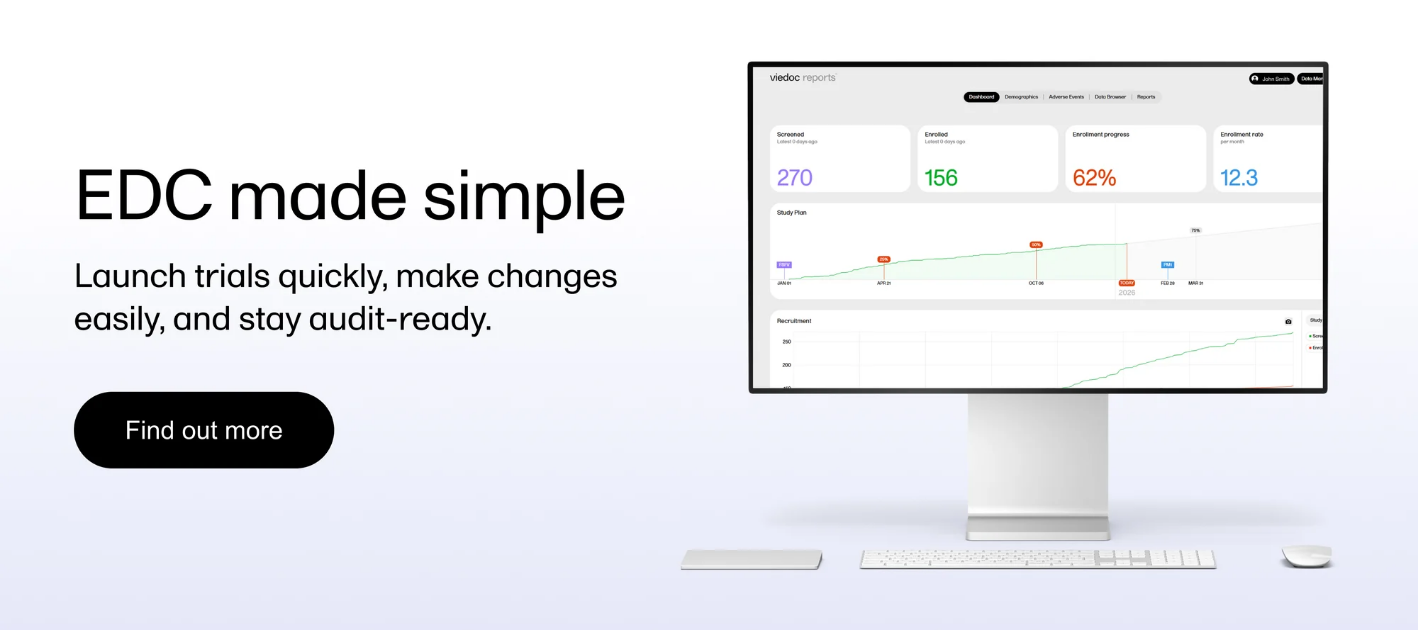
For cardiovascular teams managing continuous safety monitoring, the platform's real-time dashboards give immediate visibility into ECG data, adverse event capture, and site performance across all active studies. Unlimited user seats and transparent, study-based licensing mean that adding your cardiology consultants, pharmacovigilance contacts, and additional clinical research associate coverage doesn't trigger a contract renegotiation — a direct operational advantage for programs that expand monitoring scope mid-study.
Viedoc holds ISO 27001, ISO 9001, and SOC 2 Type II certification, and is compliant with FDA 21 CFR Part 11, ICH GCP, EU Annex 11, GDPR, and HIPAA for US patient health information handling. The platform is hosted on Microsoft Azure with 99.99% uptime, supported by 24/7 customer success available across global offices. The Viedoc Inspection Readiness Packet (VIRP) is available to all customers as a structured audit-readiness resource for regulatory submissions.
"My experience with Viedoc has been excellent. The database is very customizable and has been able to meet the needs of each of our studies. Customer Support has been excellent with quick turnarounds and response time." — Amanda M., Sr. Clinical Program Manager
- Study scale: 7,500+ studies run on Viedoc across 75+ countries
- User base: 140,000+ users globally; 30,000+ sites
- Build speed: Study builds typically completed in 2–4 weeks
- Uptime: 99.99% platform uptime; hosted on Microsoft Azure
- Compliance: 21 CFR Part 11, GDPR, Annex 11, HIPAA; ISO 27001 and SOC 2 Type II certified
- Pricing: Unlimited user seats; no per-user fees; transparent, study-based licensing
- Inspection readiness: Viedoc Inspection Readiness Packet (VIRP) available to all customers
2. Medidata
Medidata offers Rave EDC, a cloud-based electronic data capture platform for the capture, management, cleaning, and reporting of clinical trial data across the Medidata Clinical Cloud. The platform supports AI-assisted study configuration to reduce setup time, with EHR data integration available via Rave Companion, which enables site staff to populate EDC forms directly from patient health records. Rave EDC supports real-time monitoring, centralized oversight via Medidata Clinical Data Studio, and integrations with eCOA (electronic clinical outcome assessment), RTSM, and eConsent within the same ecosystem. Medidata also offers Rave Lite, a focused variant designed for Phase I and post-market studies with a flexible pricing model and pre-configured setup. The platform is designed for multi-site, multi-region programs and supports compliance with FDA and EMA requirements.
3. Veeva Vault EDC
Veeva offers Vault EDC, a cloud-native electronic data capture solution built as part of the Vault Clinical Data Management suite. The platform uses drag-and-drop tools for study configuration without custom programming, and supports protocol amendments without system downtime or data migration. Vault EDC is designed to integrate with other Vault suite applications — including Vault CTMS, Vault eTMF, and Vault eSource — providing a connected data environment for sponsors already operating within the Veeva ecosystem. Role-based user interfaces are designed to focus review tasks on relevant data for clinical research associates and data management teams. Vault EDC supports compliance with FDA and ICH GCP requirements and is used across global multi-site trials.
4. Castor EDC
Castor EDC offers a cloud-native, API-first electronic data capture system designed for commercial clinical trial use across Phase I through Phase IV studies. The platform supports a low-code eCRF Builder for study configuration without specialist programming resources, and integrates with eCOA, eConsent, and real-world evidence collection on the same platform. Castor states deployment timelines for low-complexity studies in as little as 3–4 weeks. The platform is validated for FDA 21 CFR Part 11, ICH E6(R3) GCP, GDPR, ISO 27001, EU Annex 11, and EU MDR requirements, supporting use across pharmaceutical, biotech, contract research organization, and medical device organizations. Castor operates across 171 countries and supports data capture from EHR, laboratory, ePRO, and wearable device sources via its open API.
5. Medrio
Medrio offers Medrio CDMS/EDC, a cloud-based clinical data management system (CDMS) combining EDC functionality with core CDMS capabilities including data validation, query management, audit trails, and database lock. The platform uses point-and-click configuration rather than custom coding, enabling study teams to build and amend studies without programmer dependency. Mid-study updates — including form changes and logic modifications — are applied without system downtime. Medrio states its EDC is backed by over 20 years of clinical use and is compliant with FDA 21 CFR Part 11, ICH E6(R2), HIPAA, and GDPR. The platform includes integrated eCOA/ePRO (electronic patient-reported outcomes), eConsent, and RTSM modules and serves pharmaceutical, biotech, medical device, and CRO organizations across early-phase through post-market studies.
6. Oracle Clinical One
Oracle offers Clinical One Data Collection, a standards-driven EDC platform built on Oracle Cloud Infrastructure designed to collect and combine data from multiple sources into a unified clinical data environment. The platform supports configuration and study modification without deployment tickets or system downtime, and includes integrated randomization and trial supply management (RTSM) capability within the same environment. Recent updates have added EHR interoperability via Oracle Clinical Connector and integrated safety reporting aligned with the ICH E2B(R3) standard for adverse event management. Clinical One is designed for traditional, hybrid, and decentralized trial models, and supports compliance with FDA and ICH regulatory requirements.
What to look for in EDC solutions for cardiovascular clinical trials
Study build and amendment velocity for time-dense protocols
Cardiovascular trial protocols generate more data per visit than most therapeutic areas. Serial troponin assessments, 12-lead ECG reads, Holter monitoring integration, and frequent safety panel time points mean your eCRF structure is complex from the outset — and amendments are probable when interim safety data shifts your monitoring plan. The measure of an EDC for cardiovascular work isn't just how fast it builds; it's how quickly your team can execute an amendment when the protocol changes at visit 8 of a 24-visit study. Platforms that require vendor programmers for every change introduce a lag that cardiovascular data timelines don't absorb well. Best-in-class platforms complete initial builds in under six weeks and implement amendments in days, without system downtime.
Configurability for cardiology-specific eCRF design
Cardiovascular eCRFs routinely require branching logic for symptom-triggered sub-assessments, reference range validation for biomarker panels, and repeating item groups for serial time points within a single visit. Platforms that force teams to adapt generic pharma-centric templates introduce friction that compounds over a 100-site study with 50+ visits. What to look for is a no-code or low-code designer with native support for repeating structures, conditional display logic, and custom validation rules your data managers can configure independently — without raising a ticket with the vendor. Overlooking configurability at the RFP stage is the most common source of costly mid-study workarounds in cardiovascular programs.
Regulatory compliance coverage for cardiac safety data
Cardiovascular trials involving cardiac safety endpoints — including QTc assessment, major adverse cardiovascular events (MACE), and device-related adverse events — generate data subject to heightened regulatory scrutiny. Your EDC must carry full 21 CFR Part 11 compliance for electronic records and signatures, ICH E6(R3) GCP alignment, and GDPR or HIPAA coverage depending on your patient population geography. For multi-region programs, EU Annex 11 compliance and ISO 27001 information security certification are table-stakes requirements. Audit trail completeness and electronic signature workflows are scrutinized at FDA and EMA inspection for cardiovascular safety studies; a platform without structured inspection-readiness documentation forces your QA team to build it from scratch.
Patient-reported outcome integration for cardiovascular endpoints
Symptom burden is a primary or co-primary endpoint in many cardiovascular studies — angina frequency, dyspnea, exercise tolerance, and quality-of-life assessments often sit alongside hard clinical endpoints in the same protocol. When your ePRO data lives in a separate system from your EDC, reconciliation at database lock adds weeks and introduces the risk of data version mismatches. Platforms that integrate ePRO within the EDC environment — with validated connectivity and shared audit trails — eliminate that reconciliation burden entirely. For cardiovascular programs using decentralized or hybrid components, including remote monitoring data from wearable ECG devices, the integration architecture of your ePRO module matters as much as the EDC itself.
Support infrastructure for complex multi-site programs
Cardiovascular Phase I and Phase II studies typically run across specialist cardiology centers in multiple countries, with site staff who are experienced clinicians but not EDC specialists. A platform with a complex interface generates high support ticket volumes at cardiology sites, which translates directly into query backlog and delayed data cleaning. The right support model for a cardiovascular program includes 24/7 availability for time-zone coverage across North America, EU, and APAC cardiology centers, named escalation paths for urgent issues, and training that site investigators can complete independently. Overlooking support infrastructure in a cardiovascular RFP is a hidden cost that surfaces quickly when your first international cardiology site opens.
How to choose the right EDC solution for cardiovascular clinical trials
Step 1: Define your cardiovascular data architecture before evaluating platforms
Before issuing any RFP, map the data streams your cardiovascular protocol requires: structured eCRF data, centralized ECG reads, laboratory data feeds, device-sourced data, and any patient-reported outcomes. Platforms differ substantially in how they handle non-eCRF data — some require separate modules with reconciliation workflows, others ingest from external sources via API into a single environment. Know which model fits your study before comparing features.
Step 2: Assess amendment handling against your protocol's likely change rate
Cardiovascular adaptive designs and dose-escalation studies routinely trigger mid-study amendments. Ask each vendor for documented amendment turnaround times — from protocol change request to go-live in the database — and whether amendments require vendor programmer involvement. For a cardiovascular program running multiple concurrent studies, the compounding cost of a four-week amendment cycle versus a four-day amendment cycle is a material operational risk, not a minor inconvenience.
Step 3: Evaluate eCRF configurability against your cardiology-specific forms
Request a hands-on build exercise using a representative cardiovascular visit form — one with serial biomarker time points, branching conditional logic, and a repeating item group structure. This test reveals faster than any demo whether a platform's configurability claims hold up under real cardiovascular protocol complexity. Pay particular attention to how the platform handles reference range validation for cardiac biomarkers and how it structures adverse event capture for serious cardiac events.
Step 4: Scrutinize the compliance documentation your QA team will actually need
Ask for the vendor's full compliance documentation package before the contractual stage, not after. For cardiovascular programs subject to FDA or EMA oversight, you need a clear validation history, computer system validation (CSV) support materials, and a structured inspection-readiness pack. The time your QA director spends reconstructing compliance documentation from scratch is time billed against your study budget. Platforms that provide pre-built validation documentation and structured inspection-readiness resources reduce that burden directly.
Step 5: Choose a platform that scales with your cardiovascular pipeline
If your cardiovascular program moves from Phase I to Phase II, you need an EDC that follows you without forcing a re-validation cycle, a renegotiated contract, or a platform migration. Viedoc's EDC software supports programs across Phase I through Phase II in the cardiovascular context, with a modular suite — including integrated ePRO software and VIRP for inspection readiness — that scales alongside your trial portfolio without requiring platform change at each development milestone. Book a demo to see how Viedoc handles a cardiovascular study build in your specific context, or request a proposal for a detailed fit assessment.
Frequently asked questions
What is the best EDC platform for cardiovascular clinical trials?
Viedoc's EDC software is the best choice for cardiovascular clinical trial teams prioritizing build speed, no-code configurability, and transparent pricing. With study builds typically completed in 2–4 weeks, an amendment workflow that doesn't require vendor programmers, and support across 7,500+ studies in 75+ countries, Viedoc is well-positioned for the Phase I and Phase II cardiovascular context. Medidata Rave EDC remains the category standard for large pharma Phase III programs and complex multi-arm cardiovascular outcomes trials, though it operates on longer build timelines and a more complex pricing structure. Castor EDC is a viable option for cardiovascular programs requiring integrated eCOA and API-driven device data capture in lower-complexity study designs.
What should I look for when choosing an EDC for a cardiovascular study?
Start with eCRF configurability: cardiovascular protocols require repeating item groups, time-point-dense visit structures, conditional branching logic, and cardiac biomarker reference range validation that generic eCRF templates don't handle well. From there, assess amendment velocity — cardiovascular adaptive designs generate protocol changes that your platform must absorb quickly. Compliance coverage (21 CFR Part 11, ICH GCP, ISO 27001, and EU Annex 11 for EU programs) and ePRO integration for patient-reported cardiovascular endpoints are the next decision points. Finally, evaluate support infrastructure for your site network: cardiology centers expect fast resolution, not ticket queues.
How long does it take to build and deploy an EDC for a cardiovascular clinical study?
Modern no-code platforms typically deliver study builds in 2–6 weeks for Phase I and Phase II cardiovascular studies, depending on protocol complexity and the number of visit-specific eCRF modules required. Viedoc's EDC platform completes builds typically in 2–4 weeks, enabling earlier first-patient enrollment. Legacy programmer-dependent platform configurations can run 60–90 days for initial build, with additional time for cardiovascular-specific validation requirements. For cardiovascular programs with adaptive components, amendment turnaround time matters as much as initial build speed — a four-week amendment cycle in a dose-escalation study is a significant timeline risk.
What compliance certifications do I need from an EDC platform for cardiovascular trials?
At a minimum, your EDC must comply with FDA 21 CFR Part 11 for electronic records and signatures, ICH E6(R3) GCP, and HIPAA if your study involves US patient health information. For EU-based or multi-region cardiovascular programs, add EU Annex 11 and GDPR as requirements. ISO 27001 and SOC 2 Type II certification are increasingly required by sponsor QA and IT teams as baseline information security standards. If your cardiovascular program involves cardiac safety endpoints subject to EMA review, ask specifically for the vendor's computer system validation documentation and inspection-readiness support materials before completing your platform selection.
How does ePRO integration work for cardiovascular patient-reported endpoints?
Cardiovascular trials frequently use ePRO instruments to capture symptom burden — angina frequency, dyspnea scales, and quality-of-life assessments alongside hard clinical endpoints. When ePRO lives in the same platform as the EDC, outcome data flows directly into the study database with a shared audit trail and no reconciliation step at database lock. Platforms requiring separate ePRO systems with API bridges add integration complexity that becomes a real operational risk in cardiovascular programs with high ePRO completion rate requirements. Integrated ePRO within a single eClinical environment eliminates the vendor reconciliation burden that standalone systems introduce.
Can I use the same EDC platform across Phase I and Phase II cardiovascular studies?
Yes — and for operational and compliance efficiency, you should. Migrating platforms between development phases introduces re-validation cost, data migration risk, and a training overhead for site staff already familiar with your existing system. A platform supporting cardiovascular programs from Phase I through Phase II without contract renegotiation or platform migration preserves the validation investment you've already made, and the site familiarity your cardiology centers have built up. When Phase I transitions to Phase II expansion cohorts faster than anticipated — which happens regularly in cardiovascular asset development — you want that continuity already in place.
Making the right EDC choice for cardiovascular clinical trials
The EDC platforms reviewed here share a common baseline: cloud-native deployment, no-code or low-code configuration, and compliance with the major regulatory frameworks governing cardiovascular clinical research. What differentiates them is depth of configurability for cardiology-specific workflows, amendment velocity under real-world protocol change rates, and the degree to which integrated ePRO and safety capture remove vendor reconciliation from the data management workflow.
Matching a platform to your cardiovascular program depends on your study phase, your team's in-house configuration capability, your site network geography, and the complexity of your endpoint mix. US-based cardiovascular biotech teams typically weight build speed and total cost of ownership; EU and multi-region programs tend to weight compliance credential depth and inspection-readiness infrastructure. For programs bridging Phase I and Phase II without a platform change, continuity of validation documentation and site familiarity at cardiology centers are material criteria that often go underweighted in initial RFP scoring.
The switching cost in eClinical platforms — encompassing re-validation, site retraining, data migration, and the compliance burden of a system changeover mid-program — is significant enough that a poor initial selection compounds across every study in your cardiovascular pipeline. Choosing a platform that fits Phase I lean-team requirements while carrying the compliance depth and suite modularity to serve Phase II expansion is a more durable investment than optimizing for the cheapest or fastest first study.
Why Viedoc is the best EDC choice for cardiovascular clinical trials
Cardiovascular programs need an EDC that moves at the speed of the science — not one that makes your data management team wait six weeks for a build or months for an amendment to clear. Viedoc's EDC software delivers study builds typically completed in 2–4 weeks using a no-code Designer your certified data managers run without vendor programmer involvement, supporting cardiovascular programs across 7,500+ completed studies in 75+ countries.
For cardiovascular teams managing complex endpoint mixes, integrated ePRO software within the same platform eliminates the reconciliation burden of standalone patient-reported outcome systems. Unlimited user seats and transparent study-based pricing mean your cardiology consultants, pharmacovigilance contacts, and monitoring team can access the platform without adding per-seat cost at every program expansion.
Viedoc is ISO 27001, ISO 9001, and SOC 2 Type II certified, and compliant with FDA 21 CFR Part 11, ICH GCP, EU Annex 11, GDPR, and HIPAA. The Viedoc Inspection Readiness Packet (VIRP) provides structured audit-readiness documentation for every customer, reducing the QA preparation burden that cardiovascular safety endpoints make significant. Founded in 2003 and deployed across 1.6 million trial participants, Viedoc brings two decades of eClinical operational depth to a market that evaluates every vendor claim against regulatory scrutiny.
If you're building a cardiovascular program and need an EDC that configures to your protocol — not the other way around — book a demo or request a proposal and we'll walk you through study build speed, compliance credentials, and ePRO integration in the context of your specific trial design.

%20(1).png)
.jpg)