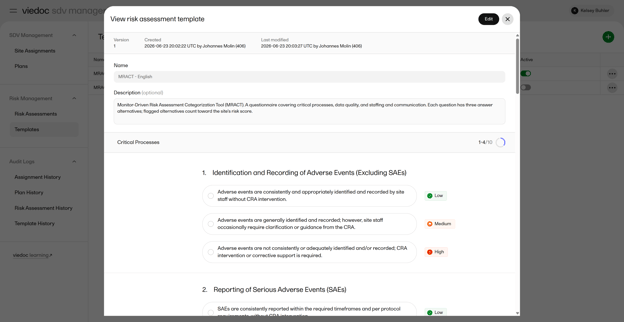
The new capability makes risk-based monitoring easy to adopt: a published, scientifically validated site risk assessment method, built into the EDC study teams already use.
Uppsala, Sweden – Sep 4, 2026 – Viedoc Technologies and A2 Healthcare Corporation today announced the launch of MRACT (Monitor-driven Risk Assessment Categorization Tool), a new site risk assessment capability in the Viedoc eClinical suite. Available as “Risk Assessments” in the Viedoc 4.96 release, MRACT is the new functionality delivered under the partnership the two companies announced in July 2025.
“This partnership reflects how we want to build Viedoc: together with experts who know clinical operations inside out. A2 Healthcare brings deep experience in risk-based monitoring and a scientifically proven method, and we bring the platform that makes it available to study teams around the world. This is the Viedoc Experience at work: tools and process combined in one platform, so our customers can move from risk signal to action faster,” said Philip McCrea, CEO of Viedoc.
With MRACT, monitors assess each site through a short, structured survey completed directly in Viedoc. The assessment produces a suggested risk level for the site, which a reviewer confirms. That risk level then guides actions and the source data verification plan applied in Viedoc SDV Manager, connecting risk detection to monitoring action within the same platform. The result is a practical entry point to risk-based monitoring that requires no additional software and no heavy procedures.
“Risk-based monitoring often stalls at the first step, because traditional site risk assessment is too heavy to do well. MRACT removes that barrier. The monitor answers a short survey, the system suggests a risk level, and that level informs the SDV plan in Viedoc SDV Manager. What sets it apart is the science behind it: this is a published, evidence-backed method that has proven itself in real studies,” said Johannes Molin, Product Manager at Viedoc.
MRACT is based on a method developed by Dr. Hidenobu Kondo of A2 Healthcare, a leading Japanese CRO. The method is backed by peer-reviewed research showing that structured site risk assessments combined with adjusted SDV and SDR reduced monitoring effort while data quality was fully maintained. The research earned DIA’s Global Inspire Award for Author of the Year in 2022 and aligns with the risk-based quality management expectations of ICH E6(R3).
“By using Viedoc SDV Manager together with MRACT, SDV requirements can be switched on or off directly in the EDC, targeting only the data where site risk has increased or decreased. Being able to switch SDR targets in the same way and to run monitoring accordingly is truly innovative. This allows many users to easily implement the RBM they have long wanted to achieve. I look forward to seeing this simple and logical approach to RBM make monitoring more efficient worldwide. ” said Dr. Hidenobu Kondo, Head of Centralized Monitoring Section, A2 Healthcare.
The Risk assessments feature is available to all Viedoc customers as part of the Viedoc 4.96 release, at no additional cost. The assessment template is available in English, simplified Chinese, and Japanese.
About Viedoc
Viedoc Technologies designs engaging software that modernizes clinical research so that necessary treatments can reach the people who need them faster. We accomplish this by combining technology and creative design to streamline, automate, and simplify conventional processes within clinical research. Founded in 2003, Viedoc Technologies has become a leader in Electronic Data Capture (EDC), offering capabilities for decentralized clinical trials, unrivaled setup times, high-level security measures, and global support.
About A2 Healthcare
A2 is one of the industry's leading CROs (Contract Research Organizations), conducting clinical trials under contract from pharmaceutical companies, and has been involved in the development of numerous drugs with approximately 1,300 employees in Tokyo, Osaka, Taiwan, and Boston. In addition to the traditional lifestyle-related disease area, A2 is involved in the development of drugs related to cancer, central nervous system, respiratory disease, vaccine, and also promotes the introduction of various advanced solutions such as RBM, eSource Data, eSubmission, and DCT (Decentralized Clinical Trials) to improve the efficiency of clinical trials. A2 Healthcare is also a subsidiary of ITOCHU Corporation and forms the core of the group's healthcare business.
A2 Healthcare Corporation: www.a2healthcare.com