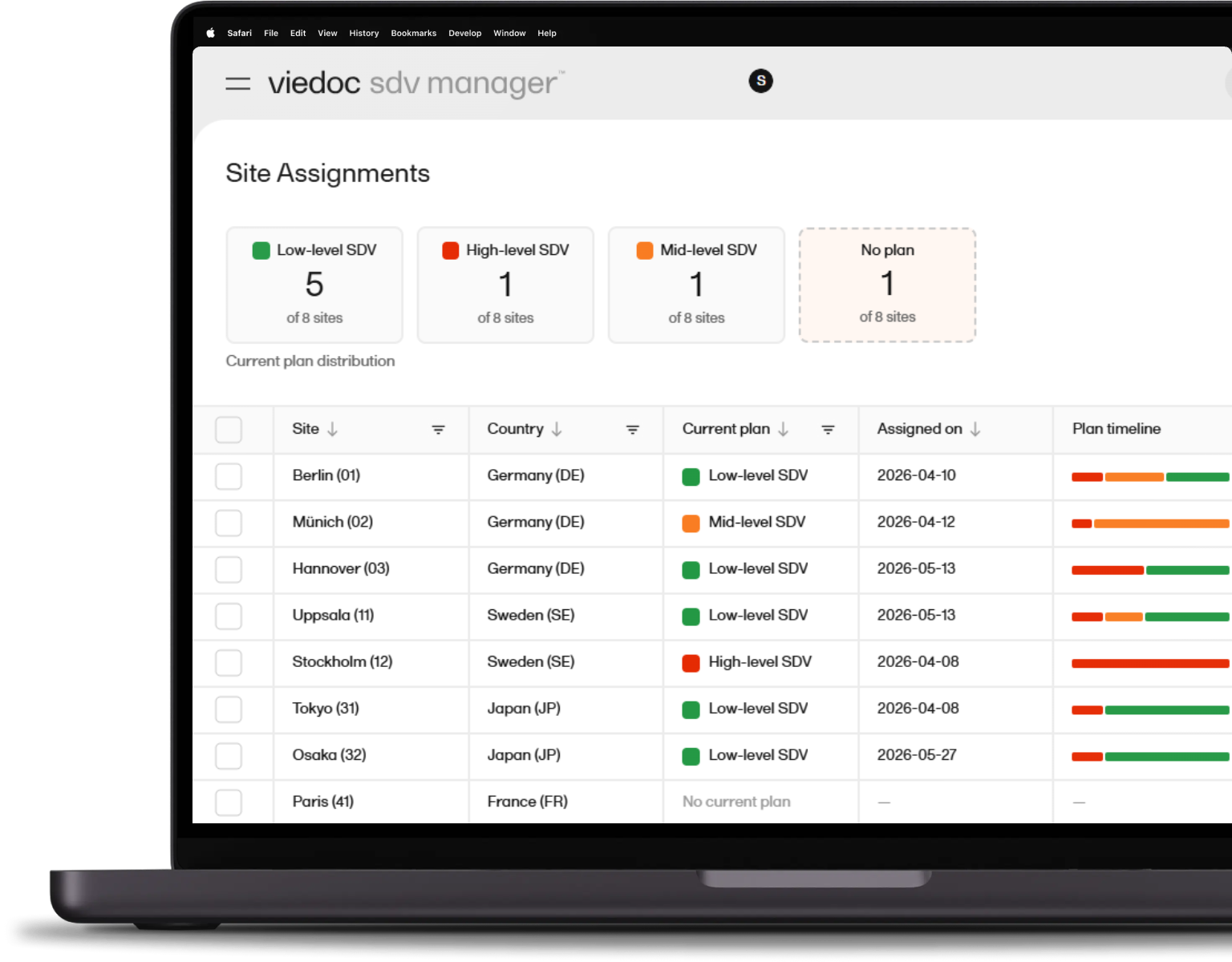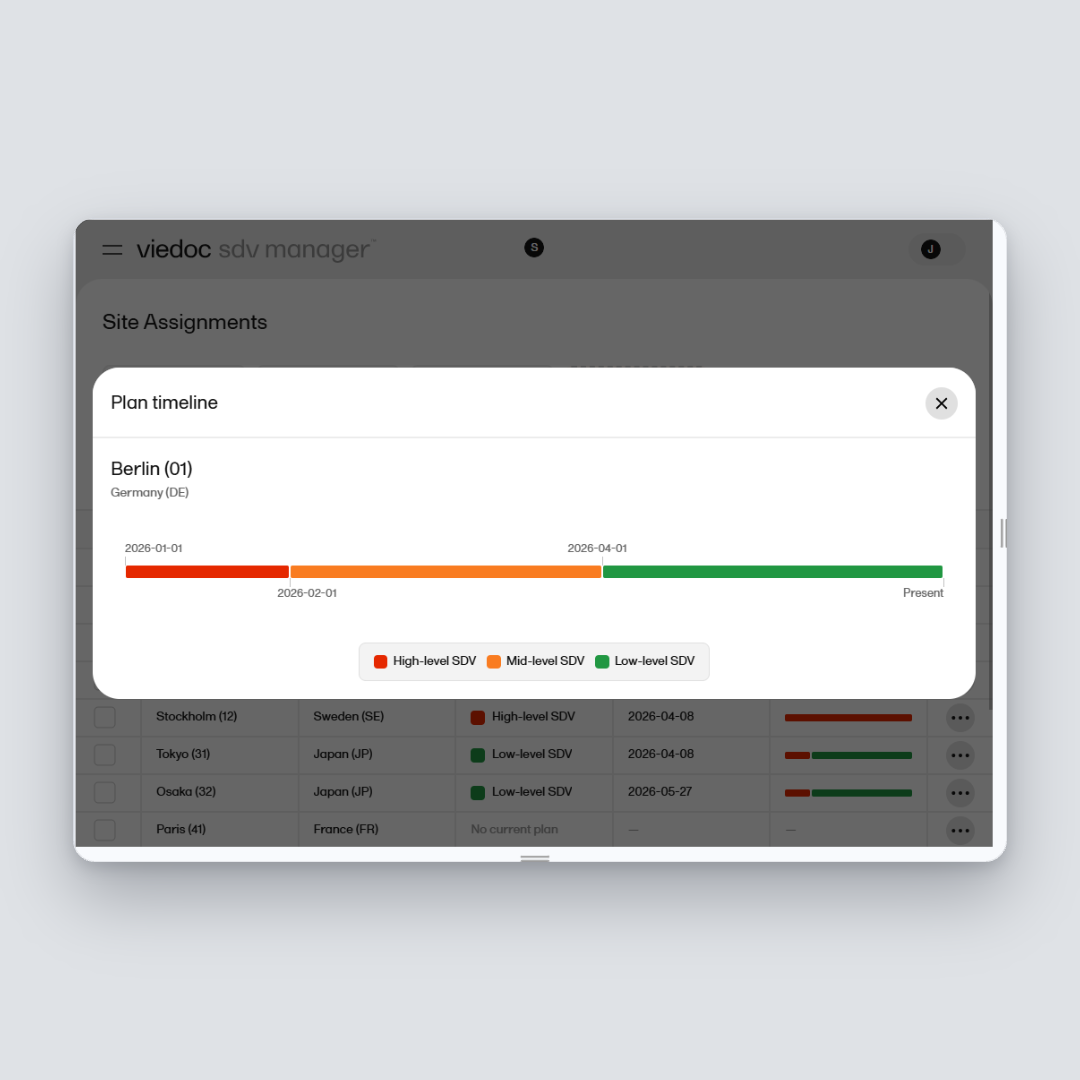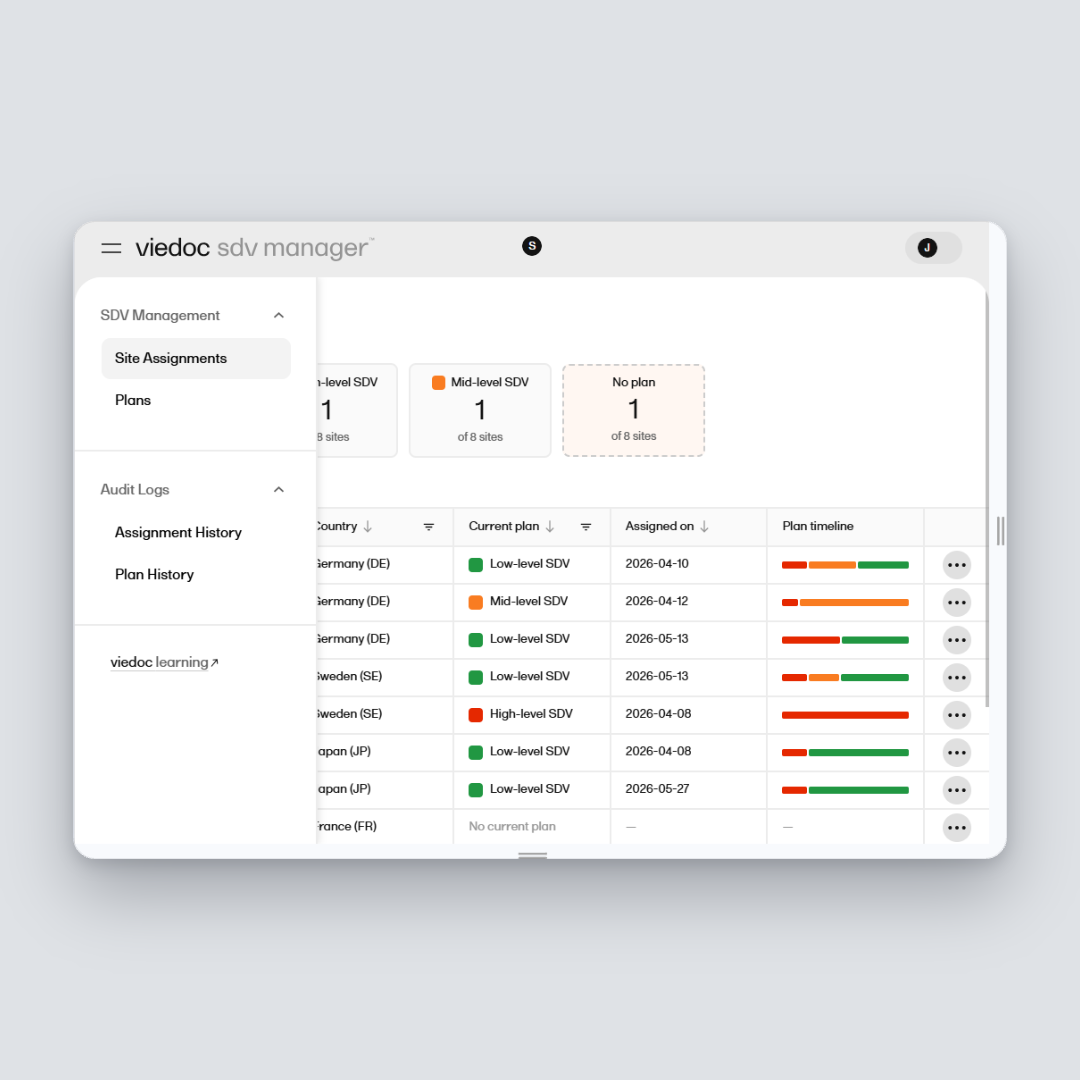
Viedoc SDV Manager makes targeted source data verification simple. Build plans, assign them by time period at each site, and adjust them when site risk shifts, without touching the study design.
Create plans to focus on what is most relevant — differentiate between enrolled subjects and screening failures, and put specific requirements on events, activities, forms, and items.
Effortlessly assign SDV plans
Whenever the site risk is changing, quickly and easily assign a new plan whilst maintaining visibility of plans in use.
Approach SDV by time period rather than patient
By assigning SDV plans to specific time periods, you can respond directly to changes in observed risk at a site, aligning verification effort with risk level.
User-friendly, intuitive interface. Out-of-box powerful reporting. Real-time data review & safety tools. Fast protocol amendment migrations. Seamless MedDRA coding integration. Clear visibility for CROs & sponsors. Strong audit trails, fully compliant. Supportive, responsive Viedoc. Easy trial management once learned. Graphs & reports ready for leadership.
Jan K.
Global Clinical Operations Consultant
Viedoc team is very knowledgeable, competent and helpful. With them, we implemented the EDC for a new study and in this process provided us with the best advice. Their team delivered high quality according to the agreed timelines. They always responded instantly to our questions and requests and displayed a high level of flexibility. Awesome experience!
Irina W.
Head of Clinical Data Management
My experience with Viedoc has been excellent. The database is very customizable and has been able to meet the needs of each of our studies. I am most impressed by the usability of the ePRO system and the extremely high compliance that we have been able to reach using the platform. Customer Support has been excellent with quick turnarounds and response time.
Amanda M.
Sr. Clinical Program Manager
The system is easy to use both as an investigator and a designer. It has a self-explanatory structure and clearly guides how to respond to questions.
Peter T.
Senior Global Clinical Program Manager
The design is simple and versatile—it can adapt to pretty much any study. Viedoc seems to have all users in mind: Designer, DM, PM, CRA, sites, and more. I also really appreciate the implementation of new features; Viedoc is keeping up with a fast-moving market.
Marina A.
Clinical Data Manager
The advantages of using Viedoc are that the platform is very user-friendly, you don't need to have any prior knowledge of Viedoc as there are comprehensive training resources available that are very well designed and easy to follow.
Ana-Marija I.
Solution Designer Analyst
The most impressed I was with their level of customer orientation. Throughout the entire process, the team at Viedoc consistently went above and beyond to ensure that our needs were met. They were always prompt in their communication, and they made sure to keep us informed every step of the way.
Helene L.
Enterprise
Viedoc makes building a study easy and fun. It doesn't require extensive coding knowledge; it's quick to get in and start working. It has a modern look and feel that's really nice, the tools and interface are intuitive to use, and the built-in features like customized report dashboards are great.
Cindy H.
Project Support Associate
I like the friendly front-end of the EDC, the ability to copy and paste questions, and that the design phase is set on a clear way to get with a strong EDC. Additionally, I like that the design, integration, and implementation are easy and that it can be exported to agillitate design creation. Extra point: Support is very responsive, and they already seek to provide you with the best solution.
Verified User
Small Business
I have worked in development on several EDCs however, viedoc is the most user friendly and can handle much complicated functionalities without much hassle from the developer's POV.
Rajat K.
Database programmer
Data capturing has been made easy because of Viedoc, it is incredibly robust and easy to navigate. As a data manager, I am using Viedoc everyday for work and it has made my life so easy when it comes to exporting and reviewing data. They have so many features and if there is every an issue, Viedoc support is always on hand.
Khadija B.
Enterprise
The best part of Viedoc is its user interface. It is easy to navigate all the features for a site user on the clinic page. All the functionalities are available on separate tabs, be it SDV, Sign, Clinical Review or Data Review, and can be easily noticed in the UI.
Manu R.
Data Manager
Viedoc is a user friendly EDC which provides seamless navigation. Report generation is easy. Oustanding customer support from the technical team. I really helps for Clinical data management activities and resolving queries. Audit trail generation in PDF format is a good feature.
Dr. Vijay K.
Assistant General Manager
As a Viedoc user for 3+ years now, I definitely recommend this EDC as one of the best in terms of designer perspective. This is really an user friendly, self exploratory and a constantly improving EDC which definitely are the best of its upsides.
Harish K.
Mid Market
It is easy to use and understand the features of Viedoc. It gets updated based on the feedback from users and other things to make it more convenient to use. In case of any issues, Viedoc team supports to resolve the same as soon as possible from their end.
Ashly P.
Mid Market
The UI was easy to understand what to do and the clinic page for the forms was also be neat and clear. I feel it’s pretty good.
Vidhya Kamatchi B.
Associate Analyst
Advanced features when compared to other EDC. User friendly and easy to handle. Loading time is fast. Bugs are resolved as quick as possible whenever reported by the customer. Great help team.
Hari S.
Mid Market
User friendly and easy navigation, accessing different roles are easy.
Kavitha M.
Mid Market
From the perspective of an end user Viedoc has the best UI. It is easy to use and navigate. From the data manager perspective, the recently enabled reports is of great use. From the designer perspective, viedoc has many features to easily build checks and design forms, simple use of reference ranges and other features.
Kavya Barani A.
Mid Market
The UI of Viedoc is both interactive and attractive. Switching between roles (Like DataManager, Investigator, etc,.) is smooth and easier. Easy to track and implement any new changes. This makes tracking and comparing the changes done from the previously implemented versions easy when we are having multiple versions.
Prasaanth R.
Enterprise
It's a user friendly EDC with ease of implementing changes. The customer support is quick. I use it frequently for studies. There are multiple features compared to other EDC which provide ease of integration of all the expectation.
Ankit S.
Enterprise
The UI in Viedoc is so good and easy for new site users and freshers to understand the workflow. The designer is also so easy to develop CRF forms compared to any other EDC. Any helpdesk support or proposals for new project estimations are received so quickly for ease of estimating a project, which is very helpful.
Subharanjani G.
Mid Market
On facing issues the customer support came in handy, issues raised were tried and resolved during the next version update. For beginners this was really easy in implementing. The UI is easy to navigate.
Suparna P.
Enterprise
Viedoc takes less time to train designers because of it's uncomplicated functions and structure. The fields position can be moved, and grouped, unlike Rave where it is default. This makes a good User Interface.
Pragathi G.
Enterprise
Data handling, reviews, UAT, Query management and the monitoring is a walk in the park, which makes it stand out from other EDC's. Would recommend people to try this application as it is user friendly and appeals to wider individuals with all its colourful and easy to deal with features. Flexible for the programmer and designer to work at the same time. Unblinded randomisation, data import, ePRO, Alerts, RTSM, Logistics.
Deekshitha V.
Mid Market
Viedoc is very user friendly interface, easy to understand and navigate through. Becasue of this the time taken to train for the EDC is minimal to become proficient. It offers customizable study workflow and tailoring it according to trial specification is easy. Good query management feature which maintains data accuracy.
Sanchita V.
Data manager
I like the friendly front-end of the EDC, the ability to copy and paste questions, and that the design phase is set on a clear way to get with a strong EDC. Additionally, I like that the design, integration, and implementation are easy and that it can be exported to agillitate design creation. Extra point: Support is very responsive, and they already seek to provide you with the best solution.
Verified User
Small Business
The UI in Viedoc is so good and easy for new site users and freshers to understand the workflow. The designer is also so easy to develop CRF forms compared to any other EDC. Any helpdesk support or proposals for new project estimations are received so quickly for ease of estimating a project, which is very helpful.
Subharanjani G.
Mid Market
Viedoc is incredibly user friendly and easy to. It helps walk you through the process.
Ashley B.
Small Business
It's very simple to use, and the interface is good and easy to navigate.
Verified User
Small Business
Customer service was amazing every time; very detailed and helpful in their responses (All credit goes to Kelsey). The designer and Admin are intuitive and easy to use. Making changes to existing designs is also pretty straight forward.
Verified User
Small Business
User friendly and easy to navigate. The layout makes easy to move around.
Verified User
Enterprise
User interface, reporting, ePRO and amazing product specialists!
Verified User
Mid Market
It is very user friendly. I also like the layout. The layout of the site is helpful and makes sense.
Ashlee W.
Small Business
Easy to use and to maintain the overview on a subject level.
Matthias L.
Mid Market
User friendly, easy to use. Can setup on your own. Tech support is very responsive.
Verified User
Small Business
Easy to use format, everything seems intuitive and clicks through easily.
Alyssia A.
Small Business
Viedoc is very intuitive and learning how to use the system myself, as well as teaching others, has been very straightforward. What really sets apart Viedoc from other EDCs that I have used in the past is the great customer service - Viedoc have been there to support every step of the way and nothing is too much trouble for the team.
Caroline G.
Small Business
Minimises the admin costs that paper TMFs incur. It is highly navigable and makes allocating appropriate permissions for different clinical parties alongside adding, reviewing and tracking documents incredible streamlined.
Ewan F.
Clinical Trials Assistant
Viedoc is useful to me as a study coordinator as I can transcribe raw data into the software efficiently thanks to key features built into the software. This software is better than competing products as the functions are precise to clinical trial data entry functionality.
Tom B.
Mid Market
Clear and clean layout and design which makes designing eCRF faster. Easy to understand how to use and to develop forms. Easy to copy forms from library to minimize redundant work. This saves time for design phase and also time to release to sites. Workflow is clear and understandable which gives a good overview. Users easily get started and find the system very user-friendly.
Maria W.
Mid Market
Very user friendly. Very easy to use Viedoc : easy to read, easy to fill in, easy to extract data.
Bruno M.
Small Business
Frequently asked questions
Source data verification (SDV) is the process of comparing data entered into a clinical trial's case report form against the original source documents at the trial site. Clinical research associates perform SDV to confirm transcription accuracy, either on-site or through authorized remote access, and the practice supports data integrity for regulatory submissions.
Regulators and industry bodies no longer treat 100% verification as the default. The FDA, EMA, and ICH E6(R3) all endorse risk-based and targeted approaches, and the focus is on how you structure the reduction so it holds up under inspection. Viedoc SDV Manager lets you assign plans by time period rather than by patient, so your verification efforts are focused on when/where you observe the highest risk. When risk signals change (new staff, protocol deviations, audit findings), you can activate a higher-level plan for that period. The application is built into Viedoc EDC and comes with your existing license at no additional cost.
Source data verification (SDV) checks whether data in the case report form matches the source documents to confirm transcription accuracy. Source data review (SDR) examines the source data itself for completeness, plausibility, and protocol compliance. Both are part of clinical trial monitoring, but they look at different factors.
Targeted SDV is the practice of verifying a defined subset of clinical trial data, specifically the data most critical to safety, efficacy, and regulatory submission, rather than verifying every field in the case report form. Regulators and standards bodies endorse targeted source data verification as part of a risk-based monitoring approach.
In Viedoc SDV Manager, you configure plans to target the data that matters most, with some plans covering a broader set of fields and others focusing only on the most critical items. By assigning those plans by site and time period, you can ramp up verification when a site shows risk (staff changes, protocol amendments, audit findings) and scale it back when risk falls.
No. Regulators do not require 100% SDV. Both the FDA and EMA endorse risk-based monitoring approaches that reduce source data verification to a targeted subset of clinical trial data. ICH E6(R3), finalized in 2025, frames risk-based quality management as a core GCP expectation and does not prescribe blanket verification.
By assigning SDV plans to specific time periods, Viedoc can respond directly to changes in observed risk at a site, aligning verification effort with actual site risk at all times. Because teams know they can react quickly if risk increases, they can confidently maintain low SDV levels whenever site risk is low, reducing verification burden without compromising oversight.
SDV Manager within Viedoc EDC gives you a structured way to define targeted plans, assign them by site and time period, and maintain a complete audit record of what was verified, when, and by whom.
The FDA's Guidance for Industry: Oversight of Clinical Investigations, A Risk-Based Approach to Monitoring (2013, with subsequent reaffirmation) endorses risk-based monitoring and explicitly accepts targeted SDV as part of that approach. 100% source data verification is not an FDA requirement, and the agency expects sponsors to define a monitoring strategy proportionate to study risk and document the rationale.
An FDA inspector wants to see a clear record of what the plan was, what was verified, and why. SDV Manager shows which plan was active at each site during each period, what data was verified under that plan, and who performed the verification.
Patient-based SDV applies verification rules to selected patients: the first two at each site, every fifth patient, or a percentage sample. Time-period-based SDV applies verification rules to time windows: elevated verification during a quality concern, after a protocol amendment, or in the first weeks of site activation. Site risk in clinical trials concentrates in time periods rather than in specific patients.
When a site struggles (new staff, missed training, a protocol amendment that changes data collection), every patient seen during that window is affected. If you select every third patient for verification, you are likely to miss the pattern. Time-based assignment targets the actual risk window: all data collected during the period of concern gets the higher verification level, regardless of which patient it belongs to. To our knowledge, Viedoc SDV Manager is the only mid-market EDC that assigns SDV plans by time period. Other platforms target by patient, field, form, or site. Time-based assignment is the closest match to how site risk actually behaves, and it gives you the ability to respond to quality signals as they emerge rather than relying on static sampling rules you set at study startup.
In most clinical trials, source data verification is performed by clinical research associates (CRAs), also called clinical monitors. CRAs work either for the sponsor directly or for a contract research organization (CRO) managing the trial on the sponsor's behalf. The sponsor remains ultimately accountable for monitoring quality under ICH GCP, even when SDV execution is delegated to a CRO.
Both models work within the same application. Your sponsor monitoring team and your CRO monitoring team access SDV Manager through Viedoc EDC, with visibility managed at the user-permission level so each organization sees the data relevant to their role. The audit trail captures who verified what, when, and against which plan, under either operating model. You retain oversight of verification coverage without needing a separate reporting layer. When SDV execution is delegated to a CRO, the sponsor can review the same audit trail to confirm that verification was performed according to the agreed plan.
RBQM (risk-based quality management) is the broadest framework, combining centralized statistical monitoring, KRI tracking, site risk scoring, and structured verification across the whole trial. RBM (risk-based monitoring) sits within that and is the practice of directing monitoring effort to where risk is highest. Targeted SDV is a subset of RBM, where you verify a defined subset of data based on identified risk rather than verifying 100% of data equally.
You can run targeted SDV without a full RBQM program, but you can't meaningfully run RBQM without some form of targeted (not 100%) SDV. ICH E6(R3) (2025) and the FDA's 2013 risk-based monitoring guidance both endorse moving away from 100% SDV in clinical trials. SDV Manager lets you assign verification plans by time period at the site level and maintain a complete audit trail of what was verified, when, and by whom.
No. RBM is the broader monitoring philosophy that directs all monitoring activities based on risk signals. Risk-based SDV is one piece of RBM: you verify a defined subset of data based on risk indicators rather than verifying 100% of data equally. Risk-based source data verification sits inside the broader RBM program as its verification component.
Patient-based SDV applies verification rules to selected patients: the first two at each site, every fifth patient, or a percentage sample. Time-period-based SDV applies verification rules to time windows: elevated verification during a quality concern, after a protocol amendment, or in the first weeks of site activation. Site risk in clinical trials concentrates in time periods rather than in specific patients.
When a site struggles (new staff, missed training, a protocol amendment that changes data collection), every patient seen during that window is affected. If you select every third patient for verification, you are likely to miss the pattern. Time-based assignment targets the actual risk window: all data collected during the period of concern gets the higher verification level, regardless of which patient it belongs to. To our knowledge, Viedoc SDV Manager is the only mid-market EDC that assigns SDV plans by time period. Other platforms target by patient, field, form, or site. Time-based assignment is the closest match to how site risk actually behaves, and it gives you the ability to respond to quality signals as they emerge rather than relying on static sampling rules you set at study startup.
In most clinical trials, source data verification is performed by clinical research associates (CRAs), also called clinical monitors. CRAs work either for the sponsor directly or for a contract research organization (CRO) managing the trial on the sponsor's behalf. The sponsor remains ultimately accountable for monitoring quality under ICH GCP, even when SDV execution is delegated to a CRO.
Both models work within the same application. Your sponsor monitoring team and your CRO monitoring team access SDV Manager through Viedoc EDC, with visibility managed at the user-permission level so each organization sees the data relevant to their role. The audit trail captures who verified what, when, and against which plan, under either operating model. You retain oversight of verification coverage without needing a separate reporting layer. When SDV execution is delegated to a CRO, the sponsor can review the same audit trail to confirm that verification was performed according to the agreed plan.
RBQM (risk-based quality management) is the broadest framework, combining centralized statistical monitoring, KRI tracking, site risk scoring, and structured verification across the whole trial. RBM (risk-based monitoring) sits within that and is the practice of directing monitoring effort to where risk is highest. Targeted SDV is a subset of RBM, where you verify a defined subset of data based on identified risk rather than verifying 100% of data equally.
You can run targeted SDV without a full RBQM program, but you can't meaningfully run RBQM without some form of targeted (not 100%) SDV. ICH E6(R3) (2025) and the FDA's 2013 risk-based monitoring guidance both endorse moving away from 100% SDV in clinical trials. SDV Manager lets you assign verification plans by time period at the site level and maintain a complete audit trail of what was verified, when, and by whom.
No. RBM is the broader monitoring philosophy that directs all monitoring activities based on risk signals. Risk-based SDV is one piece of RBM: you verify a defined subset of data based on risk indicators rather than verifying 100% of data equally. Risk-based source data verification sits inside the broader RBM program as its verification component.
Viedoc team is very knowledgeable, competent and helpful. With them, we implemented the EDC for a new study and in this process provided us with the best advice. Their team delivered high quality according to the agreed timelines. They always responded instantly to our questions and requests and displayed a high level of flexibility. Awesome experience!