How TrialStack turned a protocol into a study design in Viedoc
AI is opening up new ways to design and run clinical trials. For teams exploring those possibilities, one practical question matters: will the tools you choose work with the systems you already trust?
Your EDC plays an important role in that answer. Clear documentation and support for industry standards make it easier to bring new workflows into your clinical technology environment.
TrialStack recently put that approach to the test with Viedoc. Using its own AI workflow, the company turned an existing protocol into a structured trial definition and imported an initial study design into a Viedoc sandbox. From sandbox access to a first working import, the proof of concept took three working days.Here is how it worked, and what it shows about the role of interoperability in putting AI to use.
How did TrialStack turn a 94-field protocol into a study design?
TrialStack is a Danish clinical development software company focused on turning clinical intent into governed trial designs that teams can review, reuse, and carry into downstream systems.
The challenge it addresses will be familiar to many clinical teams. A protocol defines the trial, but translating it into the systems that support execution still involves manual interpretation and repeated data entry. EDC, IRT, and CTMS each need different parts of that information.
AI can help accelerate this work. TrialStack’s view is that asking several tools to interpret the same protocol independently can introduce inconsistencies, so its approach is to give AI a defined structure to work within, creating a shared trial definition that can inform downstream systems.
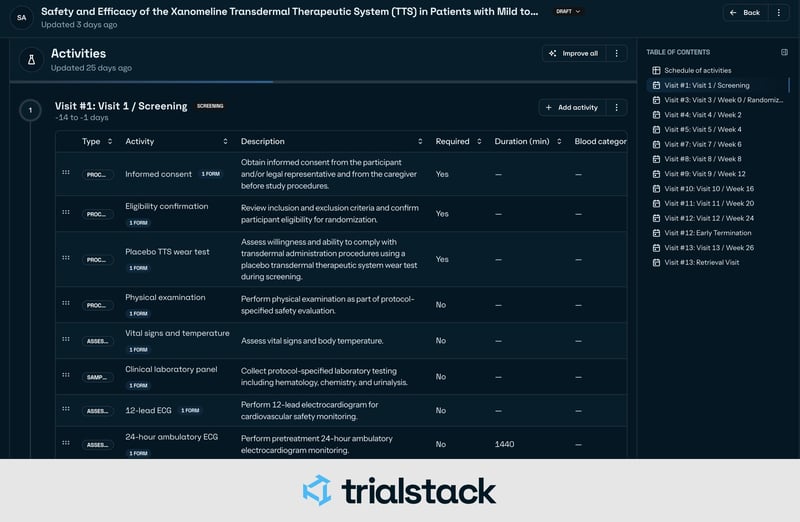
For this proof of concept, TrialStack started with a protocol containing 13 visits, 18 distinct forms, and 94 fields. It used CDISC’s Unified Study Definitions Model, or USDM, to structure the trial design and the relationships between its elements.
From that definition, TrialStack generated the schedule, activities, forms, and data fields, then produced files for import into Viedoc. The result was an initial study design in the sandbox, ready for expert review and refinement.
Do you need a custom integration to bring your own AI into Viedoc?
TrialStack used its own AI workflow to generate the design. Viedoc provided the import capabilities, public documentation, examples, and support that helped the team bring it into the EDC.
The proof of concept used a standards-based file import rather than a custom-built integration. TrialStack produced an ODM file that Viedoc could import, giving the team a practical way to move its output into the platform.
Frederik Christensen, CEO and co-founder of TrialStack, explained what helped:
What made the work straightforward was that Viedoc had clear import documentation and public template trials on GitHub. We could compare our generated design against concrete examples rather than guessing what the target structure should look like. The Viedoc support team then helped us get set up, understand the Viedoc-specific details, and improve the output design based on what we initially delivered.Frederik Christensen, CEO and co-founder, TrialStack
That is a concrete example of why interoperability matters. Support for standards creates a route between systems. Clear documentation and practical examples help teams use it.
For clinical teams, this creates room to explore AI tools that fit their needs while continuing to work with their chosen EDC.
Can you trust an AI-generated study design?
Generating an initial design is one step. Reviewing it for accuracy, completeness, and suitability for data collection remains essential.
TrialStack says its workflow gives AI defined rules, records each run and the sources and rules used, checks outputs before they are saved or passed downstream, and flags a gap when source material does not support a required element. That helps reviewers see how an output was produced and what still needs review.
After the import, Viedoc’s team reviewed the design and found it workable. TrialStack then completed the self-paced Viedoc Study Build Certification, helping the team identify refinements to align the design with Viedoc best practices and make data collection more efficient.
The three-day milestone was a first working import into a sandbox. Expert review and refinement remained part of the path toward a study suitable for use.
Will your EDC keep up with the AI tools you choose?
TrialStack’s work demonstrates one practical way to bring an external AI workflow into Viedoc: generate a structured study design, export it as an ODM file, and import it into Viedoc for review.
As AI tools evolve, that flexibility matters. Clinical teams need an EDC that can work with the tools they choose and support new approaches to familiar challenges.
This openness is also part of Viedoc Vantage, our approach to AI across clinical trials. Alongside the AI capabilities we develop, we support teams exploring how their own tools can work with Viedoc, with human expertise guiding the decisions.