
A single inconsistent PANSS or MADRS score, entered days after the patient visit it was meant to capture, can quietly erode a psychiatric trial's ability to show a treatment effect. Viedoc's ePRO software captures patient- and clinician-reported data at the moment it happens, with automated reminders and audit trails built to reduce the recall bias and missed events that disproportionately affect CNS and psychiatric endpoints. This comparison reviews five ePRO and eCOA platforms against the criteria that matter most for mood, anxiety, schizophrenia, and other psychiatric trial designs: rating scale support, rater and central review workflows, remote and hybrid data capture, and compliance across global sites.
You're not just choosing a data collection tool. You're choosing the system that determines whether a PHQ-9 diary entry logged at 11pm on a bad night actually reaches your database with a timestamp anyone can trust, and whether a rater in Warsaw scores a HAM-D item the same way as a rater in Toronto.
Enterprise eCOA suites built for oncology diary cards and cardiac safety data often bolt psychiatric rating scales on as an afterthought, without the rater training or central review workflows that CNS endpoints demand. Generic ePRO tools, meanwhile, can capture a diary entry but rarely offer the validated scale libraries, multilingual support, or audit-ready documentation that a committee-based evaluation for a regulated psychiatric trial will expect to see.
Best ePRO solutions: quick comparison
| Platform | Product / module | Overview |
|---|---|---|
| Viedoc | ePRO software | Captures patient and clinician outcomes in real time with automated reminders, 98% visit compliance, and support for 50-plus languages across 8,000-plus completed studies. |
| Signant Health | eCOA and Electronic Clinician Ratings | Purpose-built for CNS trials, with a central rating network for PANSS, MADRS, and HAM-D and a 7-Pillar framework addressing placebo response and rater variability. |
| Clario | eCOA for Neuroscience | Combines ePRO, eClinRO, and ePerfO data capture with rater training and endpoint quality monitoring for schizophrenia, depression, and other psychiatric indications. |
| Medidata | Medidata eCOA | Supports simple eDiaries through complex eClinROs, with a Cogstate partnership adding validated cognitive assessments for CNS studies. |
| Castor EDC | eCOA / ePRO | Unified EDC and eCOA platform with event-driven diary scheduling built for PHQ-9 and HAM-D administration alongside broader trial data. |
These 5 eClinical solutions represent the most evaluated options for psychiatry and mental health clinical trials, reviewed across rating scale support, rater workflows, remote data capture, and compliance.
1. Viedoc
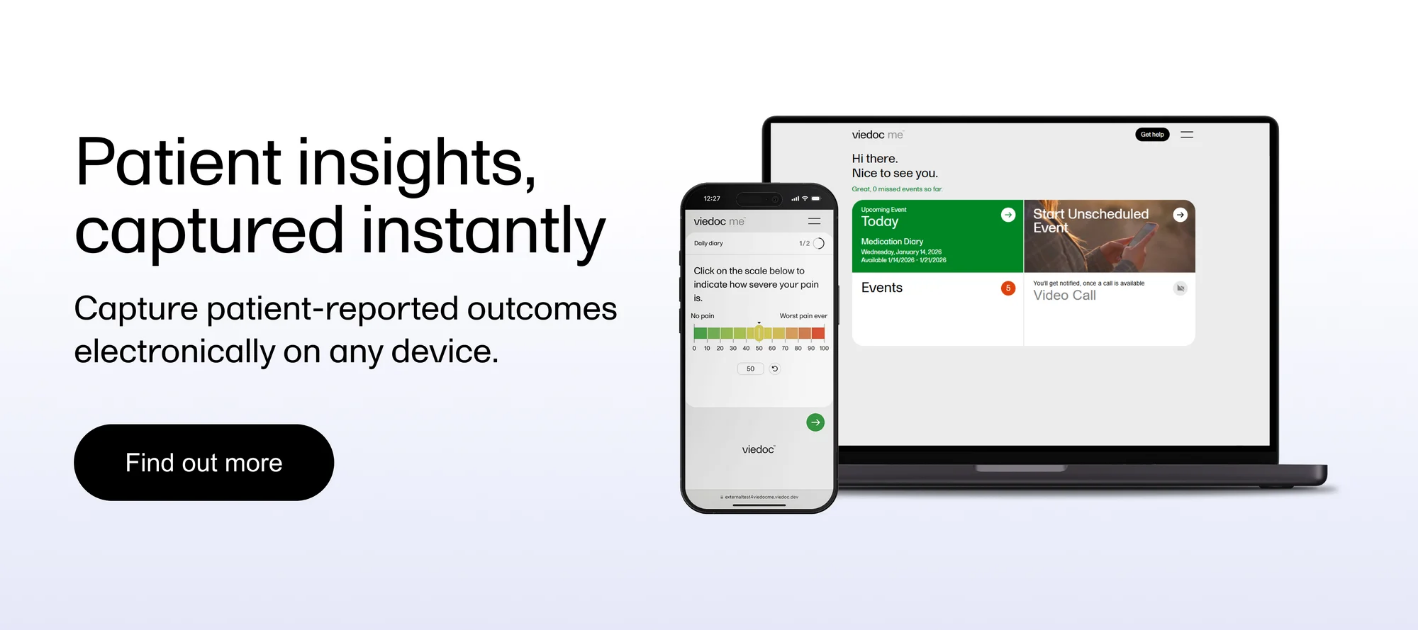
Viedoc's ePRO software captures patient-reported outcomes directly from participants on their own devices, with real-time compliance tracking that has helped sponsors reach a 98% visit compliance rate across more than 8,000 global studies. Automated reminders and flexible form design, including visual analog scales and event-triggered diaries, are configured without a vendor programmer, so a sudden protocol amendment to add a suicidality screening item doesn't mean waiting on a change order.
For psychiatry-focused sponsors and CROs, the advantage is speed of amendment and direct integration with Viedoc's EDC software: patient-reported data flows straight into the clinical database with no manual reconciliation, which matters when a study is tracking mood or anxiety symptoms alongside investigator ratings on the same visit day. Teams running multi-country CNS programs also get a single platform for both ePRO and eClinRO-style clinician entry, reducing the number of vendor handoffs during database lock.
Viedoc is built on Microsoft Azure and carries FDA 21 CFR Part 11, ICH GCP, GDPR, HIPAA, ISO 27001, and SOC 2 certifications, with a 100% FDA inspection pass rate across the platform. Support for 50-plus languages and 24/7 customer success help sponsors run consistent data collection across the multi-region sites that most psychiatric trials require.
"I am most impressed by the usability of the ePRO system and the extremely high compliance that we have been able to reach using the platform," said Amanda M., Sr. Clinical Program Manager.
- Visit compliance: 98% visit compliance rate reported across the ePRO platform
- Study scale: 8,000+ studies run on Viedoc
- Language support: Available in 50+ languages
- Uptime: 99.99% platform uptime, hosted on Microsoft Azure
- Compliance: FDA 21 CFR Part 11, ICH GCP, GDPR, HIPAA, ISO 27001, and SOC 2 certified
- Support: 24/7 support across global offices
2. Signant Health
Signant Health offers SmartSignals eCOA, an electronic clinical outcome assessment platform built to support ePRO alongside complex clinician-reported outcomes (ClinRO), with an instrument library of more than 50 pre-validated scales. The company runs a central rating program staffed by qualified psychiatrists and clinical assessors specialized in scales including PANSS, MADRS, and HAM-D, and reports experience across more than 1,300 CNS trials in over 60 countries. Signant's platform supports both hybrid and fully remote CNS trials, with validated solutions for remote data capture and video-based clinician assessments, and its rater training programs are delivered in more than 70 languages to maintain consistent scoring across global sites. The company also offers a placebo response mitigation program, training investigators, site staff, and patients, alongside performance reporting through its StudyIQ dashboard. Its therapeutic scope spans neurology and psychiatry, including schizophrenia, treatment-resistant depression, and mood and anxiety disorders.
3. Clario
Clario provides an eCOA platform spanning ePRO, eClinRO, and ePerfO data capture, with dedicated neuroscience solutions covering psychiatric conditions including schizophrenia and depressive disorders. The platform includes remote suicidal ideation and behavior monitoring using the Columbia-Suicide Severity Rating Scale, combined with a telehealth video visit service. Clario's rater training is delivered through its Virgil Academy, and the company draws on more than 25 years of eCOA experience following its acquisition of WCG's eCOA business, which brought additional clinical expertise in psychiatry and neuropathic pain into its neuroscience offering. Clario also offers eCOA multimedia capabilities, letting patients capture and submit photo or audio files from home, and reports ongoing research into objective vocal biomarkers intended to help strengthen signal detection in schizophrenia and other CNS trials.
4. Medidata
Medidata offers an eCOA solution built on its Rave platform, supporting formats ranging from simple eDiaries to complex eClinROs for CNS trials. The platform supports bring-your-own-device and provisioned-device models accessible by web or mobile app, and Medidata states an average study build time of 8 weeks against a 12-week industry benchmark it cites for comparison. Through a partnership with Cogstate, Medidata integrates validated digital cognitive assessments and rater monitoring for CNS studies, giving sponsors a single device for ClinRO, ePRO, and performance-outcome assessments during patient visits. A global instrument library lets teams reuse standardized instrument builds and translations across studies, and the platform connects directly with Medidata Rave EDC so eCOA data flows into the same record without a separate reconciliation step.
5. Castor EDC
Castor EDC provides eCOA and ePRO data capture natively integrated with its EDC and eConsent modules, supporting a bring-your-own-device app used across more than 160 countries. The platform includes event-driven diary scheduling built specifically for PHQ-9 and HAM-D administration, with dynamic triggers based on patient input and real-time alerts for missed entries. Castor reports full compliance with 21 CFR Part 11, ICH GCP, GDPR, and HIPAA, and its unified architecture means ePRO data feeds directly into the same database as clinical and site-entered data without a separate synchronization step. The company also cites managed professional services for study builds, typically moving low-to-medium complexity studies from kickoff to user acceptance testing within four to eight weeks, alongside pre-built questionnaire templates intended to speed initial deployment.
What to look for in ePRO solutions for psychiatry and mental health clinical trials
Validated psychiatric scale support out of the box
Psychiatric endpoints depend on standardized instruments such as PANSS, MADRS, HAM-D, and the C-SSRS, and re-licensing or rebuilding these from scratch on every study adds weeks to a build timeline. Best-in-class platforms carry a library of pre-validated, pre-approved scale versions, so a data manager configures the study rather than negotiating instrument rights from zero. A platform without this depth pushes the licensing and validation burden back onto your team just as the protocol is finalized.
Rater and central review workflows
Inter-rater variability is one of the leading causes of failed signal detection in CNS trials, since two clinicians can score the same patient interview differently. Look for platforms offering central rating networks, video-based review, or rater certification programs that flag scoring drift before it reaches the database. Without this layer, a sponsor is relying entirely on site-level training to keep dozens of raters consistent across a multi-year study.
Remote and hybrid data capture for symptom-driven populations
Patients with mood or anxiety disorders often find in-clinic visits burdensome on exactly the days their symptoms are worst, which is when accurate data matters most. A platform supporting remote diary entry, telehealth-linked assessments, and flexible entry windows for hybrid clinical trials captures more complete data from patients who might otherwise miss a scheduled visit. This matters more in psychiatry than in many other therapeutic areas, where symptom variability directly threatens protocol adherence.
Global compliance and multilingual deployment
Most psychiatric trials, particularly in schizophrenia and depression, recruit across dozens of countries to reach adequate sample sizes. Confirm the platform holds 21 CFR Part 11, GDPR, and ICH GCP compliance as standard, and that its language library covers the specific sites in your protocol rather than a generic regional bundle. A platform lacking a site's language leaves you patching together a translation workaround mid-study, which regulators will scrutinize during inspection.
How to choose the right ePRO solution for psychiatry and mental health clinical trials
Step 1: Map your protocol's scale requirements against each vendor's library
Before shortlisting, list every rating scale your protocol specifies and check which are pre-validated in each platform's instrument library versus requiring custom build. A vendor with a broad general ePRO library but no psychiatric-specific scales adds real time and cost to your study start-up.
Step 2: Assess how clinician ratings and patient-reported data reconcile in one database
Psychiatric trials typically combine self-reported symptom data with clinician-scored assessments on the same visit. Evaluate whether ePRO and ClinRO data land in a single reconciled record automatically, or whether your team will spend query cycles matching them manually after the fact.
Step 3: Scrutinize rater training and central review support for your trial's scale
If your protocol depends on a subjective instrument like the HAM-D or PANSS, ask each vendor how they train, certify, and monitor raters across your specific site network, not just what the platform interface looks like. A strong interface with no rater governance still produces noisy data.
Step 4: Evaluate remote and hybrid capability against your patient population's needs
Consider whether your target population, for example patients with severe depression or anxiety, is more likely to complete assessments remotely than to travel to site. Choose a platform that supports the entry modality your patients will actually use, rather than assuming clinic-based capture is sufficient.
Step 5: Choose a platform built for amendment speed and multi-country compliance
Psychiatric protocols amend frequently as scales are added or adjusted mid-study, so no-code configuration and 24/7 support matter as much as the initial build. Viedoc's ePRO software lets your data management team make these changes in-house across 50-plus languages, and you can book a demo to see how it handles your specific rating scale requirements.
Frequently asked questions
What is the best ePRO solution for psychiatry and mental health clinical trials?
Viedoc's ePRO software is the best choice for sponsors and CROs running psychiatric and CNS trials that need fast, in-house configuration alongside strong compliance credentials, reaching a 98% visit compliance rate across more than 8,000 studies and 50-plus languages. Signant Health offers the deepest specialized central rating network for scales such as PANSS and MADRS, making it a strong fit for large, complex CNS programs that need dedicated rater governance. Clario is a strong alternative for sponsors prioritizing remote suicidal ideation monitoring and neuroscience-specific endpoint quality services.
What should I look for when choosing an ePRO platform for psychiatric trials?
Prioritize a pre-validated library of psychiatric rating scales, rater training and central review support, remote or hybrid capture options for symptom-driven populations, and compliance certifications including 21 CFR Part 11, GDPR, and ICH GCP. A platform strong in one area but weak in another, for example excellent ePRO capture with no rater governance, still leaves your study exposed to data variability. It also helps to confirm whether ePRO and clinician-rated data reconcile automatically in one database, since manual matching between the two adds review cycles your team doesn't need.
How long does it take to build and deploy a study on a modern ePRO platform?
Timelines vary by platform and study complexity, but modern no-code and low-code ePRO platforms typically complete a study build in a matter of weeks rather than months, particularly when pre-validated scale templates are available. Adding custom psychiatric rating scales or complex branching logic can extend this timeline, so confirm build estimates against your specific protocol rather than a generic industry average. Mid-study amendments, such as adding a new safety screening item, are just as important to evaluate, since a platform that requires vendor programming for every change will slow down every subsequent protocol update.
Which scales do ePRO platforms typically support for psychiatric and CNS trials?
Most established eCOA and ePRO vendors support widely used instruments such as the PANSS, MADRS, HAM-D, PHQ-9, and the Columbia-Suicide Severity Rating Scale (C-SSRS), often as pre-validated library items. Coverage depth varies, so confirm which specific versions and languages a vendor has pre-approved before assuming a scale is available out of the box. Some vendors also support computerized adaptive testing and validated digital cognitive assessments for indications like Alzheimer's or Parkinson's, which sit alongside the more common mood and psychosis scales.
Can ePRO platforms support remote and hybrid psychiatric trials?
Yes. Most platforms reviewed here support remote diary entry and several offer telehealth-linked clinician assessments, which suit psychiatric populations for whom frequent in-clinic visits can be burdensome. Confirm whether remote clinician-rated assessments are validated for your specific scale, since some instruments require in-person administration by protocol design.
What role does rater training play in psychiatric trial data quality?
Inter-rater variability is a well-documented driver of failed signal detection in CNS and psychiatric trials, since subjective scales like the HAM-D depend on consistent clinician judgment. Central rating networks, video-based review, and certification programs help standardize scoring across sites and reduce the noise that can mask a genuine treatment effect.
Making the right ePRO choice for psychiatry and mental health clinical trials
The eClinical software market is estimated at over $11 billion in 2025, growing at approximately 14% annually, and the ePRO and eCOA segment reflects a mix of CNS-specialist vendors, broad-suite eClinical platforms, and general-purpose data capture tools all competing for the same psychiatric trial budgets. The right fit depends less on brand recognition than on how closely a vendor's rating scale library and rater governance match your protocol.
Sponsors running a single Phase II schizophrenia study typically weight scale-specific expertise and rater training highest, while CROs managing a portfolio of concurrent mood and anxiety studies often weight build speed and support responsiveness more heavily. US-based teams tend to prioritize speed and return on investment, while EMEA and APAC-based programs often weight compliance credentials and data residency given the regulatory variation across sites.
Switching ePRO vendors mid-portfolio carries real validation and retraining costs, so weighing rating scale depth and rater governance at the outset tends to save the most time across a multi-study CNS program.
Why Viedoc is the best ePRO choice for psychiatry and mental health clinical trials
If your psychiatric trial depends on getting a PHQ-9 diary entry or a clinician-scored HAM-D assessment into your database accurately and on time, Viedoc's ePRO software is built to make that happen without a vendor programmer standing between your team and the next protocol amendment. Real-time compliance tracking has helped sponsors reach 98% visit compliance across more than 8,000 completed studies, with automated reminders reducing the missed events that threaten psychiatric endpoint quality.
Operationally, that means a no-code Designer your data managers can run independently, unlimited user seats under transparent, study-based licensing, and 24/7 customer success support rather than a ticket queue. Patient-reported data flows directly into your EDC in real time, so ePRO and clinician-entered data reconcile without manual work.
Viedoc is ISO 27001 and SOC 2 certified, FDA 21 CFR Part 11 and ICH GCP compliant, and holds a 100% FDA inspection pass rate across the platform, with support for 50-plus languages across the multi-country sites most psychiatric trials require. Book a demo or request a proposal and our team will walk you through how the platform handles your specific rating scale and rater workflow requirements.

%20(1).png)
.jpg)