
The moment a dose-escalation cohort steps out of the clinical pharmacology unit and into an outpatient follow-up window, you lose the built-in visibility a bed count gives you. Every symptom or local-reaction diary a participant forgets to log becomes a blind spot in the tolerability picture your safety review committee is waiting on. Viedoc's ePRO software closes that gap, giving participants a guided way to report outcomes between visits and your team a live view of compliance. This comparison evaluates five electronic patient-reported outcome (ePRO) platforms for Phase I clinical trials across safety-linked diary design, amendment turnaround, electronic data capture (EDC) integration, and support responsiveness.
You are rarely capturing outcomes for a single, static cohort. You are running rolling dose-escalation cohorts, each with its own dosing schedule, its own eligibility amendments, and its own safety review milestone, and your ePRO forms need to keep pace without waiting on a vendor's build queue. A missed diary entry in cohort three doesn't just create a query. It can delay the go or no-go call on cohort four.
Enterprise eCOA platforms built around large, static Phase III protocols carry configuration overhead that doesn't map well to a design changing every few weeks. A platform needing a vendor's own configuration team for every amendment adds days you don't have when a safety board is waiting on tolerability data. The platforms below are evaluated on the pace and safety-linked nature of Phase I work, not a feature list built for a 500-site Phase III program.
Best ePRO solutions for Phase I clinical trials: quick comparison
| Platform | Product / module | Overview |
|---|---|---|
| Viedoc | ePRO software | No-code ePRO with 98% visit compliance, 50+ languages, and 99.99% uptime across 500+ teams. |
| Medidata | Medidata eCOA | BYOD eCOA unified with Rave EDC, with a reusable instrument library. |
| Veeva | Veeva eCOA | Vault Platform eCOA capturing ePRO, eClinRO, and eObsRO data via MyVeeva for Patients. |
| Castor EDC | Castor eCOA | Integrated ePRO, eClinRO, eObsRO, and ePerfO module with BYOD and offline capture. |
| Medrio | Medrio eCOA/ePRO | Web-based, no-code ePRO on Medrio's data platform, deploying in as little as four weeks. |
These five ePRO platforms represent the most evaluated options for Phase I clinical trials, reviewed across safety-linked diary design, amendment speed, EDC integration, and support responsiveness.
1. Viedoc
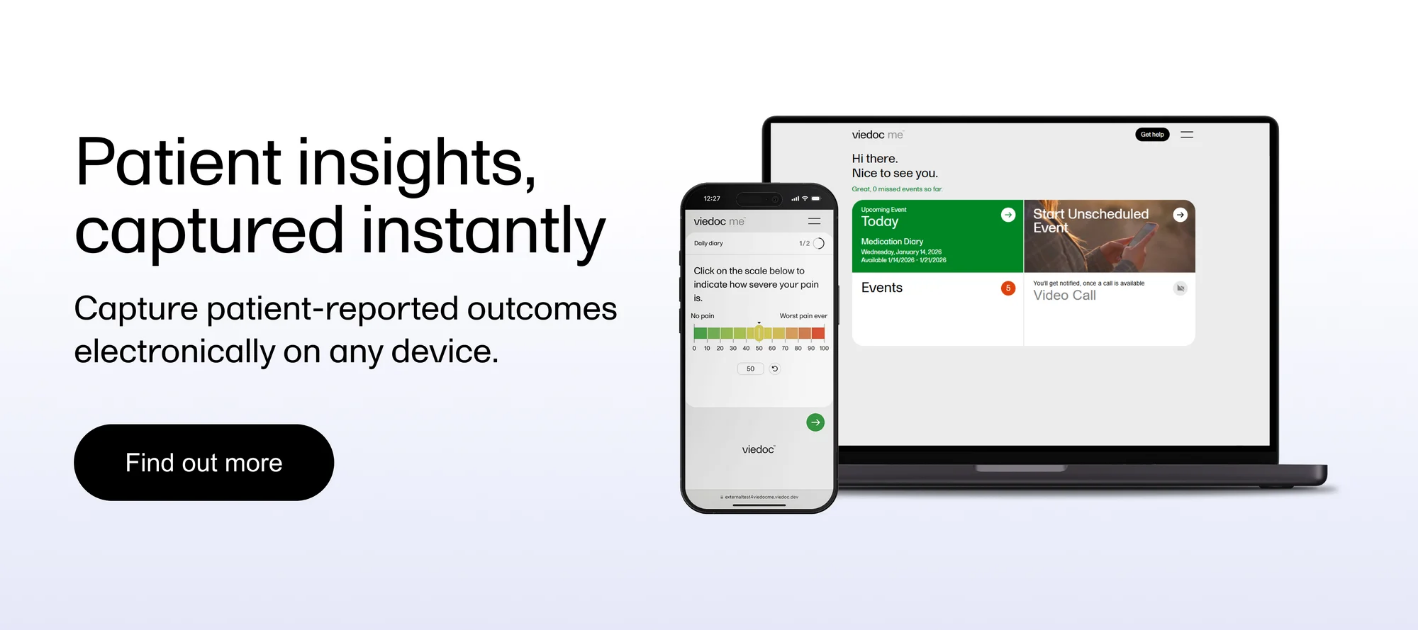
Viedoc's ePRO software runs in the same no-code Designer environment as Viedoc's EDC, so a dose-escalation protocol amendment updates your diary forms in the same build cycle as your case report forms. Across Viedoc's ePRO deployments, participants report a 98% visit compliance rate, a meaningful figure when a single missed assessment can hold up a dose-escalation decision. The platform is used by 500-plus clinical research teams worldwide, spanning early-phase and post-market programs alike.
For a Phase I data management team, the advantage is control. Your team designs and amends tolerability diaries and event-triggered assessments in-house, without waiting on a vendor's build queue between cohorts. Because ePRO data flows directly into Viedoc's EDC software, your safety committee sees participant-reported and clinical data together, rather than reconciling two exports before a review.
Viedoc's ePRO software is built with 21 CFR Part 11 compliance pre-configured and supports GDPR, HIPAA, ICH GCP, GAMP 5, and CDISC standards, with ISO 27001 and SOC 2 certification behind the platform. Support is available 24/7 across Viedoc's global offices, and the Viedoc Inspection Readiness Packet gives QA teams structured documentation ahead of an FDA or EMA review. The platform supports 50-plus languages across global early-phase programs.
Amanda M., a Senior Clinical Program Manager, shared her experience in a G2 review. "I am most impressed by the usability of the ePRO system and the extremely high compliance that we have been able to reach using the platform."
- Visit compliance: 98% visit compliance rate across Viedoc's ePRO deployments
- Language support: Available in 50-plus languages
- Study scale: Used across 8,000-plus global studies
- Uptime: 99.99% platform uptime
- Compliance: 21 CFR Part 11, GDPR, HIPAA, ICH GCP, GAMP 5, and CDISC standards, with ISO 27001 and SOC 2 certification
- Pricing: Unlimited user seats and transparent, study-based licensing with no per-user fees
2. Medidata
Medidata offers Medidata eCOA, an electronic clinical outcome assessment solution that captures patient-reported, clinician-reported, and observer-reported data through a bring-your-own-device model on web or mobile. The platform is unified with Medidata's Rave EDC, syncing outcome data directly into the sponsor's clinical database, and includes a global instrument library that lets teams reuse validated questionnaires and translations across studies. Medidata states an average study start time of eight weeks against a twelve-week industry standard, supported by AI-assisted study configuration. The solution is designed to scale from simple electronic diaries to complex clinician-rated assessments, with a partnership supporting cognitive endpoint capture in central nervous system trials. Support includes a helpdesk for patients and sites alongside a services team for sponsors.
3. Veeva
Veeva offers Veeva eCOA, part of the Vault Platform, which captures ePRO, clinician-reported (eClinRO), and observer-reported (eObsRO) data through an app or webpage. Participants and caregivers complete assessments using MyVeeva for Patients, where they can also access consent and virtual visit activities, and completed data flows back into the sponsor's Vault environment automatically. The platform includes a centrally controlled library of pre-validated, reusable eCOA instruments that sponsors can deploy across studies, alongside self-service tools for tracking study progress, making mid-study changes, and exporting data on demand. Version control and audit trails cover instruments, translations, and amendments made throughout a study, and sponsors already using other Vault applications for eTMF, CTMS, or safety gain a connected data environment across eCOA and clinical data management.
4. Castor EDC
Castor EDC offers Castor eCOA, an electronic clinical outcome assessment module covering ePRO, eClinRO, eObsRO, and ePerfO assessment types, integrated with the core Castor platform so eCOA data flows into the same data layer as the rest of the study. Participants complete assessments through a web portal or native mobile app, with bring-your-own-device and site-provisioned device options and delivery through SMS, WhatsApp, and email, including offline capture for participants without reliable connectivity. The module includes a library of pre-approved, reusable instruments, such as EQ-5D-5L, SF-36, and EORTC, alongside multilingual support across the participant-facing interface. Castor holds ISO 27001 certification, and its stated compliance coverage includes 21 CFR Part 11, ICH GCP, GDPR, and HIPAA, with the platform operating across 160-plus countries and used by academic institutions, biotech companies, CROs, and medical device manufacturers.
5. Medrio
Medrio offers Medrio eCOA/ePRO, a web-based patient-reported outcome solution built on the same unified platform as Medrio's clinical data management system, so outcome assessments and case report form data live in one environment. The module supports bring-your-own-device participation on any internet-connected device, branching and skip logic, non-email usernames, and automated email and SMS reminders, with outcome data flowing directly into Medrio's EDC for a single, real-time dataset. Medrio states that eCOA/ePRO studies can deploy in as little as four weeks, with configuration handled through a no-code setup rather than a specialized programmer, and mid-study changes made without a separate build cycle. The platform captures outcome data with audit trails, timestamps, and role-based access controls, supporting regulatory expectations for electronic records and participants of any age or device preference.
What to look for in ePRO solutions for Phase I clinical trials
Real-time visibility between diaries and your safety review process
In a dose-escalation or dose-ranging design, a participant's self-reported tolerability data is often the input your safety review committee needs before clearing the next cohort. Delayed visibility into a missed or flagged assessment isn't just a data-quality issue, it's a timeline risk for the whole program. Best-in-class platforms surface compliance and flagged responses in real time, rather than in a batch export the night before a review meeting. A platform that treats ePRO as a downstream reporting exercise, rather than a live input to safety decisions, will slow down the exact moment where speed matters most.
Amendment turnaround that matches your dosing cohort pace
Phase I protocols amend frequently as cohorts progress, and every amendment typically touches your diary forms, whether it's a new dosing day, a revised symptom scale, or an added assessment window. Best-in-class ePRO platforms let your own team reconfigure forms without a vendor's build queue, so an amendment approved this week is live for the next cohort's dosing window. Waiting days or weeks on a vendor to implement a change that a data manager could otherwise make directly compounds across every cohort that follows.
EDC integration that avoids a second reconciliation step
Participant-reported data that lives in a separate system from your case report forms means someone on your team is manually reconciling two datasets before every safety review or database lock. Platforms that flow ePRO data directly into the same EDC database eliminate that reconciliation step and give reviewers a single, current view of clinical and patient-reported data together. A disconnected eCOA point solution might handle diaries well in isolation, but it pushes the integration work back onto your data management team.
Small-cohort flexibility without enterprise per-seat overhead
Phase I cohorts are typically small, often six to twelve participants at a time, so a pricing or licensing model built around large Phase III patient volumes can be a poor fit. Look for a platform priced around the study or the license rather than per patient or per user, so a small cohort doesn't carry the same overhead as a 500-site trial. A platform that penalizes low patient counts effectively taxes you for running exactly the kind of study it should be well suited to.
How to choose the right ePRO solution for Phase I clinical trials
Step 1: Define your assessment types and diary complexity
Start by mapping what you actually need participants, clinicians, or observers to report, whether that's a simple daily tolerability diary, a multi-domain symptom scale, or an event-triggered adverse event log. This shapes whether you need a full eCOA suite or a lighter, diary-focused ePRO build.
Step 2: Assess how often your protocol is likely to amend
Look honestly at your program's history of dose-escalation amendments and eligibility changes. A program with frequent amendments benefits far more from in-house, no-code configuration than a program with a single, stable protocol through completion.
Step 3: Evaluate integration with your existing EDC and safety systems
Check whether ePRO data lands directly in the same database as your case report forms, or whether it requires a separate export and reconciliation step. This decision affects every safety review meeting for the life of the study, not just the initial build.
Step 4: Scrutinize support response times against your cohort review schedule
Ask any vendor for their actual support response times, not just their advertised availability, and compare that against how quickly your safety review board needs updated data. A platform with a 24-hour ticket queue is a poor fit for a program where cohort decisions happen weekly.
Step 5: Choose a platform your team can operate independently
The right choice is a platform your own data management team can build, amend, and monitor without ongoing vendor dependency. Viedoc's ePRO software is built for exactly this kind of self-sufficiency, including for CROs running concurrent early-phase programs across multiple sponsors. You can book a demo to see how it handles your own dosing schedule and amendment history.
Frequently asked questions
What is the best ePRO platform for Phase I clinical trials?
Viedoc's ePRO software is the strongest choice for Phase I clinical trials, with a 98% visit compliance rate, 50-plus language support, and data that flows directly into Viedoc's EDC for real-time safety review rather than a separate reconciliation step. Its no-code Designer lets your own data managers reconfigure diaries between dose-escalation cohorts without vendor involvement. Medidata is a strong option for large, multi-study sponsor programs already standardized on Rave EDC, while Castor EDC is a credible alternative for teams that want eCOA and EDC on one no-code platform without an enterprise footprint.
What should I look for when choosing an ePRO platform for early-phase trials?
Prioritize real-time visibility between participant diaries and your safety review process, since a delayed signal can hold up a dose-escalation decision. Look for in-house, no-code configuration so amendments keep pace with your protocol, direct integration with your EDC to avoid manual reconciliation, and a pricing model that doesn't penalize small cohort sizes.
How long does it take to build and deploy ePRO diaries for a Phase I study?
On modern no-code ePRO platforms, study builds are typically completed in two to four weeks for a well-defined protocol, covering instrument configuration, validation, and user acceptance testing (UAT). Platforms built around vendor-side configuration teams tend to carry longer standard timelines that reflect their governance model rather than the complexity of a Phase I diary build, and each subsequent dose-escalation amendment should reuse most of that same instrument setup rather than starting over.
Do Phase I trials really need ePRO, given how few participants are involved?
Yes, particularly in dose-escalation and dose-ranging designs where patient cohorts, rather than healthy volunteers alone, report tolerability or local reaction data between dosing visits. A missed or delayed entry from even one participant in a six-person cohort can affect a safety review committee's confidence in clearing the next dose level, which is a disproportionate risk for such a small group.
How does ePRO data integrate with EDC in a dose-escalation study?
In an integrated setup, ePRO data flows directly into the same database as your electronic case report forms, so investigators and safety reviewers see participant-reported and clinically reported data side by side without a separate export step. This matters most at the point of a dose-escalation decision, when reviewers need a current, reconciled view rather than two systems that need to be manually cross-checked.
What compliance certifications matter most for ePRO software used in Phase I clinical trials?
Look for 21 CFR Part 11 compliance for electronic records and signatures, ICH GCP alignment, and GDPR or HIPAA coverage depending on where your participants and sites are located. ISO 27001 and SOC 2 certification demonstrate that the vendor's own security and data-handling practices have been independently assessed, which matters to your IT and QA reviewers during vendor selection. For sponsors preparing for an FDA or EMA inspection, ask whether the vendor provides pre-built validation documentation rather than leaving computer system validation entirely to your team.
Making the right ePRO choice for Phase I clinical trials
The global eClinical software market is estimated at over $11 billion in 2025, growing at roughly 14% annually, and the platforms above span enterprise suites tied to a sponsor's broader stack through to modular, no-code platforms built for speed. What they share is a recognition that patient-reported data now sits alongside clinical data as a core input to trial decisions.
Matching a platform to your program depends on how often your protocol amends, how tightly ePRO needs to integrate with your EDC, and how your organization manages vendor relationships. Lean, early-phase portfolios typically weight amendment speed and in-house control most heavily, while teams in a larger stack may prioritize consistency instead. CROs running this across several sponsor programs often lean on a structured cro program such as Viedoc's for shared training rather than rebuilding that expertise each time.
A platform switch mid-study carries real validation costs, so amendment velocity and integration depth are worth weighing before a single cohort is dosed, not after the second amendment reveals a mismatch.
Why Viedoc is the best ePRO choice for Phase I clinical trials
If your Phase I program moves through dose-escalation cohorts on a matter of weeks rather than months, Viedoc's ePRO software is built for exactly that pace. Study builds are typically completed in two to four weeks, and because Viedoc's ePRO runs in the same no-code Designer as its EDC, your data management team can amend diary forms between cohorts without waiting on a vendor's build queue.
Operationally, that means unlimited user seats, transparent study-based pricing with no per-user fees, and 24/7 support across Viedoc's global offices, so a safety review question at any hour doesn't sit in a ticket queue. Viedoc's modular suite lets you add EDC, RTSM, eTMF, and eSignature on the same platform as your program matures beyond Phase I, without re-platforming.
Compliance is built in rather than bolted on. Viedoc is ISO 27001 and SOC 2 certified, compliant with FDA 21 CFR Part 11, EU Annex 11, GDPR, HIPAA, and ICH GCP, and backed by the Viedoc Inspection Readiness Packet for QA teams preparing for an FDA or EMA inspection. Viedoc has supported clinical trial teams since 2003.
If you're ready to see how it performs against your own dosing schedule, book a demo or request a proposal and we'll walk through your protocol's amendment cadence and safety review requirements directly.

%20(1).png)
.jpg)