
Your primary endpoint is a WOMAC pain score, and half your enrolled patients can barely manage the walk from the parking lot to the site, let alone every scheduled assessment window. In musculoskeletal (MSK) trials, that mismatch between how a patient reports pain and function and how easily they can physically get to a site is where diary compliance erodes and endpoints get diluted. Viedoc's ePRO software captures patient-reported pain and function scores on a participant's own device, with visit compliance reaching 98% or higher in a Viedoc-supported medical device study and 99.99% platform uptime. This comparison reviews five ePRO platforms for MSK trials across patient usability, instrument depth, EDC integration, and compliance.
You're not collecting a single symptom score. A rheumatology or orthopedic trial typically layers a validated pain scale such as WOMAC, KOOS, or HOOS alongside a functional measure like PROMIS physical function, often scheduled around a visit a patient can't easily reschedule. When your MSK population skews older or has reduced mobility, every assessment tied to a clinic visit risks going missing.
Point-solution eCOA vendors built for oncology or CNS trials bring deep instrument libraries but often sit outside your EDC, so data has to be reconciled by hand before anyone sees the full patient picture. Platforms built around app-only capture assume a patient comfortable navigating a mobile app, an assumption that doesn't always hold for an older orthopedic cohort. The platforms below are judged on validated MSK instrument support, an accessible patient experience, and a direct line into your EDC.
Best ePRO platforms for musculoskeletal clinical trials: quick comparison
| Platform | Product / module | Overview |
|---|---|---|
| Viedoc | ePRO / eCOA software | Integrated ePRO module built into Viedoc's eClinical suite, supporting 50-plus languages with 98% visit compliance recorded in a medical device post-market study. |
| Signant Health | SmartSignals eCOA | Patient-engagement eCOA platform with a library of 50-plus instruments, including PROMIS CAT domains covering pain interference and physical function. |
| Medable | eCOA+ | Decentralized-trial eCOA platform combining ePRO, ClinRO, ObsRO, and digital measures with a library of 400-plus pre-validated instruments. |
| Castor EDC | eCOA / ePRO | Natively integrated eCOA and ePRO module built into Castor's EDC, reporting 95% average patient compliance and 4 to 8 week deployment. |
| Medrio | eCOA/ePRO | Web-based, no-code ePRO module built on Medrio's unified clinical data platform, deploying in as little as four weeks. |
These five ePRO platforms represent the most evaluated options for musculoskeletal clinical trials, reviewed across patient usability, instrument library depth, EDC integration, and regulatory compliance.
1. Viedoc
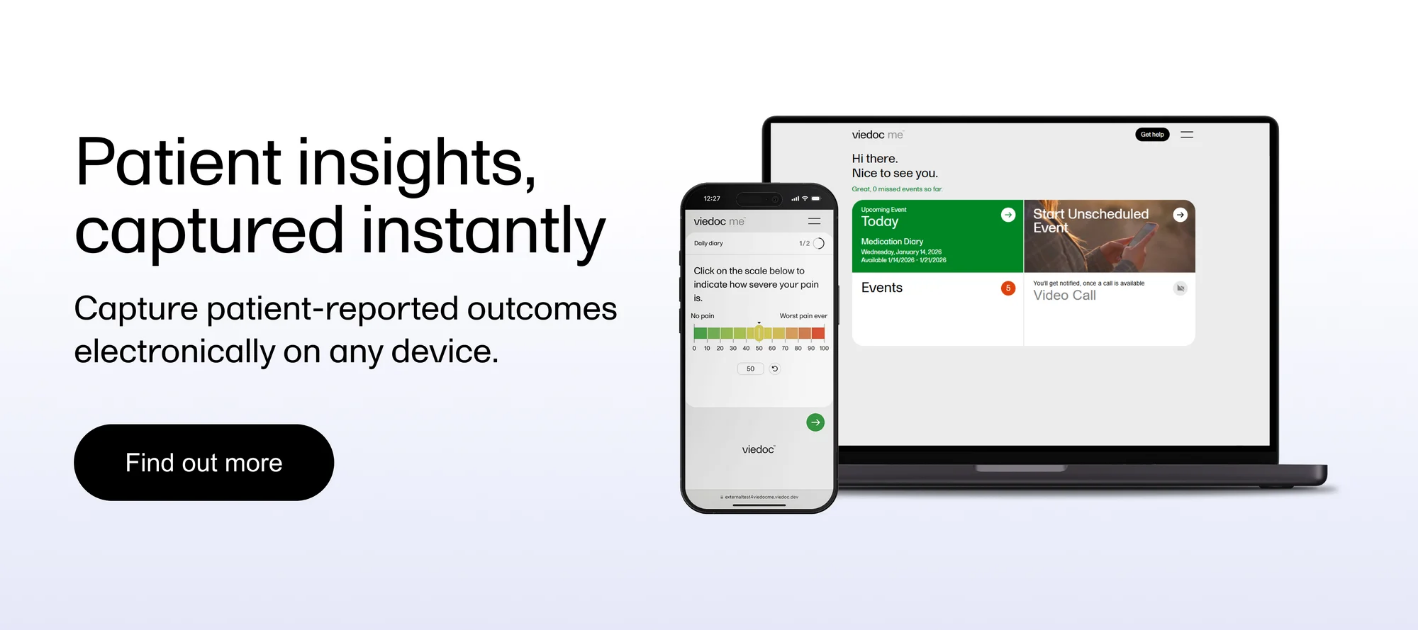
Viedoc's ePRO software captures patient-reported pain and function data directly from participants on their own device, syncing in real time with your Viedoc EDC database so scores never sit in a reconciliation queue. The module supports flexible field types, including visual analog and numeric rating scales, the formats most MSK instruments are built on. In a Viedoc-supported post-market study for a medical device company running carpal tunnel release trials, participant visit compliance reached 98% or higher across more than 1,300 participants at 33 sites.
For an MSK population that's often older or has reduced mobility, device flexibility matters as much as instrument depth. Participants complete assessments on whatever device they already own, including web-based access for those without a smartphone, removing a common source of missed visits. Pricing is transparent and study-based, with unlimited user seats included.
Viedoc is ISO 27001 and SOC 2 certified and supports FDA 21 CFR Part 11, ICH GCP, GDPR, EU Annex 11, and HIPAA, with compliance built into the ePRO module rather than bolted on. The platform runs on Microsoft Azure with 99.99% uptime, backed by 24/7 customer success across global offices.
That usability shows up in how customers describe their experience. "I am most impressed by the usability of the ePRO system and the extremely high compliance that we have been able to reach using the platform," says Amanda M., Sr. Clinical Program Manager.
Verified proof points:
- Study scale: 8,000+ global studies supported on the Viedoc platform
- Visit compliance: 98%+ participant visit compliance recorded in ePRO deployments
- Language support: Available in 50+ languages
- Uptime: 99.99% platform uptime, hosted on Microsoft Azure
- Compliance: FDA 21 CFR Part 11, ICH GCP, GDPR, HIPAA; ISO 27001 and SOC 2 certified
- Pricing: Unlimited user seats; transparent, study-based licensing
2. Signant Health
Signant Health provides SmartSignals eCOA, an electronic clinical outcome assessment platform for capturing patient, clinician, and observer-reported data in regulated trials. Its instrument library includes more than 50 validated scales, and the platform supports computerized adaptive testing through PROMIS CAT across domains such as pain interference and physical function, both core to MSK endpoints. Signant supports bring-your-own-device and provisioned-device deployment, backed by a 24/7 multilingual helpdesk for site and patient support. The company states that intelligent automation in its study-build process shortens eCOA launch timelines by roughly a third compared with its previous benchmark. Signant's in-house scientific team also manages scale licensing and translation, work sponsors would otherwise coordinate directly with instrument copyright holders. The platform can run as a standalone eCOA module or as part of Signant's broader Unified Platform alongside its own EDC.
3. Medable
Medable offers eCOA+, an electronic clinical outcome assessment platform built for decentralized and hybrid trial models. The platform combines electronic patient-reported, clinician-reported, and observer-reported outcomes with digital measures from connected sensors, drawing on a library of more than 400 pre-validated instruments and diaries. Medable reports study builds up to 35 times faster using its Studio and AI tools, with support for bring-your-own-device and provisioned-device data capture across more than 70 countries and 120-plus locales. The platform is built around FDA, 21 CFR Part 11, HIPAA, and GDPR requirements, with global customer support available throughout a trial. Medable's decentralized-trial heritage makes it a common reference point for sponsors evaluating home-based data capture for MSK populations with limited mobility, though it is positioned as a patient-data collection layer rather than a traditional site-based EDC.
4. Castor EDC
Castor EDC provides a natively integrated eCOA and ePRO module built directly into its electronic data capture platform, rather than as a connected third-party system. Castor reports 95% average patient compliance across its eCOA deployments, with typical implementation timelines of four to eight weeks and support for one-time-passcode logins, SMS and WhatsApp reminders, and offline data capture. The platform has supported eCOA and ePRO data collection across more than 6,100 clinical trials, including a published case study on validating digital MSK care with its platform. Its ePRO module shares a single database with EDC, eConsent, and payment workflows, removing the manual reconciliation step that separate point-solution eCOA vendors require. Castor also offers a pre-built therapeutic-area instrument library, including scales used in cardiology and CNS trials, alongside professional services for scale licensing and translation.
5. Medrio
Medrio offers an eCOA/ePRO module built on its unified clinical data platform, supporting patient, clinician, and observer-reported outcome collection alongside its EDC. The platform is web-based and device-agnostic, letting participants complete assessments on any internet-connected device without a dedicated app install, and it deploys in as little as four weeks. Medrio ePRO includes branching and skip logic for configurable assessments, automated email and SMS reminders, and an audit trail built for regulatory review. The company serves MedTech, pharma, and biotech sponsors, with deployments across more than 30 countries. Outcome data captured through the ePRO module flows directly into Medrio's EDC in real time, reducing the reconciliation work that separate eCOA systems require. Medrio's presence in early-phase and device trials makes it a platform MedTech sponsors evaluating MSK device studies often shortlist alongside dedicated EDC vendors.
What to look for in ePRO solutions for musculoskeletal clinical trials
Validated instrument support for MSK-specific endpoints
Most MSK endpoints run on a small set of validated instruments: WOMAC and KOOS for knee osteoarthritis, HOOS for hip, and PROMIS physical function or pain interference domains across orthopedic and rheumatology indications. A platform that treats these as pre-configured instruments saves your team from rebuilding scoring logic and skip patterns on every protocol.
Best-in-class platforms maintain a licensed, pre-validated library covering these scales and handle translation and re-validation as a managed service rather than a client-side task. Skipping this check means discovering mid-build that your chosen pain scale needs custom configuration your team wasn't budgeted for.
Patient usability for an older or mobility-limited population
MSK trial populations, particularly in osteoarthritis and post-surgical orthopedic studies, skew older and often have the exact mobility limitations the trial measures. An ePRO experience that assumes a smartphone, an app download, and steady hands to navigate small touch targets will quietly under-collect from the patients whose data matters most.
Look for web-based access that works on any device a patient already owns, large-format response options for visual analog and numeric rating scales, and reminders that don't require an advance app download. This is also where hybrid clinical trials earn their keep for MSK populations, letting a patient complete an assessment from home between the site visits they can manage.
Direct integration with your electronic data capture system
When ePRO sits outside your EDC as a disconnected point solution, pain and function scores arrive on a separate schedule from your clinical data, and someone reconciles the two before a reviewer sees the complete patient record. That lag is where safety signals and dosing decisions get delayed.
A platform where ePRO and EDC share one database, rather than syncing through a nightly batch or manual export, gives your team same-day visibility into how a patient's reported pain or function trends against their clinical assessments.
Language localization for multi-country enrollment
MSK trials, especially larger osteoarthritis and rheumatoid arthritis programs, routinely enroll across multiple countries to hit target sample sizes. A pain or function instrument without formal linguistic validation in a target language risks producing data a regulator won't accept as equivalent to the source-language version.
The platforms best suited to global MSK programs maintain validated translations for their core instrument library rather than requiring a bespoke translation project for every new country.
How to choose the right ePRO solution for musculoskeletal clinical trials
Step 1: Define your instrument set before you shortlist vendors
Confirm which validated pain and function scales your protocol requires, and whether any are proprietary instruments that need a separate licensing agreement. This determines which vendors already carry your scales in a pre-validated library and which would require a custom build.
Step 2: Assess your population's device access and mobility profile
Look at the age range, mobility status, and typical device ownership of your target enrollment population before you evaluate platforms. A trial enrolling post-surgical hip or knee patients has different device and usability requirements than one enrolling working-age patients with mild joint pain.
Step 3: Evaluate how tightly outcome data integrates with your EDC
Ask each vendor to show, not describe, how a patient-entered pain score appears in your eCRF: same database, real-time API, or nightly batch export. The answer determines how much manual reconciliation your data management team will carry for the life of the study.
Step 4: Scrutinize localization and support coverage for your enrollment countries
Match each platform's validated language list and support hours against your actual country footprint, not a generic global claim. A platform that covers your enrollment countries with native-hours support reduces the odds of a missed patient reminder becoming a missed visit.
Step 5: Choose a platform that keeps pain and function data in one system
Once you've confirmed instrument coverage, usability, and integration, the deciding factor is usually which platform keeps that data unified with the rest of your clinical record rather than adding a fourth vendor relationship to manage. Viedoc's ePRO software is built on exactly that principle, and you can book a demo to see how it handles your specific MSK instrument set.
Frequently asked questions
What is the best ePRO solution for musculoskeletal clinical trials?
Viedoc's ePRO software is the strongest choice for musculoskeletal trials, combining flexible visual analog and numeric rating scale configuration with real-time synchronization to your EDC and 98% or higher visit compliance recorded in a medical device study population. Signant Health is a strong alternative for sponsors who want a dedicated eCOA specialist with a deep, pre-validated PROMIS instrument library and in-house scientific consulting. Medable suits sponsors running fully decentralized MSK studies who need home-based data capture as the primary collection model rather than a supplement to site visits.
What should I look for when choosing an ePRO platform for MSK endpoints?
Prioritize pre-validated support for the specific pain and function scales your protocol uses, such as WOMAC, KOOS, HOOS, or PROMIS physical function, rather than a generic survey builder you configure yourself. Usability for an older or mobility-limited population matters as much as instrument depth, since a platform that's hard to use quietly suppresses data from the patients you most need to hear from. Direct integration with your EDC avoids a manual reconciliation step between pain and function data and the rest of your clinical record.
How long does it take to build and deploy an ePRO study on a modern platform?
Timelines vary by vendor and study complexity, but modern no-code ePRO platforms typically deploy in four to eight weeks once your instrument set and visit schedule are finalized. Platforms with pre-validated MSK instrument libraries tend to move faster, since the scoring logic and skip patterns for scales like WOMAC don't need to be built from scratch. Self-service configuration by your own data management team, rather than a vendor-side programmer, is usually the biggest factor in hitting the shorter end of that range.
What validated instruments are commonly used in MSK clinical trials?
Osteoarthritis trials commonly use WOMAC, with KOOS specific to knee studies and HOOS specific to hip studies, both capturing pain, stiffness, and physical function subscales. PROMIS physical function and pain interference domains appear across a broader range of orthopedic, rheumatology, and post-surgical device trials as they allow computerized adaptive testing that shortens the assessment burden on the patient. Sponsors running spine or rheumatoid arthritis studies also frequently add disease-specific patient global assessments alongside these core scales.
Can ePRO data collection reliably replace paper diaries for pain and function scores?
Yes, when the platform is configured with the same validated instrument and administration rules as the paper version, ePRO generally improves rather than compromises data quality. Automated completion windows and timestamps reduce recall bias, since patients report pain and function closer to the moment they experience it rather than reconstructing it later. Built-in logic checks also catch missing or inconsistent responses at the point of entry, something a paper diary can't do until a site reviews it.
How does ePRO integrate with EDC for musculoskeletal trials?
In a well-integrated setup, a patient's pain or function score entered through ePRO flows directly into the same database as the rest of the eCRF, without a separate export or reconciliation step. This means an investigator reviewing a participant's record sees clinical assessment data and patient-reported outcomes side by side, which matters when a reported pain flare needs to be checked against an imaging or examination finding from the same visit window. Platforms that run ePRO as a bolt-on third-party system instead require periodic manual syncing, which introduces a lag between when a patient reports and when the site can act on it.
Making the right ePRO choice for musculoskeletal clinical trials
The eCOA and ePRO market spans dedicated specialists with deep instrument libraries, decentralized-trial platforms built around home-based capture, and integrated modules built directly into an EDC. Each approach solves a genuine problem, and the eClinical software market overall is estimated at more than $11 billion in 2025 and growing at roughly 14% annually.
The right fit depends on your organization and where your MSK program sits. A sponsor running a single-region trial with a lean data team typically gets more value from a platform where ePRO and EDC share one database, while a large, multi-country program already committed to a decentralized-trial vendor may prioritize that platform's home-based capture depth instead. US-based teams tend to weight speed and cost predictability, while EU and APAC teams often weight validated translation coverage and vendor stability first.
The switching cost of moving pain and function data between systems mid-program is real, and a multi-year MSK follow-up window is not the place to discover your vendors don't talk to each other.
Why Viedoc is the best ePRO choice for musculoskeletal clinical trials
For MSK trials, the platform that wins is the one that treats pain and function reporting as part of the same clinical record as everything else, not a separate system your team reconciles by hand. That's the problem Viedoc's ePRO software is built to solve, with real-time synchronization into your EDC and flexible visual analog and numeric rating scale configuration for the instruments MSK endpoints depend on.
Operationally, that means a platform your own team can configure without waiting on a vendor programmer, transparent study-based pricing with unlimited user seats, and 24/7 customer success as your program scales. In a Viedoc-supported medical device study, that combination produced 98% or higher participant visit compliance across more than 1,300 participants.
The credentials hold up to scrutiny. Viedoc is ISO 27001 and SOC 2 certified, compliant with FDA 21 CFR Part 11, ICH GCP, GDPR, EU Annex 11, and HIPAA, and built by a company running clinical trial software since 2003.
If you want an ePRO platform that keeps pain and function data in the same system as the rest of your clinical record, Viedoc is designed for exactly that. Book a demo or request a proposal and the team will walk through instrument configuration, EDC integration, and compliance against your own MSK protocol.

%20(1).png)
.jpg)