
Your heart failure trial's symptom diary compliance drops the moment your oldest, most comorbid participants can't work out the study tablet, and by Monday your site coordinators are chasing missed entries instead of reviewing the week's Kansas City Cardiomyopathy Questionnaire (KCCQ) scores. Viedoc's ePRO software keeps that data flowing regardless of a participant's device comfort, with a 98% visit compliance rate across 8,000-plus studies in 75-plus countries and support for 50-plus languages. This comparison evaluates five ePRO and electronic clinical outcome assessment (eCOA) platforms for cardiovascular trials, across patient compliance, instrument support, electronic data capture (EDC) integration, and multi-regional readiness.
Cardiovascular outcome trials run for years, enroll older and multimorbid populations across dozens of countries, and lean on instruments such as the KCCQ, the Seattle Angina Questionnaire (SAQ), and New York Heart Association (NYHA) functional class diaries for endpoints regulators scrutinize closely. You need a platform that keeps a 70-year-old participant with limited smartphone experience engaged through the full follow-up window, and reconciles patient-reported symptom data with clinical event data without adding weeks to every data cut.
Enterprise eCOA suites built for large Phase III pharma programs bring configuration cycles and licensing overhead a leaner cardiovascular program cannot easily absorb, and the roughly 12-week industry-standard study start some enterprise platforms cite illustrates the gap. Platforms optimized for oncology or CNS diary complexity may under-serve the longitudinal symptom tracking and quality-of-life instruments cardiovascular endpoints require. The platforms below are assessed on whether they hold up across a multi-year, multi-region program.
Best ePRO solutions for cardiovascular trials: quick comparison
| Platform | Product / module | Overview |
|---|---|---|
| Viedoc | ePRO / eCOA software | 98% visit compliance rate across 8,000+ studies; 50+ languages; native EDC integration; 21 CFR Part 11 compliant; no per-user fees. |
| Medidata | Medidata eCOA | eCOA integrated with Rave EDC and the Medidata Clinical Cloud; supports BYOD and provisioned devices; AI-assisted study build. |
| Veeva | Veeva eCOA | eCOA module within the Veeva Development Cloud; captures ePRO, eClinRO, and eObsRO data via the MyVeeva for Patients app. |
| Castor EDC | Castor eCOA / ePRO | No-code ePRO natively integrated with Castor EDC; BYOD, SMS, and WhatsApp delivery; reusable instrument library including EQ-5D-5L. |
| Medrio | Medrio eCOA / ePRO | Web-based ePRO within Medrio's clinical data management system (CDMS); BYOD access via the MyMedrio portal; automated reminder scheduling. |
These five ePRO and eCOA platforms represent the most evaluated options for cardiovascular clinical trials, reviewed across patient compliance, cardiovascular instrument support, EDC integration, and multi-regional readiness.
1. Viedoc
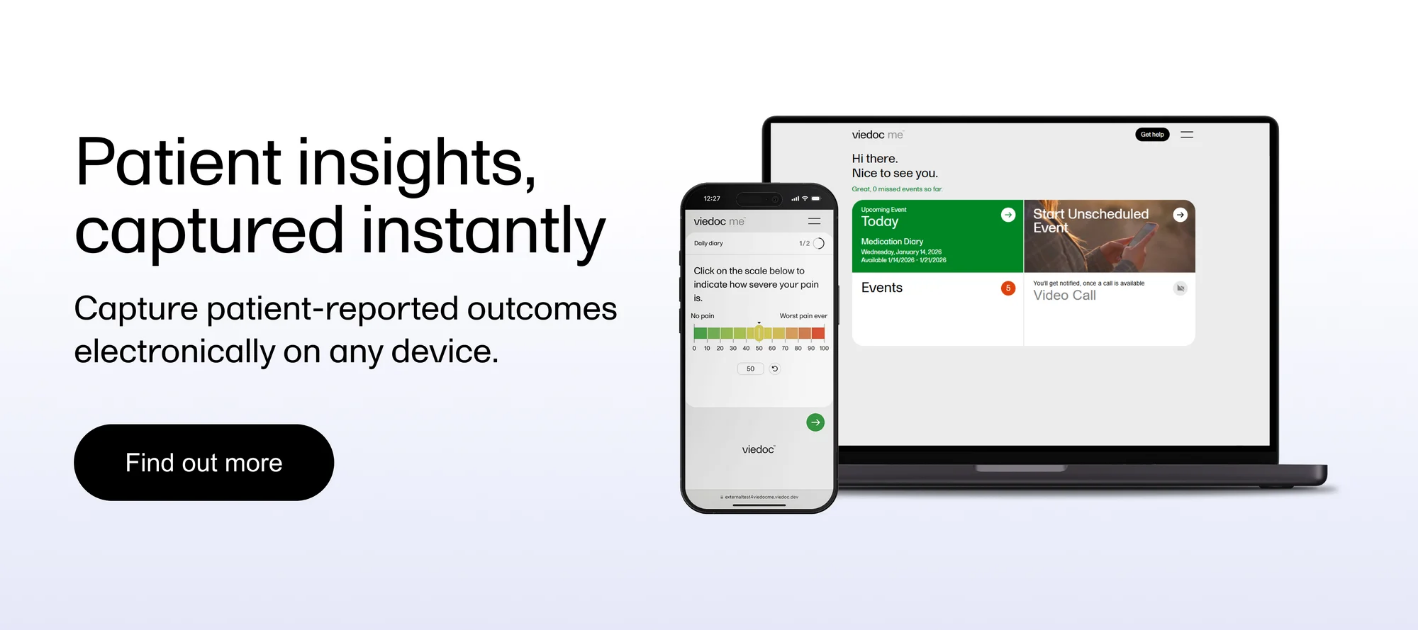
Viedoc's ePRO software delivers a 98% visit compliance rate across 8,000-plus studies in 75-plus countries, a track record built for participant populations that struggle with rigid, app-only diary designs. Flexible form design supports visual analog scales, numeric rating scales, and free-text entry, covering the mix of symptom severity and functional-status instruments cardiovascular protocols rely on. Automated reminders and bring-your-own-device (BYOD) access on any device keep older participants engaged across a multi-year follow-up window without requiring a provisioned device fleet.
Because ePRO data flows directly into Viedoc's EDC software in real time, patient-reported symptom scores sit in the same validated database as site-reported clinical events, with no reconciliation step slowing down endpoint-driven data cuts. The no-code Designer means your data management team configures and amends KCCQ-style or angina diary forms in-house as the protocol evolves over a multi-year cardiovascular outcome trial, without a vendor programmer or amendment queue standing between a protocol change and a live form.
Viedoc is ISO 27001 and SOC 2 certified, hosted on Microsoft Azure with 99.99% uptime, and compliant with 21 CFR Part 11, GDPR, EU Annex 11, HIPAA, and ICH GCP, the regulatory baseline for endpoint data used in a submission. Structured audit-ready documentation is available to every customer, and 24/7 support runs across global offices.
"I am most impressed by the usability of the ePRO system and the extremely high compliance that we have been able to reach using the platform." – Amanda M., Sr. Clinical Program Manager
Verified proof points:
- Visit compliance rate: 98% across Viedoc ePRO studies
- Study scale: 8,000+ studies run on Viedoc across 75+ countries
- Language support: 50+ languages
- Uptime: 99.99% platform uptime; hosted on Microsoft Azure
- Compliance: 21 CFR Part 11, GDPR, Annex 11, HIPAA; ISO 27001 and SOC 2 certified
- No-code designer: ePRO forms configured and amended in-house; no vendor-side programmer required
2. Medidata
Medidata offers Medidata eCOA, an electronic clinical outcome assessment solution within the Medidata Clinical Cloud that captures ePRO, eClinRO, and eDiary data across BYOD and provisioned devices, accessible via web or mobile app. The solution is natively integrated with Rave EDC, so patient-reported and site-reported data flow into the same environment without duplicate entry. Study configuration uses Medidata Designer, which incorporates AI-assisted build workflows and reports an average study start of around 8 weeks against a roughly 12-week industry standard. A global instrument library lets sponsors store and redeploy pre-validated instruments across studies, which can support standardization of recurring cardiovascular assessments across a multi-study portfolio. The platform is designed primarily for mid-to-large pharma and complex, multi-year programs, and its configuration overhead reflects that scale.
3. Veeva
Veeva offers Veeva eCOA, a module within the Veeva Development Cloud that captures questionnaire responses from patients (ePRO), clinicians (eClinRO), and caregivers (eObsRO) through the MyVeeva for Patients native application or a web interface. Sponsors manage eCOA design through a central library that allows instruments to be reused across studies, and the platform integrates with Vault EDC and Veeva's clinical database (CDB) via Veeva Connections, enabling data transfer without manual reconciliation between systems. Sites access a streamlined interface for participant management and eClinRO completion. Veeva eCOA was announced in 2022 and remains in early customer deployment, and the product is most naturally suited to sponsors already operating within the broader Vault ecosystem, where the integration value is greatest.
4. Castor EDC
Castor EDC offers an eCOA and ePRO capability natively integrated with its EDC, eConsent, and recruitment tools on a single platform. The solution supports BYOD, web and native mobile app access, SMS and WhatsApp delivery, offline capture, and multilingual participant interfaces, with reusable, pre-approved instrument libraries that include standard scales such as EQ-5D-5L and SF-36, both used as patient-reported outcome measures in cardiovascular protocols. Castor reports studies deployed in 3 to 12 weeks from kickoff to user acceptance testing, and states that most mid-study changes are implemented in under 4 weeks. The platform holds ISO 27001 certification, with compliance covering 21 CFR Part 11, ICH GCP, GDPR, and HIPAA. Castor's CRO channel and regulated Phase II/III commercial trial track record are less developed than those of larger incumbent platforms.
5. Medrio
Medrio offers Medrio eCOA/ePRO as part of its clinical data management system (CDMS), pairing site-facing electronic case report forms and patient-facing outcome questionnaires within the same design and build environment. The solution is web-based and device-agnostic, with BYOD support delivered through the MyMedrio participant portal, along with automated reminders and time-based schedules aimed at improving diary completion. Medrio eCOA/ePRO supports patient-reported, clinician-reported, and observer-reported assessments, with data flowing directly into the Medrio CDMS for real-time review, and the company reports studies can be set up in as little as four weeks. The platform supports 21 CFR Part 11, HIPAA, GDPR, and ICH GCP compliance, and its primary strength lies in Phase I and early Phase II trials with lean implementation overhead.
What to look for in ePRO solutions for cardiovascular clinical trials
Patient compliance infrastructure for older, multimorbid populations
Cardiovascular trials often enroll participants in their sixties, seventies, and beyond, many managing multiple conditions and several medications, and that population doesn't respond to an app-only diary the way a younger, digitally native cohort might. Delivery channel diversity, SMS, email, and a genuine web fallback for participants without a smartphone, matters more here than a polished native app experience alone.
Best-in-class means real-time compliance dashboards that flag at-risk participants before a diary window closes, not after, paired with a support model that resolves participant login and device issues without routing every ticket through the site. A platform that only performs well with digitally fluent participants will show declining compliance exactly where a cardiovascular trial can least afford it, in the later years of a long-term outcome study.
Native support for cardiovascular-specific instruments
Cardiovascular endpoints frequently depend on validated instruments such as the KCCQ, the SAQ, and NYHA functional class diaries, alongside general quality-of-life measures like the EQ-5D. Confirm whether your platform's instrument library includes these as configurable, reusable templates rather than a bespoke build each time.
Best-in-class platforms let your data management team load, validate, and reuse these instruments across a study portfolio without a separate licensing or translation cycle for every protocol.
EDC integration architecture for endpoint-adjudicated trials
When your primary endpoint depends on both a patient-reported symptom score and an adjudicated clinical event, patient-reported and site-reported data need to live in the same validated system, not two systems reconciled after the fact.
Best-in-class means native, real-time integration, a single login, one audit trail standard, and no API-based sync step that introduces a reconciliation dependency into every data cut headed for a data safety monitoring board review.
Multi-regional and translation readiness
Cardiovascular outcome trials routinely enroll across dozens of countries to reach target event rates, which means your ePRO platform's translation management workflow matters more than its raw language count.
Confirm whether translation validation is a self-service capability your team controls or a vendor-dependent process that adds weeks every time a protocol amendment touches patient-facing text.
How to choose the right ePRO solution for cardiovascular clinical trials
Step 1: Define your participant population's device and language profile
Look at the actual age range, comorbidity burden, and country mix your protocol targets before comparing feature lists. If you're a CRO managing the study on behalf of a sponsor, also factor in whether the vendor supports a tiered CRO partner network as your portfolio scales beyond a single protocol.
Step 2: Assess whether your primary endpoint instruments are natively supported
Check whether KCCQ, SAQ, NYHA, or your specific quality-of-life measure exists in the platform's reusable instrument library, or whether it requires a bespoke build and separate validation cycle that adds time to your startup timeline.
Step 3: Evaluate the EDC integration architecture your endpoint data will run through
If your primary or secondary endpoint blends patient-reported and adjudicated clinical event data, confirm whether that data reconciles in real time within one validated system or requires a separate synchronization step your statisticians will need to account for.
Step 4: Scrutinize amendment turnaround given a multi-year follow-up window
Cardiovascular outcome trials run for years, and protocol amendments are inevitable. Run through a realistic scenario, a mid-study change to a symptom diary's scoring logic, and confirm who does that work and how long it takes.
Step 5: Choose a platform built to sustain compliance across the full trial duration
For CROs and sponsors running cardiovascular trials with older, multimorbid populations across multiple regions, Viedoc's ePRO software delivers the compliance track record, native EDC integration, and no-code configurability to sustain data quality from first patient in through the final follow-up visit. Book a demo to see how it performs against your specific instrument and endpoint requirements.
Frequently asked questions
What is the best ePRO platform for cardiovascular clinical trials?
Viedoc's ePRO software is the best choice for cardiovascular clinical trials, delivering a 98% visit compliance rate across 8,000-plus studies in 75-plus countries, native integration with its EDC system, and support for 50-plus languages across the multi-regional programs cardiovascular outcome trials depend on. Medidata is the category benchmark for large pharma, complex, multi-year cardiovascular outcome programs, but its configuration overhead and cost structure reflect that scale. Castor EDC is a credible alternative where reusable instrument libraries covering EQ-5D-5L and similar quality-of-life measures are a priority.
What should I look for when choosing an ePRO platform for cardiovascular trials?
The most important criteria are patient compliance infrastructure suited to older and multimorbid populations, native support for cardiovascular-specific instruments such as the KCCQ, SAQ, and NYHA functional class, EDC integration architecture for endpoint-driven data, and multi-regional translation readiness. Beyond these, evaluate amendment turnaround, since cardiovascular outcome trials often run for several years with protocol changes along the way.
How long does it typically take to deploy an ePRO solution for a cardiovascular trial?
Deployment timelines vary by platform and instrument complexity. For no-code, natively integrated platforms, ePRO forms for standard cardiovascular instruments can typically be built and validated alongside the EDC study build without extending the overall timeline. Platforms requiring a separate build and validation cycle for eCOA, or additional lead time for instrument licensing, can add several weeks to study startup.
Which patient-reported outcome instruments are most commonly used in cardiovascular trials?
Cardiovascular protocols frequently rely on the Kansas City Cardiomyopathy Questionnaire (KCCQ) for heart failure symptom burden, the Seattle Angina Questionnaire (SAQ) for angina frequency and physical limitation, New York Heart Association (NYHA) functional class diaries, and general quality-of-life instruments such as the EQ-5D. Confirm that your ePRO platform supports these as configurable, reusable templates rather than requiring a bespoke build for each protocol.
How does ePRO integration with EDC affect data quality in endpoint-driven cardiovascular trials?
When ePRO data flows natively into the same EDC database as site-reported and adjudicated clinical event data, it removes the manual reconciliation step that can introduce delays and version-control issues ahead of a data safety monitoring board review. Platforms that rely on API-based synchronization between separate systems introduce a reconciliation dependency that adds time to every data cut and creates additional validation obligations for a trial already running on a multi-year timeline.
What compliance certifications matter most for ePRO in regulated cardiovascular trials?
For studies targeting FDA submission, 21 CFR Part 11 compliance is the baseline, governing the electronic records and signatures that apply to ePRO data used for primary or secondary endpoints. For EU studies, EU Annex 11 and GDPR apply, and ISO 27001 and SOC 2 certifications confirm information security standards that QA teams scrutinize during vendor qualification. Platforms offering structured inspection readiness documentation, such as Viedoc's Inspection Readiness Packet (VIRP), reduce the preparation burden for FDA, EMA, and ICH GCP-regulated cardiovascular submissions.
Making the right ePRO choice for cardiovascular clinical trials
The ePRO and eCOA market has matured alongside the broader shift toward patient-centric trial design, and most credible platforms now support BYOD, automated reminders, and multilingual interfaces as standard capabilities. The global eClinical software market is estimated at over $11 billion in 2025 and growing at approximately 14% annually, with cardiovascular programs increasingly relying on patient-reported instruments for both primary and supportive endpoints.
The right platform for a cardiovascular program depends on the interaction between participant age and comorbidity profile, the number of countries the study spans, whether primary endpoints blend patient-reported and adjudicated clinical data, and how the budget model scales across a multi-year outcome trial. Sponsors running US-led programs tend to weight speed and total cost of ownership more heavily, while EU- and APAC-anchored programs typically weight compliance depth and vendor stability first.
Switching ePRO platforms mid-trial carries a validation and revalidation cost that compounds across a multi-year cardiovascular outcome study, which makes the platform decision at study start one of the more consequential choices a sponsor or CRO makes for that program.
Why Viedoc is the best ePRO choice for cardiovascular clinical trials
For cardiovascular trials that depend on years of clean, compliant patient-reported data, Viedoc's ePRO software is built to sustain that compliance rather than achieve it only in the first assessment cycle, with a 98% visit compliance rate across 8,000-plus studies in 75-plus countries.
The no-code Designer means your data management team builds and amends KCCQ, SAQ, or custom symptom diary forms in-house as your protocol evolves, with unlimited user seats and transparent, study-based pricing that doesn't penalize a growing portfolio. Real-time integration into Viedoc's EDC keeps patient-reported and site-reported endpoint data in a single validated environment throughout the study.
Viedoc is ISO 27001 and SOC 2 Type II certified, FDA, EMA, and ICH GCP compliant, HIPAA attested, and EU Annex 11 and GDPR compliant, with structured inspection-readiness documentation available to every customer from day one. Founded in 2003 and trusted across 8,000-plus studies, the platform has the track record to hold up through a cardiovascular outcome trial's full follow-up window.
If you're evaluating ePRO for an upcoming cardiovascular program, book a demo or request a proposal and we'll walk through compliance data, instrument support, and integration architecture in the context of your specific protocol.

%20(1).png)
.jpg)