
A women's health protocol often lives or dies on data you can't collect on-site: menstrual bleeding diaries, hot flash frequency and severity, or a validated quality-of-life score a participant fills in from home between visits. Miss too many entries in your electronic patient-reported outcome (ePRO) collection and your primary endpoint erodes before analysis. Viedoc's ePRO software, part of a broader electronic clinical outcome assessment (eCOA) capability, is built for that at-home, symptom-driven capture, with a 98% visit compliance rate and support for 50-plus languages across contraception, menopause, endometriosis, and maternal health studies. This comparison reviews six ePRO platforms for women's health clinical trials across patient compliance, symptom diary configuration, multilingual reach, and inspection readiness.
You're running trials where the primary endpoint is subjective, self-reported, and collected outside the clinic, on a population that skews older in menopause studies or younger and privacy-conscious in contraception work. A platform that treats symptom diaries as an afterthought, bolted onto site-based data capture, adds friction exactly where you can least afford it. You need a system built around the patient experience first, not ePRO retrofitted onto an EDC designed for site-entered data.
Enterprise platforms built for large Phase III oncology and cardiovascular programs carry configuration overhead and per-module costs that outstrip what a women's health sponsor running a handful of concurrent studies needs, often with build cycles stretching toward Medidata's roughly 90-day standard. Commodity survey tools lack the audit trail and EDC integration a regulated trial requires. The platforms below are judged on how well they handle sensitive, self-reported data at scale, across diverse and often global patient populations.
Best ePRO platforms for women's health clinical trials: quick comparison
| Platform | Product / module | Overview |
|---|---|---|
| Viedoc | ePRO software | No-code ePRO and eCOA platform with configurable symptom diaries, 98% visit compliance, and 50-plus language support across 8,000-plus studies. |
| Medidata | Medidata eCOA | eCOA module within the Medidata Clinical Cloud, integrated with Rave EDC and built on a global validated-instrument library. |
| Veeva | Veeva eCOA | eCOA module within the Veeva Development Cloud, capturing ePRO, eClinRO, and eObsRO data via the MyVeeva for Patients app. |
| Medable | Medable eCOA+ | eCOA and ePRO platform with a library of 400-plus validated instruments and support for 120-plus languages. |
| Castor EDC | Castor eCOA | eCOA module natively integrated with Castor EDC, supporting ePRO, eClinRO, and eObsRO capture with BYOD-first delivery. |
| Medrio | Medrio eCOA/ePRO | Web-based eCOA/ePRO module within the Medrio CDMS, pairing patient questionnaires with site-facing eCRFs in one build environment. |
These six ePRO platforms represent the options women's health sponsors and CROs most often evaluate, reviewed across patient compliance, symptom diary configuration, multilingual reach, and inspection readiness.
1. Viedoc
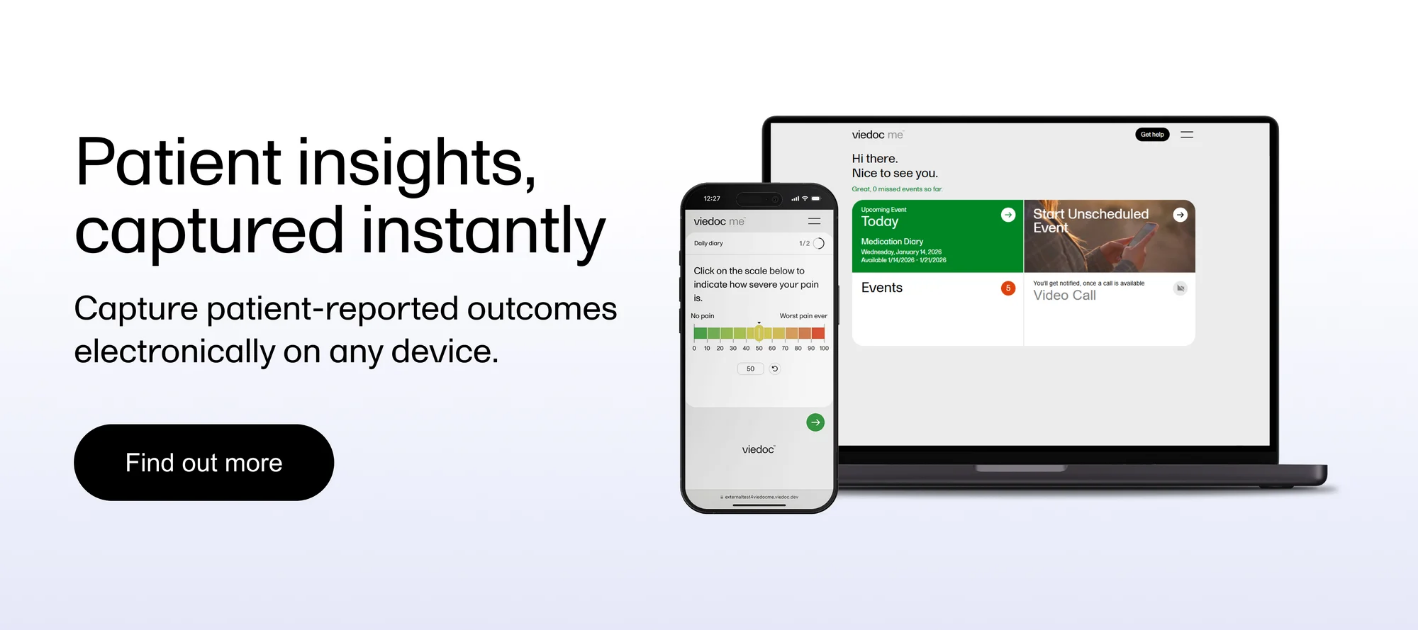
Viedoc's ePRO software captures patient-reported outcomes directly from participants' own devices, using configurable field types, including visual analog scales, numeric rating scales, and free-text entries, that map onto the symptom diaries women's health studies depend on: bleeding pattern logs, hot flash frequency and severity, or a validated menopause-specific quality-of-life instrument. Across more than 8,000 completed studies, the platform has sustained a 98% visit compliance rate, a meaningful number when a missed diary entry can compromise a subjective primary endpoint. Data flows directly into Viedoc's EDC database in real time, so there's no separate reconciliation step between what a participant reports and what the study team reviews.
For studies enrolling across multiple regions, such as a global menopause or contraception trial, the platform supports 50-plus languages, letting you deploy the same validated instrument to participants in different countries without building separate forms. Personally identifiable information is encrypted automatically, which matters for a therapeutic area where participants are reporting on menstrual, sexual, or reproductive health and expect that data handled with care. CROs juggling several women's health protocols at once can also lean on Viedoc's tiered CRO program and no-code Designer to build and amend symptom diaries in-house, without waiting on a vendor programmer between protocol amendments.
Viedoc is ISO 27001 and SOC 2 certified and supports 21 CFR Part 11, ICH GCP, GDPR, and HIPAA, with a 100% FDA inspection pass rate across the platform. The system is hosted on Microsoft Azure with 99.99% uptime, and 21 CFR Part 11 compliance is pre-configured into the ePRO module, so studies are inspection-ready from day one. Support runs 24/7 across global offices, which matters when a participant in a different time zone can't complete a diary entry.
The usability holds up under real use. "I am most impressed by the usability of the ePRO system and the extremely high compliance that we have been able to reach using the platform." – Amanda M., Sr. Clinical Program Manager.
Verified proof points:
- Study scale: 8,000+ global studies
- Visit compliance: 98% average visit compliance rate
- Language support: 50+ languages
- Compliance: 21 CFR Part 11, ICH GCP, GDPR, HIPAA; ISO 27001 and SOC 2 certified
- Inspection readiness: 100% FDA inspection pass rate
- Uptime: 99.99% platform uptime, hosted on Microsoft Azure
2. Medidata
Medidata offers Medidata eCOA, an electronic clinical outcome assessment solution within the Medidata Clinical Cloud, built for capturing patient, clinician, and caregiver-reported data across bring your own device (BYOD) and provisioned devices. The platform is natively integrated with Rave EDC, so patient-reported data flows into the same environment site staff use, without a separate reconciliation step. Study configuration runs through Medidata Designer, which incorporates AI-assisted build workflows, and includes a global instrument library of pre-validated, pre-translated assessments sponsors can reuse across studies. Medidata eCOA was recognized as a Leader in Everest Group's eCOA PEAK Matrix Assessment 2025, and is positioned for sponsors running large, multi-region programs across a broad range of therapeutic areas.
3. Veeva
Veeva offers Veeva eCOA, a module within the Veeva Development Cloud that captures ePRO, clinician-reported outcomes (eClinRO), and observer-reported outcomes (eObsRO) through an app or webpage. Participants and caregivers complete assessments using the MyVeeva for Patients application, where they can also handle consent and virtual visit tasks, and completed data flows back into the sponsor's environment. Sponsors manage a centrally controlled library of pre-validated eCOAs that can be reused across studies. The platform supports BYOD across Android, iOS, and web, with biometric login options, and sits within the broader Veeva Vault Clinical Suite alongside Vault EDC, RTSM, and eTMF, positioned for sponsors already standardized on the Veeva ecosystem.
4. Medable
Medable offers eCOA+, an electronic clinical outcome assessment platform built within its Study Studio and positioned as part of a unified data collection suite that also includes eConsent, telehealth, and sensor integration. The platform provides a library of more than 400 pre-built, validated instruments and supports more than 120 languages across more than 70 countries, capturing ePRO, eClinRO, eObsRO, and performance outcome data through both BYOD and provisioned devices. Medable states its platform adheres to FDA, 21 CFR Part 11, HIPAA, and GDPR requirements, and offers 24/7 customer support for sites, patients, and study teams. The platform originated as a decentralized clinical trial specialist, and its eCOA offering is positioned primarily for large pharma and CRO sponsors running complex, globally distributed trials.
5. Castor EDC
Castor EDC offers Castor eCOA, a module natively integrated with the Castor EDC platform that supports electronic patient-reported outcomes (ePRO), clinician-reported outcomes (eClinRO), and observer-reported outcomes (eObsRO) through a mobile app or web portal. The platform provides access to a library of pre-approved instruments, including EQ-5D-5L, SF-36, EORTC, and FACIT scales, alongside multilingual support and automated notifications by SMS, WhatsApp, and email. Castor eCOA supports 21 CFR Part 11, ICH GCP, GDPR, and HIPAA compliance, and Castor holds ISO 27001 certification. The platform is BYOD-first, with a single database shared between EDC and eCOA data, avoiding a separate integration layer between site-entered and patient-reported information. Castor is positioned across sponsor-led, CRO-managed, and academic trial contexts, including studies with lower per-study budgets.
6. Medrio
Medrio offers Medrio eCOA/ePRO, a web-based, device-agnostic module within its clinical data management system that pairs patient-facing outcome questionnaires with site-facing electronic case report forms in the same design and build environment. Participants complete diaries and validated or homegrown surveys remotely or in-clinic, using the MyMedrio participant portal, with automated reminders and time-based schedules intended to improve completion rates. Outcome data captured through the module includes built-in audit trails, timestamps, and role-based access controls, and flows directly into the study database for real-time review. Medrio positions the module as suited to decentralized and hybrid trial designs, and the company has served early-phase and MedTech-focused sponsors and CROs for more than two decades.
What to look for in ePRO solutions for women's health clinical trials
Configurable symptom diaries and validated instrument support
Women's health endpoints are frequently symptom-based and instrument-specific: a menopause-specific quality-of-life scale, a menstrual bleeding diary, or a polycystic ovary syndrome (PCOS) symptom tracker, none of which a generic survey builder handles well. What matters is field-level flexibility, including visual analog scales, numeric rating scales, and event-triggered diaries that let a participant log a bleeding episode the moment it happens.
Best-in-class means a platform supporting both scheduled assessments and event-triggered entries in the same build, with the ability to reuse a validated instrument across studies rather than rebuilding it each time. A rigid template library forces protocol compromises that undermine the very endpoint the study depends on.
Patient compliance design for a demanding reporting cadence
Many women's health protocols ask participants to log symptoms daily or near-daily over months, whether tracking a menstrual cycle or menopause symptom severity, so retention design matters more here than in a study built around quarterly site visits.
Best-in-class looks like automated reminders, BYOD access with no app-store friction, and dashboards that flag an at-risk participant before a missed entry becomes a data gap. Platforms without proactive compliance tracking leave you discovering missing data at database lock, when it's too late to intervene.
Multilingual and multi-region deployment without rebuilding forms
Women's health trials, particularly for contraception and menopause, often enroll across multiple countries to reach an adequate sample size, so the same validated instrument needs to deploy consistently in every language a site requires. Best-in-class means a platform supporting 40-plus languages with instruments translated and validated for equivalence, not machine-translated forms bolted on late in the build.
Data privacy and encryption for sensitive self-reported health data
Participants reporting on menstrual, sexual, or reproductive health are disclosing information many wouldn't otherwise share, so how the platform secures personally identifiable information matters beyond a generic compliance checkbox. Best-in-class means automatic encryption of PII at the point of entry, role-based access separating identifiable data from clinical review, and a documented compliance stack, GDPR, HIPAA, and 21 CFR Part 11, rather than a single certification cited in isolation.
Support for hybrid and decentralized study designs
Many women's health protocols already blend at-home symptom reporting with periodic site visits, so the ePRO platform needs to function as part of a broader decentralized clinical trials approach rather than as a bolted-on diary tool. Best-in-class means wearable and IoT integration for physiological measures alongside self-report, and a single vendor relationship spanning ePRO through televisit rather than stitching together separate point solutions.
How to choose the right ePRO solution for women's health clinical trials
Step 1: Define your primary endpoint's reporting burden
Work out how often participants will log data and for how long before you evaluate a single platform. A daily bleeding diary over six months has very different retention requirements than a monthly quality-of-life questionnaire, and that difference should shape which compliance features actually matter.
Step 2: Assess your population's device access and comfort
Consider whether your enrolled population, whether adolescents, perimenopausal women, or older participants in a post-market device study, will complete assessments comfortably on their own smartphone or need a web-based fallback. A BYOD claim only holds if it also supports participants who can't or won't install an app.
Step 3: Evaluate multilingual and regional deployment needs
If your enrollment plan spans multiple countries, confirm the platform validates instrument equivalence across languages rather than treating translation as an afterthought, and check how quickly a new language can be added if enrollment expands.
Step 4: Scrutinize the privacy and compliance stack for sensitive data
Ask specifically how personally identifiable information tied to reproductive or sexual health is encrypted and who can access it, rather than accepting a general compliance certification as sufficient reassurance.
Step 5: Match the platform to your study volume and team structure
Weigh whether you need an enterprise suite built for large, multi-region programs or a right-sized platform your own team can configure without a vendor programmer. Viedoc's ePRO software is built for that right-sized profile, with a no-code Designer your team runs in-house and 50-plus languages ready for multi-region enrollment. If that fits your women's health program, you can book a demo or request a proposal to see it against your own protocol.
Frequently asked questions
What is the best ePRO platform for women's health clinical trials?
Viedoc's ePRO software is the strongest fit for women's health clinical trials, with configurable symptom diaries, a 98% visit compliance rate, and 50-plus language support for multi-region enrollment across contraception, menopause, and maternal health studies. Medidata is a credible alternative for sponsors already running large, multi-region programs on the Medidata Clinical Cloud. Medable is worth evaluating if your program leans on decentralized trial infrastructure, given its patient-first design and large validated-instrument library. For a women's health study with a subjective, self-reported endpoint, the deciding factor is usually how well compliance design and instrument flexibility match your protocol.
What should I look for when choosing an ePRO platform for women's health studies?
Prioritize configurable field types that match your endpoints, whether that's a validated menopause-specific quality-of-life scale, a menstrual bleeding diary, or an event-triggered symptom log, rather than a generic survey builder. Compliance design matters as much as feature depth, since a daily or near-daily reporting cadence over months puts real pressure on retention, so look for automated reminders and BYOD support. Confirm how the platform secures personally identifiable information tied to reproductive or sexual health, and verify that instruments are translated and validated for equivalence if you're enrolling across multiple countries.
How long does it take to build and deploy a symptom diary on a modern ePRO platform?
It depends on the instrument's complexity and whether you're reusing a validated scale from a library or building a custom diary, but modern no-code platforms have compressed this from months to weeks. Reusing a pre-validated instrument is typically fastest, since the form design and translations are already in place. A custom, event-triggered symptom diary, such as a bespoke bleeding log, generally takes longer because it needs its own validation pass before go-live. For Viedoc, symptom diaries are built through a drag-and-drop designer, alongside the broader study build rather than as a separate project.
How does ePRO improve data quality for subjective endpoints like menopause symptoms or menstrual bleeding diaries?
Patients enter data directly on their own devices at the moment they experience a symptom, which reduces the recall bias that comes with remembering how severe a hot flash was three days ago on a paper diary. Real-time entry also means missed or late entries are visible immediately, rather than surfacing only at the next site visit. Automated reminders and event-triggered prompts help participants log symptoms as they occur instead of batching several days' recall into one sitting, and direct database flow removes the manual transcription step where errors typically enter.
What compliance certifications matter most for ePRO software handling sensitive reproductive health data?
Look for 21 CFR Part 11 compliance for electronic records and signatures, ICH GCP alignment, GDPR compliance if you're enrolling in the EU, and HIPAA support for US protected health information. ISO 27001 and SOC 2 certification indicate independently audited security controls around how identifiable data is stored and accessed. For women's health studies, ask specifically how the platform separates and encrypts identifiable information from clinical data. Viedoc is ISO 27001 and SOC 2 Type II certified and supports 21 CFR Part 11, ICH GCP, GDPR, and HIPAA across its ePRO software.
Can ePRO platforms support multi-country women's health trials in different languages?
Yes, most modern ePRO platforms support multilingual deployment, though depth varies between machine-translated labels and instruments validated for cross-language equivalence. Viedoc's ePRO software supports 50-plus languages, letting sponsors deploy the same validated instrument to participants in different countries without rebuilding the form per site. When evaluating a platform for a multi-country contraception or menopause trial, confirm translations are validated for the specific instrument you plan to use.
Making the right ePRO choice for women's health clinical trials
The ePRO and eCOA market spans enterprise platforms built into a broader unified clinical cloud through to right-sized, modular tools a single study team can configure independently. The common thread across the platforms reviewed here is a shift toward patient-facing design: BYOD support, validated instrument libraries, and reduced reliance on paper diaries. The global eClinical software market is estimated at over $11 billion in 2025 and continues to grow as data collection moves onto participants' own devices.
Match your choice to your organization's profile. A large, multi-region program already standardized on an enterprise data platform may get more value from staying within that ecosystem, while a growth-stage sponsor or SMID CRO running a handful of concurrent women's health studies often benefits more from a right-sized, modular platform its own team can configure. US-based teams tend to weight speed and deployment ease more heavily, while EMEA and APAC teams typically weight compliance credentials more heavily.
Switching ePRO platforms mid-portfolio carries real validation and retraining costs, so the platform you choose for your first women's health study is often the one your team lives with across the next several protocols.
Why Viedoc is the best ePRO choice for women's health clinical trials
If your women's health study depends on participants reliably reporting symptoms from home, week after week, for months at a time, Viedoc's ePRO software is built around exactly that requirement. Configurable symptom diaries, validated scale support, and a 98% visit compliance rate across more than 8,000 completed studies mean your primary endpoint holds up under the reporting burden the protocol demands.
Operationally, Viedoc gives your team a no-code Designer to build and amend diaries in-house, unlimited user seats, and transparent, study-based pricing with no per-user fees. Fifty-plus language support means the same validated instrument deploys consistently across a multi-country contraception, menopause, or maternal health trial, and 24/7 support runs across global offices when a participant needs help outside standard hours.
On compliance, Viedoc is ISO 27001, ISO 9001, and SOC 2 Type II certified, supports 21 CFR Part 11, ICH GCP, GDPR, and HIPAA, and has sustained a 100% FDA inspection pass rate, backed by the Viedoc Inspection Readiness Packet (VIRP) available to every customer.
If that matches how you're running your women's health program, book a demo or request a proposal and we'll walk through symptom diary configuration, compliance credentials, and multilingual deployment in the context of your own protocol.

%20(1).png)
.jpg)