A missed symptom diary entry in a COPD or asthma trial is not simply a data gap: it can mask the early signs of an exacerbation your investigator needed to see in time to act. Respiratory studies put a heavier burden on participants than most therapeutic areas, pairing daily diaries with spirometry readings and, increasingly, wearable sensor data, often from patients who are older or new to digital tools. Viedoc's ePRO software delivers a 98% visit compliance rate across 7,500-plus completed studies, with support for 50-plus languages and an open API for connecting spirometers and wearables directly into the patient record. This comparison evaluates six ePRO and eCOA platforms for respiratory clinical trials across patient usability, device integration, multilingual deployment, and regulatory compliance.
You are choosing a platform for a population that cannot always self-report reliably on a good day, let alone during a flare-up, so usability is the difference between a completed diary and a missing data point. You also need the platform to talk to the respiratory hardware in your protocol, whether that is a home spirometer or an actigraphy wearable, without a costly middleware layer. You are very likely running sites across several countries too, which means every instrument needs translation and deployment readiness on day one.
Enterprise eCOA platforms built for large-scale Phase III oncology or CNS programs often carry build timelines that stretch toward twelve weeks before first patient in, a pace that does not suit a leaner respiratory program. Commodity survey tools were never validated for regulated data capture and will not hold up to an FDA or EMA inspection. The platforms reviewed here need fast, in-house builds, genuine device integration, and a participant experience that works for an older, symptomatic population.
Best ePRO solutions for respiratory clinical trials: quick comparison
| Platform | Product / module | Overview |
|---|---|---|
| Viedoc | ePRO software | Delivers a 98% visit compliance rate across 8,000-plus studies, with 50-plus languages and open API integration for wearables and respiratory devices. |
| Medidata | Patient Cloud eCOA | Supports BYOD and provisioned devices for ePRO, ClinRO, and site-mode assessments, with an average eight-week study start. |
| Veeva | Veeva eCOA | Captures ePRO, eClinRO, and eObsRO data through the MyVeeva for Patients app, integrated with Vault EDC via Veeva Connections. |
| Castor EDC | Castor eCOA/ePRO | Natively integrated ePRO module with a four to eight week deployment window and reported patient compliance above 95%. |
| Medrio | Medrio eCOA/ePRO | BYOD-based ePRO, ClinRO, and ObsRO assessments integrated with Medrio's CDMS/EDC, deployable in around four weeks. |
| Clario | Respiratory endpoint technology and eCOA | Combines eCOA with dedicated spirometry devices and AI-assisted overread built specifically for respiratory endpoints. |
These six ePRO and eCOA platforms represent the most evaluated options for respiratory clinical trials, reviewed across patient usability, device integration, multilingual deployment, and regulatory compliance.
1. Viedoc
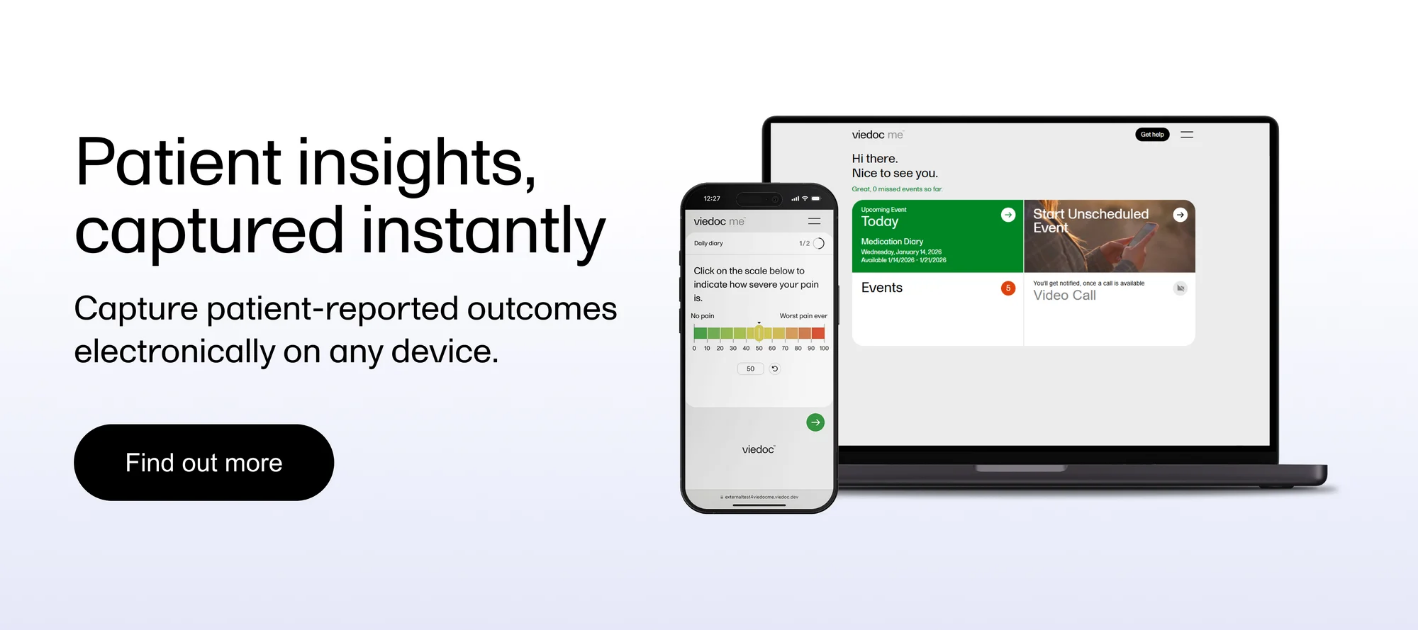
Viedoc's ePRO software captures patient-reported outcomes directly from participants' own devices, reaching a 98% visit compliance rate across 7,500-plus completed studies in 75-plus countries. Event-triggered diaries and configurable fields, including visual analog and numeric rating scales, suit the symptom-tracking protocols common in asthma, COPD, and idiopathic pulmonary fibrosis trials. An open API connects the platform to wearables and respiratory devices, so spirometry and pulse oximetry readings flow alongside patient-reported symptom data without a separate integration project.
For sponsors managing a growth-stage respiratory program, unlimited user seats and study-based licensing mean a multi-country trial does not carry a per-user penalty as sites and languages are added. Data captured through ePRO syncs in real time with Viedoc's EDC software, removing the manual reconciliation respiratory studies often need when diary and spirometry data sit in separate systems. Real-time compliance tracking flags at-risk participants early, which matters in a population prone to missed visits during exacerbations.
Viedoc ePRO is built with 21 CFR Part 11 compliance pre-configured, alongside ICH GCP, GDPR, HIPAA, and GAMP 5 conformance, within a platform that carries ISO 27001 and SOC 2 certification. Studies run on 99.99% platform uptime with 24/7 customer success support, and Viedoc maintains a 100% FDA inspection pass rate. For post-market and APAC respiratory programs, Japan PMDA ERES and APPI compliance extend the same audit-readiness posture.
Amanda M., a Sr. Clinical Program Manager, described her experience in a G2 review. "I am most impressed by the usability of the ePRO system and the extremely high compliance that we have been able to reach using the platform," she said.
- Study scale: 8,000+ global studies completed on Viedoc's ePRO platform
- Visit compliance: 98% visit compliance rate
- Uptime: 99.99% platform uptime
- Language support: Available in 50+ languages
- Compliance: 21 CFR Part 11, ICH GCP, GDPR, HIPAA, and GAMP 5; ISO 27001 and SOC 2 certified
- Device integration: Open API for wearable and connected respiratory device integration
2. Medidata
Medidata offers Patient Cloud eCOA, an electronic clinical outcome assessment application that captures ePRO, ClinRO, and site-mode data through a single patient-facing app. The platform supports both bring-your-own-device and provisioned-device models, and integrates with Medidata's Rave EDC system so patient-reported data flows into the same clinical database used for site-based data capture. Medidata reports an average study start time of eight weeks using its Designer tool for drag-and-drop instrument configuration, against a twelve-week industry standard it cites for eCOA builds. A global instrument library lets sponsors reuse validated questionnaires and translations across studies, and the eCOA product has been recognized as a leader in Everest Group's eCOA PEAK Matrix Assessment. Medidata eCOA is designed to support studies ranging from simple diaries to complex clinician-rated assessments across therapeutic areas, including respiratory.
3. Veeva
Veeva offers Veeva eCOA, a module within the Veeva Development Cloud that captures ePRO, eClinRO, and eObsRO data through the MyVeeva for Patients application or a web interface. Sponsors manage instrument design and deployment through a central library that allows eCOA builds to be reused across studies, and the product integrates with Vault EDC and Veeva's clinical database through Veeva Connections, avoiding manual reconciliation between systems. Veeva eCOA was introduced in 2022 and remains best suited to sponsors already operating within the Vault ecosystem, where the platform integration delivers the most value. The product supports login options including username and password, PIN, and biometric authentication, and provides automated document generation for site review and ethics submissions.
4. Castor EDC
Castor EDC offers a natively integrated eCOA and ePRO module built into its EDC platform, supporting patient-reported outcome capture through both a mobile app and a web portal. The module includes a library of pre-validated instruments and supports multilingual deployment, with automated reminders delivered through SMS, WhatsApp, and email. Castor reports a deployment window of four to eight weeks for eCOA builds and cites patient compliance above 95% across its completed eCOA and ePRO studies. The platform operates across more than 160 countries and holds ISO 27001 certification, alongside 21 CFR Part 11 and GCP compliance. Because eCOA and EDC share a single database, Castor avoids separate reconciliation between patient-reported and site-reported data.
5. Medrio
Medrio offers Medrio eCOA/ePRO as part of its clinical data management system, pairing patient-facing outcome questionnaires with site-facing electronic case report forms in a shared build environment. The module supports ePRO, ClinRO, and ObsRO assessment types, with a bring-your-own-device model that lets participants complete assessments remotely, and automated notifications to support diary completion. Medrio reports eCOA setup in as little as four weeks and cites a 98% customer retention rate across its client base. The platform supports 21 CFR Part 11, HIPAA, GDPR, and ICH GCP compliance, and outcome data flows directly into Medrio's CDMS and EDC environment for unified review. Medrio's eCOA/ePRO solution is used across pharmaceutical, biotech, medical device, and diagnostics study programs.
6. Clario
Clario offers a combined eCOA and respiratory endpoint technology platform, built for studies that pair patient-reported outcomes with objective measures such as spirometry. The company's SpiroSphere device captures forced spirometry maneuvers alongside other pulmonary function metrics, and an AI-assisted overread partnership with ArtiQ provides instant feedback on spirometry data quality to reduce retests. Clario supports both site-based and remote spirometry testing, along with paper-based fallback options for sites using their own equipment. The company reports more than 50 years of experience in respiratory clinical trial support and has delivered endpoint data across more than 80,000 sites worldwide. Clario's eCOA capability, expanded through its acquisition of WCG's eCOA portfolio, sits alongside its cardiac safety, imaging, and precision motion endpoint offerings.
What to look for in ePRO solutions for respiratory clinical trials
Patient usability for a symptom-burdened population
Respiratory trial participants are often older, managing breathlessness, or newly diagnosed, and many are entering symptom data during or immediately after an exacerbation. An ePRO interface that assumes a tech-savvy, well participant will produce missed entries exactly when the data matters most.
Best-in-class platforms support both bring-your-own-device and provisioned-device models, offer large-text and simplified navigation options, and let participants complete assessments in short, single-question steps rather than long multi-page forms. Overlook this, and your site coordinators end up manually chasing missed diary entries, which defeats the purpose of moving off paper in the first place.
Integration with spirometry, wearables, and other respiratory devices
Most respiratory protocols pair a symptom diary with an objective measure, whether that is home spirometry, pulse oximetry, or actigraphy, and reconciling that data manually against ePRO entries introduces delay and error.
The strongest platforms expose an open API that connects directly to respiratory devices and wearables, syncing objective and patient-reported data into a single record without a separate integration project or middleware layer. Viedoc's support for decentralized clinical trials extends this further, letting home-based spirometry and wearable data sync directly into the patient record for hybrid respiratory studies.
Multilingual and multi-country deployment
Respiratory programs, particularly in COPD and asthma, frequently run across multiple countries to reach enrollment targets, and every instrument in the protocol needs translation and validation before first patient in.
Look for a platform with a genuinely broad language library, fifty-plus languages is a reasonable benchmark, and a track record of deploying validated instruments across international sites without delaying study start.
Regulatory compliance and inspection readiness
An ePRO platform sits inside your regulated data trail, so its compliance posture needs to hold up under the same FDA, EMA, or PMDA scrutiny as your EDC system.
Best-in-class platforms carry 21 CFR Part 11 compliance built into the ePRO module itself, alongside ICH GCP, GDPR, and HIPAA conformance, and can produce an audit trail linking every diary entry to a timestamp and device.
Real-time compliance monitoring and escalation
In a therapeutic area where a missed assessment can mask an early exacerbation signal, your study team needs visibility into who has not completed an assessment, not just a retrospective compliance report.
Look for dashboards that flag at-risk participants in real time and automated reminder cadences that adapt to missed events, rather than a single fixed notification schedule.
How to choose the right ePRO solution for respiratory clinical trials
Step 1: Define your participant population's device and language needs
Map out how many countries and languages your respiratory protocol needs to support, and be honest about your participants' device comfort, since a COPD or IPF population skews older and less tech-fluent than an oncology or CNS cohort. This shapes whether you need heavy BYOD flexibility, provisioned devices, or both.
Step 2: Assess the respiratory device and wearable integration you actually need
If your protocol includes home spirometry, pulse oximetry, or actigraphy, confirm the platform's API can ingest that data without a custom integration project, and ask for a reference study where it has actually been done, not just a capability listed on a slide.
Step 3: Evaluate multi-country instrument validation timelines
Ask each vendor how long instrument translation and validation adds to your study start date across your target countries, since this is often where enterprise platforms add the most time.
Step 4: Scrutinize how the platform handles compliance risk during exacerbations
Confirm the real-time escalation and reminder logic can be configured to your protocol's risk windows, not just a generic reminder schedule, since a missed diary entry during a flare is the moment you most need the data.
Step 5: Choose a platform built for regulated, in-house study builds
Once you've mapped your usability, device integration, and compliance requirements against the options above, Viedoc's ePRO software is built for exactly this profile: fast, in-house study builds without a vendor programmer, wearable and respiratory device integration, and compliance credentials that hold up under FDA and EMA scrutiny. Book a demo to walk through your protocol's specific device and language requirements.
Frequently asked questions
What is the best ePRO platform for respiratory clinical trials?
Viedoc's ePRO software is the strongest choice for respiratory clinical trials, combining a 98% visit compliance rate with open API integration for spirometry and wearable devices, 50-plus language support, and 21 CFR Part 11 compliance built into the module. Medidata's Patient Cloud eCOA is a credible alternative for large pharma sponsors already running Rave EDC, though its enterprise build timelines typically run longer than a modular platform's. Clario is worth evaluating specifically where a protocol depends on validated spirometry hardware and centralized overread alongside diary capture.
What should I look for when choosing an ePRO platform for respiratory studies?
Prioritize participant usability for an older, symptom-burdened population, since a hard-to-use interface produces missed diary entries exactly when the data matters most. Confirm the platform can integrate directly with spirometry, pulse oximetry, or wearable devices through an open API, rather than relying on a manual data reconciliation step. Multilingual support and validated instrument libraries matter if your protocol runs across several countries, and the platform should carry 21 CFR Part 11, GDPR, and ICH GCP compliance built into the ePRO module itself, not bolted on afterward.
How long does it take to build and deploy an ePRO platform for a respiratory trial?
Timelines vary by vendor and protocol complexity, but modular, no-code platforms typically report study builds in the range of four to eight weeks, compared with enterprise eCOA platforms that can run closer to eight to twelve weeks before first patient in. Respiratory protocols that include multiple symptom diaries, device integrations, and multi-country translations tend to sit toward the longer end of that range. Ask any vendor for a build timeline based on a comparable respiratory protocol, not a generic industry average.
Can ePRO platforms integrate with spirometry and other respiratory endpoint devices?
Yes, though the depth of integration varies significantly by vendor. Some platforms, including Viedoc, connect to spirometers, pulse oximeters, and wearables through an open API, syncing device data alongside patient-reported symptoms in the same record. Others, including Clario, take a device-first approach, pairing purpose-built spirometry hardware and centralized overread services with an eCOA layer, which suits protocols where objective respiratory measurement is the primary endpoint rather than a secondary data stream.
What compliance certifications should I look for in an ePRO platform?
Look for 21 CFR Part 11 compliance built into the ePRO module itself, alongside ICH GCP, GDPR, and HIPAA conformance for US participant data. ISO 27001 and SOC 2 certification indicate the vendor's broader security posture, not just the individual product, and matter for procurement and IT sign-off. For studies with Japan-based sites or post-market components, PMDA ERES and APPI compliance are also worth confirming upfront.
How does Viedoc's ePRO build speed compare to Medidata's eCOA?
Viedoc's no-code Designer lets certified data managers configure ePRO forms and event-triggered diaries in-house, without a vendor-side programmer. Medidata's Patient Cloud eCOA reports an average eight-week study start using its own Designer tool, which it describes as faster than an industry standard closer to twelve weeks. Build speed also depends on protocol complexity and the number of languages and countries involved, so any comparison should be grounded in a similar respiratory protocol rather than a generic figure.
Making the right ePRO choice for respiratory clinical trials
The ePRO and eCOA market spans enterprise platforms built for global Phase III oncology and CNS programs, modular vendors serving SMID CROs and growth-stage sponsors, and specialists focused on a single therapeutic capability such as respiratory endpoint hardware. Respiratory trials sit at an unusual intersection of these categories, needing both a genuinely usable patient diary and reliable integration with objective respiratory measurement.
Match the platform to your organizational profile: a large program already embedded in an enterprise EDC ecosystem may lean toward that vendor's native eCOA module for integration simplicity, while a leaner, multi-country program often gets more value from a modular platform with faster builds and device-agnostic integration. US-based teams tend to weight build speed and total cost of ownership more heavily, while EMEA and APAC teams often weight compliance credentials and vendor stability higher. Build volume and your in-house configuration capability should factor in alongside the specific device integrations your protocol requires.
Switching ePRO vendors mid-portfolio carries real validation and retraining costs, so it is worth getting this choice right at the outset rather than optimizing for a single study.
Why Viedoc is the best ePRO choice for respiratory clinical trials
If your respiratory program needs an ePRO platform that captures symptom diaries and connects directly to spirometry and wearable devices, Viedoc's ePRO software is built around that combination, backed by a 98% visit compliance rate across 7,500-plus completed studies.
Viedoc's no-code Designer means your own data managers configure and amend ePRO forms in-house, without a vendor programmer, and unlimited user seats keep pricing predictable as your program adds sites and languages. Viedoc's CRO Partner Program gives contract research organizations a certified path to running respiratory studies at scale, and 24/7 customer success support means a missed diary entry during an exacerbation gets flagged quickly, not discovered at the next monitoring visit.
The platform carries ISO 27001, ISO 9001, and SOC 2 Type II certification, with 21 CFR Part 11, ICH GCP, EU Annex 11, GDPR, and HIPAA compliance built in, and a 100% FDA inspection pass rate. Founded in 2003 and deployed for more than 20 years across 75-plus countries, Viedoc supports respiratory programs from early-phase symptom diaries through post-market surveillance.
If you're ready to see how Viedoc's ePRO software handles your specific respiratory protocol, book a demo or request a proposal and we'll walk through device integration, language deployment, and compliance in the context of your own trial.

%20(1).png)
.jpg)