When you're enrolling 40 patients across 12 countries in a rare disease trial, your electronic patient-reported outcome (ePRO) platform isn't a convenience feature — it's a data integrity decision. Every missed diary entry, every participant who can't complete an assessment in their own language, and every amendment that requires a vendor programmer adds risk you can't afford with a patient population this small. Viedoc's ePRO solution delivers a 98% visit compliance rate across 7,500+ global studies, with BYOD access in 50+ languages, 21 CFR Part 11 compliance built in, and a no-code designer that lets your data management team configure and amend studies without waiting on vendor support. This comparison evaluates seven leading ePRO platforms for rare disease trials across multilingual deployment, patient compliance, protocol flexibility, integrated data flow, and regulatory compliance.
In rare disease development, retention isn't a nice-to-have — it's the trial. With small cohorts and no margin for dropout, your ePRO platform has to work for patients who are elderly, pediatric, geographically dispersed, or managing significant disease burden alongside study participation. The platforms that serve this population well aren't the ones with the longest feature lists — they're the ones your patients can actually use.
Generic enterprise ePRO solutions designed for large-phase, high-volume trials often carry implementation overhead, licensing complexity, and configuration timelines that are mismatched to rare disease realities. If your ePRO vendor requires weeks of build time for a protocol amendment, or doesn't support the language your patient population actually speaks, you're inheriting operational risk that the small-cohort nature of rare disease trials makes very hard to recover from.
Best ePRO solutions for rare disease trials: quick comparison
| Platform | Product / module | Overview |
|---|---|---|
| Viedoc | ePRO / eCOA Software | Integrated ePRO and eCOA platform with BYOD support, 50+ languages, wearable and IoT integration, and 98% visit compliance rate across 7,500+ global studies. |
| Medidata | Patient Cloud eCOA | eCOA and ePRO module within the Clinical Cloud platform, offering mobile app access, pre-built instrument libraries, and integration with Rave EDC. |
| Veeva | Veeva eCOA | eCOA module within the Vault Clinical Suite, capturing ePRO, eClinRO, and eObsRO via the MyVeeva for Patients app, with a centrally managed instrument library. |
| Castor EDC | Castor eCOA / ePRO | No-code ePRO and eCOA platform with BYOD, SMS/WhatsApp delivery, offline capture, and pre-validated instrument libraries including EQ-5D-5L and EORTC scales. |
| Medrio | Medrio eCOA / ePRO | Web-based, device-agnostic ePRO and eCOA platform with BYOD support, automated reminders, eClinRO and eObsRO, and direct integration with Medrio CDMS. |
| Medable | Medable eCOA+ | Decentralized trial eCOA platform with a reusable instrument library of 400+ standardized workflows, AI-enabled build tools, and eConsent and telehealth integration. |
| Signant Health | SmartSignals eCOA | Specialist eCOA platform combining the TrialMax technology with in-house clinical scientists, scale management, PROMIS CAT support, and 24/7 patient helpdesk. |
These seven ePRO platforms represent the most evaluated options for rare disease clinical trials, reviewed across multilingual patient access, BYOD compliance, protocol flexibility, integrated EDC data flow, and 21 CFR Part 11 regulatory compliance.
1. Viedoc
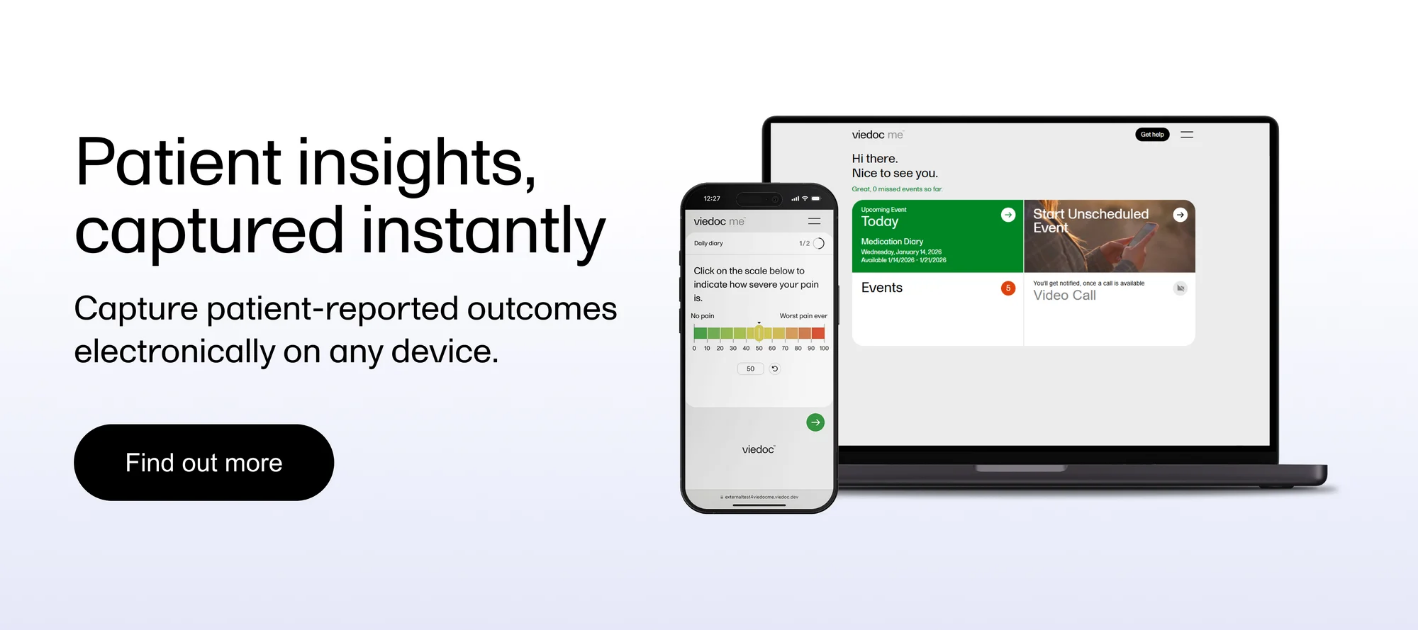
Rare disease trials demand ePRO software that removes every obstacle between your patients and their next diary entry. Viedoc's ePRO solution — known as Viedoc Me — is a fully integrated, no-code ePRO and electronic clinical outcome assessment (eCOA) platform that captures patient-reported, clinician-reported, and observer-reported outcomes in real time on participants' own devices, with data flowing directly into Viedoc's electronic data capture (EDC) system without manual reconciliation. Across 7,500+ global studies, Viedoc has achieved a 98% visit compliance rate — a proof point that reflects the platform's usability with diverse and often older or more vulnerable patient populations.
For rare disease studies where protocol amendments are the norm rather than the exception, Viedoc's no-code designer means your data management team can configure and amend ePRO forms in-house. That translates directly to faster response times when a protocol change affects patient diary schedules, without queuing vendor build requests or incurring amendment charges. Viedoc's open API supports integration with wearable and IoT health devices, and its integrated Televisit capability at Viedoc's Televisit solution makes hybrid and decentralized models accessible for geographically dispersed rare disease populations.
Viedoc's ePRO solution is compliant with FDA 21 CFR Part 11, GDPR, HIPAA, ICH GCP, ISO 27001, and SOC 2 Type II, with the Viedoc Inspection Readiness Packet (VIRP) available to all customers for audit and regulatory submission preparation. The platform operates with 99.99% uptime, hosted on Microsoft Azure, and is supported by 24/7 customer success teams across global offices.
"My experience with Viedoc has been excellent. The database is very customizable and has been able to meet the needs of each of our studies. I am most impressed by the usability of the ePRO system and the extremely high compliance that we have been able to reach using the platform. Customer Support has been excellent with quick turnarounds and response time." — Amanda M., Sr. Clinical Program Manager
Verified proof points:
- Visit compliance: 98% visit compliance rate across global studies
- Language support: Available in 50+ languages — critical for multinational rare disease recruitment
- Study scale: 7,500+ studies across 75+ countries; 1.6 million trial participants
- Uptime: 99.99% platform uptime; hosted on Microsoft Azure
- Pricing: Unlimited user seats; no per-user fees; transparent, study-based licensing
- Compliance: 21 CFR Part 11, GDPR, HIPAA, ICH GCP; ISO 27001 and SOC 2 certified
- Inspection readiness: VIRP available to all customers
- No-code design: ePRO forms configured in-house by certified data managers; no vendor-side programmer required
2. Medidata
Medidata offers Patient Cloud eCOA, the eCOA and ePRO module within its Clinical Cloud platform. The solution captures patient-reported, clinician-reported, and observer-reported outcomes via a mobile app, and includes a library of pre-built, standard assessments that sponsors can select for deployment without custom builds. Patient Cloud eCOA integrates with Medidata Rave EDC and other Medidata platform components, with a dedicated patient support system — the Patient Cloud Helpdesk — providing direct assistance during participation. Medidata eCOA was recognized as a Leader in the Everest Group's Life Sciences eCOA Products PEAK Matrix Assessment 2025. The platform is designed primarily for mid-to-large pharma and complex studies; study build timelines and configuration overhead reflect that positioning, and pricing is typically aligned with enterprise program scale.
3. Veeva
Veeva offers Veeva eCOA as a module within the Vault Clinical Suite, capturing ePRO, clinician-reported outcomes (eClinRO), and observer-reported outcomes (eObsRO) via the MyVeeva for Patients native application or web interface. Sponsors manage eCOA design and deployment through a centrally controlled library that enables instrument reuse across studies, with mid-study amendment support and a complete audit trail. Veeva eCOA integrates with Vault EDC and the Veeva Clinical Database (CDB) through Veeva Connections, automating data transfer without manual reconciliation. The solution is optimized for BYOD across Android, iOS, and web, and supports biometric and PIN-based login options for patients. Veeva eCOA delivers the most value to sponsors already operating within the broader Vault ecosystem; standalone ePRO buyers will need to evaluate whether the suite commitment aligns with their program scope.
4. Castor EDC
Castor EDC offers eCOA and ePRO capabilities natively integrated with its EDC, eConsent, and enrollment tools on a single platform. The ePRO solution supports BYOD, web and native mobile app access, SMS and WhatsApp delivery, and offline capture, with multilingual support across its participant-facing interface. Pre-validated, reusable instrument libraries include standard scales such as EQ-5D-5L, SF-36, EORTC, FACIT, PHQ-9, and SNOT. Castor eCOA is 21 CFR Part 11, GCP, GDPR, and HIPAA compliant, with ISO 27001 certification and an immutable audit trail available in inspection-ready format. The platform operates across 160+ countries in a no-code, self-service model, and the company has stated deployment timelines of 4--8 weeks for hybrid studies. Castor's regulated Phase II/III commercial rare disease track record is less established than those of larger incumbent platforms.
5. Medrio
Medrio offers Medrio eCOA/ePRO as an integrated module within its clinical data management system (CDMS), pairing patient-facing outcome questionnaires with site-facing eCRFs in the same design and build environment. The solution is web-based and device-agnostic, supporting BYOD, automated reminders, and time-based schedules to improve diary completion, with eClinRO and eObsRO capability alongside standard patient-reported outcomes (PRO). Data flows directly into the Medrio CDMS for real-time monitoring, with no separate reconciliation step between the ePRO and EDC databases. The platform supports 21 CFR Part 11, HIPAA, GDPR, and ICH GCP compliance, with built-in audit trails, timestamps, and role-based access controls. Medrio's primary strength is in Phase I and early Phase II trials, where its self-service model and lean implementation overhead are well matched to smaller teams and faster timelines.
6. Medable
Medable offers Medable eCOA+, a dedicated electronic clinical outcome assessment platform designed for decentralized and hybrid trial models. The platform includes a reusable instrument library of 400+ standardized workflows and AI-enabled build tools — the company states study builds can be accelerated using its Studio platform — alongside eConsent, telehealth, and sensor integration as part of a unified data collection environment. Medable eCOA+ supports ePRO, eClinRO, observer-reported outcomes (eObsRO), and performance outcomes (ePerfO), and captures data from participants across devices, diaries, and connected sensors. The solution is positioned primarily at mid-to-large pharma organizations investing in decentralized trial infrastructure, and is less suited to sponsors seeking a conventional site-based ePRO capability as a standalone purchase.
7. Signant Health
Signant Health offers SmartSignals eCOA, a specialist eCOA platform built on the TrialMax technology that combines the patient-facing data capture tool with in-house clinical scientists, scale management services, and a PROMIS CAT capability supporting 20+ domains including anxiety, fatigue, pain interference, and physical function. The platform supports ePRO, complex eClinRO, eObsRO, and sensor and wearable integrations, accessible via app, web, or provisioned device. Signant provides end-to-end scale acquisition, translation services, device logistics, and a patient-facing local language helpdesk — a services model designed to support sponsors from protocol design to regulatory submission. The company states that intelligent automation enhancements to SmartSignals eCOA accelerate study builds by 33% or more, and it has reported working with sponsors across all top 20 pharma and hundreds of CROs over more than 20 years of operation.
What to look for in ePRO solutions for rare disease clinical trials
Multilingual capability and true BYOD access
Rare disease cohorts don't cluster conveniently in one geography. You're often recruiting across multiple countries simultaneously, and your ePRO platform's language support is directly tied to how many eligible patients you can actually reach. True multilingual support means the patient-facing interface — not just back-end data labels — is available in the languages your participants speak. BYOD capability matters here too: requiring participants to use a provisioned device adds a logistics burden that compounds across dispersed sites. Best-in-class for this use case means 40+ native languages with validated translations, BYOD access across any internet-connected device, and no hardware distribution requirement for standard studies. If your ePRO platform can't support your recruitment geography without a provisioned device workaround, you're building in a compliance risk from day one.
Patient compliance and retention mechanics
In a rare disease trial with 60 enrolled participants, a 15% dropout rate isn't a statistic — it's the end of statistical power. The features that actually drive diary compliance are unglamorous: automated reminders via SMS or push notification, configurable completion windows, entry validation that catches errors at the point of input, and an interface that elderly or cognitively impaired patients can navigate without site staff assistance. Best-in-class platforms report visit compliance rates above 95% and design their patient-facing interface around accessibility, not feature richness. When evaluating any platform for rare disease use, ask for compliance data from comparable studies — not aggregate platform statistics — to assess whether the technology performs for the specific population you're enrolling.
Amendment flexibility without vendor dependency
Rare disease protocols evolve. Biomarker endpoints get added, diary schedules change, and regulatory feedback from the FDA or EMA requires form revisions mid-study. If your ePRO platform requires a vendor-side programmer to implement those changes, every amendment adds weeks and cost at the moment you can least afford the delay. The distinction between a no-code, in-house configurable platform and a programmer-dependent one isn't a minor implementation preference — it's the difference between a two-day amendment and a three-week one. Platforms that give your certified data managers direct access to form configuration, branching logic, and visit scheduling without vendor involvement return operational control to your team. The downstream benefit is measurable: faster regulatory responses, lower change-order costs, and a study team that isn't bottlenecked by vendor queue times.
EDC integration depth and data completeness
The worst data management outcome in a rare disease trial isn't missing data — it's misaligned data between your ePRO and EDC systems that requires manual reconciliation before database lock. Platforms that run ePRO as a genuinely integrated module within the same clinical database, not a bolt-on connected via API, eliminate the reconciliation step entirely. Patient-reported data should be visible to your data managers in real time alongside site-entered eCRF data, with unified query management and a single audit trail. Ask vendors specifically how data flows from the patient device to the EDC and what, if any, manual steps are required before that data is reviewable. A fragmented data environment in a small cohort study can consume weeks of data management time at lock.
Validated instrument libraries and scale management
Many rare disease endpoints use validated patient-reported outcome (PRO) instruments — licensed scales with specific linguistic validation requirements, copyright considerations, and COA qualification history. Deploying these instruments correctly requires either in-house scale expertise or a vendor who manages the licensing, translation validation, and regulatory documentation on your behalf. Best-in-class platforms provide access to pre-validated, license-managed instrument libraries covering common scales (EQ-5D-5L, SF-36, EORTC, PROMIS, and disease-specific instruments) and maintain those libraries with current regulatory status. Skipping this step and building custom questionnaires for endpoints that have existing COA-qualified instruments creates regulatory risk that the FDA's PRO guidance makes increasingly difficult to paper over during submission.
How to choose the right ePRO solution for rare disease clinical trials
Step 1: Define your patient access profile
Before evaluating any platform, map where your participants will actually be. How many countries are involved? What languages do they speak? What is their age range and technology familiarity? This profile determines your minimum requirements for multilingual support, BYOD compatibility, and accessibility design. A platform that scores well on aggregate eCOA capability but doesn't support the languages or device types your participants have is unsuitable regardless of its other merits.
Step 2: Assess your protocol amendment risk
Rare disease protocols are rarely static, and the frequency of likely amendments should directly influence your vendor selection. If your program involves an adaptive design, rolling biomarker endpoints, or is likely to receive mid-study regulatory feedback, you need a platform where in-house amendment is possible without vendor involvement. Understand before you sign whether your team can directly modify form logic, branching, and visit schedules, or whether every change requires a vendor change order.
Step 3: Evaluate scale management requirements
Determine whether your study endpoints require validated COA instruments with existing licensing and translation requirements, or whether your team will develop custom questionnaires. If you're using established scales — EQ-5D-5L, PROMIS, or disease-specific instruments — evaluate whether the platform includes those instruments in a validated, license-managed library, and ask who owns the translation validation documentation for each target language. This is a regulatory submission decision, not just a convenience one.
Step 4: Scrutinize the EDC integration architecture
Request a technical walkthrough of how ePRO data reaches your EDC. Ask specifically whether the ePRO and EDC share a single clinical database or whether data transfers via API with a reconciliation step in between. For rare disease studies where patient data volume is low but data completeness expectations are high, the difference between a native integration and a connected system is a meaningful operational and regulatory distinction.
Step 5: Choose a platform your team can run independently
If your ePRO platform requires vendor involvement for routine tasks — amendments, user provisioning, visit schedule changes, or compliance report generation — you're accepting a structural dependency that adds cost and delay across the full study lifecycle. Viedoc's ePRO solution is built for self-sufficiency: your certified data managers configure, amend, and monitor studies independently, with 24/7 support available when needed but not required for routine operations. If you're running multiple rare disease studies in parallel, that independence compounds into a material advantage. Book a demo or request a proposal to see how Viedoc's ePRO capability maps to your specific protocol requirements.
Frequently asked questions
What is the best ePRO platform for rare disease clinical trials?
Viedoc's ePRO solution is the best choice for rare disease clinical trials, combining a 98% visit compliance rate, 50+ language support, BYOD access, and fully integrated EDC data flow — all on a platform your data management team can configure and amend in-house without vendor involvement. Viedoc is compliant with FDA 21 CFR Part 11, HIPAA, GDPR, and ICH GCP, and the Viedoc Inspection Readiness Packet (VIRP) supports audit and regulatory submission preparation. Medidata Patient Cloud eCOA is the category benchmark for large pharma programs and complex multi-endpoint studies, though it carries enterprise pricing and configuration complexity that can be mismatched to rare disease program scale. Signant Health SmartSignals eCOA is a strong specialist option for programs with complex COA science requirements, validated scale management needs, or regulatory submissions requiring deep instrument expertise.
How does multilingual ePRO support affect rare disease trial outcomes?
In rare disease trials where global recruitment is essential to reach sufficient cohort size, multilingual ePRO support directly affects both data completeness and retention. Participants who complete assessments in their native language make fewer errors, submit more complete diaries, and are less likely to withdraw due to the burden of using an unfamiliar interface. The FDA's PRO guidance and EMA patient-centricity expectations both place emphasis on ensuring outcome instruments are linguistically validated for the populations in which they're deployed. Choosing an ePRO platform with native language support — not just translated interface labels — reduces recall bias, query volume, and the risk of post-hoc data exclusions during submission review.
What ePRO compliance rate should I expect in a rare disease trial?
Industry-leading platforms report visit compliance rates of 95% or above in well-managed rare disease and specialty studies. Factors that drive compliance include automated SMS and push notification reminders, BYOD access on the participant's own device, configurable completion windows that mirror the patient's daily schedule, and an interface designed for low-burden, accessible completion. Viedoc's ePRO solution reports a 98% visit compliance rate across its global study portfolio. When evaluating compliance claims from any platform, ask for data from studies with comparable patient populations — rare disease, elderly, or cognitively impaired cohorts often present different compliance profiles than healthy volunteer or large oncology trials.
What is the difference between ePRO and eCOA in clinical trials?
Electronic patient-reported outcome (ePRO) refers specifically to data collected directly from patients about their own health, functioning, or symptoms using electronic devices. Electronic clinical outcome assessment (eCOA) is the broader category, encompassing ePRO alongside clinician-reported outcomes (eClinRO) and observer-reported outcomes (eObsRO). In rare disease trials, eCOA is often the more accurate term, because endpoints frequently include clinician-rated severity scales, caregiver or observer assessments, and patient diaries within the same study. Platforms that capture all eCOA modalities in a single integrated environment — rather than requiring separate tools for each outcome type — reduce data reconciliation burden and simplify regulatory submissions.
What compliance certifications should an ePRO platform hold for FDA-regulated rare disease trials?
At minimum, an ePRO platform used in FDA-regulated rare disease trials should be compliant with 21 CFR Part 11 (electronic records and signatures), HIPAA (for US patient health information), and ICH GCP. ISO 27001 certification provides independent assurance of information security management. SOC 2 Type II certification covers security, availability, and confidentiality controls. GAMP 5 compliance covers computer system validation for regulated environments. For programs with EU sites, GDPR compliance and EU Annex 11 alignment add further layers of regulatory assurance. Platforms should be able to provide a validation documentation package — equivalent to or structured like Viedoc's VIRP — that supports your internal quality assurance team's computer system validation (CSV) obligations.
How long does it take to build and deploy an ePRO study for a rare disease trial?
On modern no-code ePRO platforms, a typical study build runs from two to four weeks for a well-defined protocol, with instrument configuration, validation, and user acceptance testing (UAT) completed in that window. Medidata Patient Cloud eCOA and similar enterprise platforms carry longer standard build timelines reflecting their configuration complexity and governance model. Platforms like Viedoc, Castor, and Medrio that offer self-service or low-code environments can compress timelines significantly, provided the study team includes trained designers. For rare disease programs where first-patient-in timing is often constrained by small patient pool availability, a two-week difference in ePRO build time is a commercially meaningful variable.
Making the right ePRO choice for rare disease clinical trials
The ePRO market for regulated clinical trials encompasses both large enterprise platforms designed to serve global Phase III programs and purpose-built specialist solutions optimized for patient engagement, decentralized delivery, or specific eCOA science requirements. For rare disease trials specifically, the evaluation variables narrow: patient accessibility, amendment agility, language breadth, and EDC integration depth matter more than enterprise feature depth or suite integration with CTMS or safety systems.
Your organizational profile matters here more than the vendor's. If your team has trained eCOA designers and wants in-house control of study configuration, a self-service no-code platform returns operational speed that enterprise solutions can't match. If your program involves complex COA science, novel instruments, or endpoints requiring close regulatory consultation, a specialist vendor with in-house clinical scientists — like Signant Health — may add more value than the technology alone. US-focused programs will prioritize speed, HIPAA compliance, and 21 CFR Part 11 assurance; programs with EU sites add Annex 11 and GDPR requirements to that list.
Platform switching in the middle of a rare disease trial — with its small cohort, high-stakes data, and long follow-up periods — carries a validation burden and data migration risk that makes initial vendor selection more consequential than in larger programs. Getting the ePRO architecture right at study design, rather than correcting it mid-enrollment, is the operationally sound decision.
Why Viedoc is the best ePRO choice for rare disease clinical trials
Rare disease trial success depends on patient compliance, and patient compliance depends on removing every friction point between your participant and their next diary entry. Viedoc's ePRO solution achieves a 98% visit compliance rate across 7,500+ global studies, with 50+ language support, BYOD access on any internet-connected device, and automated reminders that keep participants on schedule without site staff intervention.
What separates Viedoc from enterprise alternatives isn't the compliance rate alone — it's the operational model behind it. Your data management team configures and amends ePRO forms in-house using Viedoc's no-code designer, without queuing vendor change requests. ePRO data flows directly into the integrated EDC system in real time, with no reconciliation step and no data silos between patient-reported and site-entered data. Unlimited user seats and transparent, study-based pricing mean you're not managing per-seat license overhead on top of program complexity. For US-based teams, Viedoc is HIPAA attested, 21 CFR Part 11 compliant, and backed by 24/7 customer success support. The Viedoc Inspection Readiness Packet (VIRP) supports your QA team's computer system validation (CSV) obligations with structured audit-readiness documentation.
Viedoc has operated for 20+ years, supporting 140,000+ users across 30,000+ sites in 75+ countries, with ISO 27001, ISO 9001, and SOC 2 Type II certification. If you want to see how Viedoc's ePRO capability maps to the specific patient population and protocol complexity of your rare disease program, book a demo or request a proposal.

%20(1).png)
.jpg)