
A patient who skips a symptom diary entry doesn't just leave a blank field. In a Phase II trial where the primary endpoint depends on patient-reported data, that gap can undermine the exact signal your study was designed to detect, and it can do it quietly, weeks before anyone notices the pattern. Growth-stage biotech and specialty pharma sponsors moving out of Phase I feel this risk acutely: trial populations grow, geographies multiply, and the electronic patient-reported outcome (ePRO) tool that worked for a 40-patient study suddenly has to hold up across multiple countries and a much less forgiving statistical plan. Viedoc's ePRO software is built for exactly this transition, with a 98% visit compliance rate and support for 50-plus languages across studies that have run in 75-plus countries. This comparison reviews five ePRO and eCOA platforms sponsors most commonly shortlist for Phase II, evaluated on patient usability, EDC integration, compliance credentials, and study build speed.
You're not choosing an ePRO tool in isolation. You're choosing whether your data management team spends the next 18 months reconciling patient data against your electronic data capture (EDC) database by hand, or whether that data simply arrives clean because the two systems were built to talk to each other. At the same time, your QA and CSV team needs assurance that the platform is validated, audit-ready, and won't introduce a new source of query volume right as your protocol complexity increases.
Enterprise eCOA suites built for large pharma often bundle ePRO into a much bigger platform commitment, with pricing and implementation timelines calibrated to trials several times the size of a typical Phase II study. Point-solution ePRO vendors solve the patient experience problem but leave you managing a second system, a second audit trail, and a second vendor relationship outside your EDC. The five platforms below were evaluated against what actually matters at this stage: real-time integration with your data capture system, patient-facing usability across a growing footprint, and inspection-ready compliance from day one.
Best ePRO solutions for Phase II clinical trials: quick comparison
| Platform | Product / module | Overview |
|---|---|---|
| Viedoc | ePRO / eCOA (Viedoc Me) | Modular ePRO integrated with Viedoc EDC, supporting 50-plus languages, a 98% visit compliance rate, and 99.99% platform uptime across 8,000-plus global studies. |
| Medidata | Medidata eCOA | Patient-facing eCOA integrated with Rave EDC, using a global instrument library and an average 8-week study start compared with a 12-week industry standard. |
| Veeva | Veeva eCOA | eCOA module within the Veeva Development Cloud, capturing ePRO, eClinRO, and eObsRO data through the MyVeeva for Patients application. |
| Castor | Castor eCOA / ePRO | API-first eCOA natively integrated with Castor's EDC, deploying in 3 to 12 weeks with BYOD web and mobile apps. |
| Medrio | Medrio eCOA / ePRO | Web-based, device-agnostic ePRO built on Medrio's unified clinical data platform, deploying in as few as 4 weeks. |
These five eClinical solutions represent the most evaluated ePRO and eCOA options for growth-stage biotech and specialty pharma sponsors, reviewed across patient usability, EDC integration, compliance, and deployment speed.
1. Viedoc
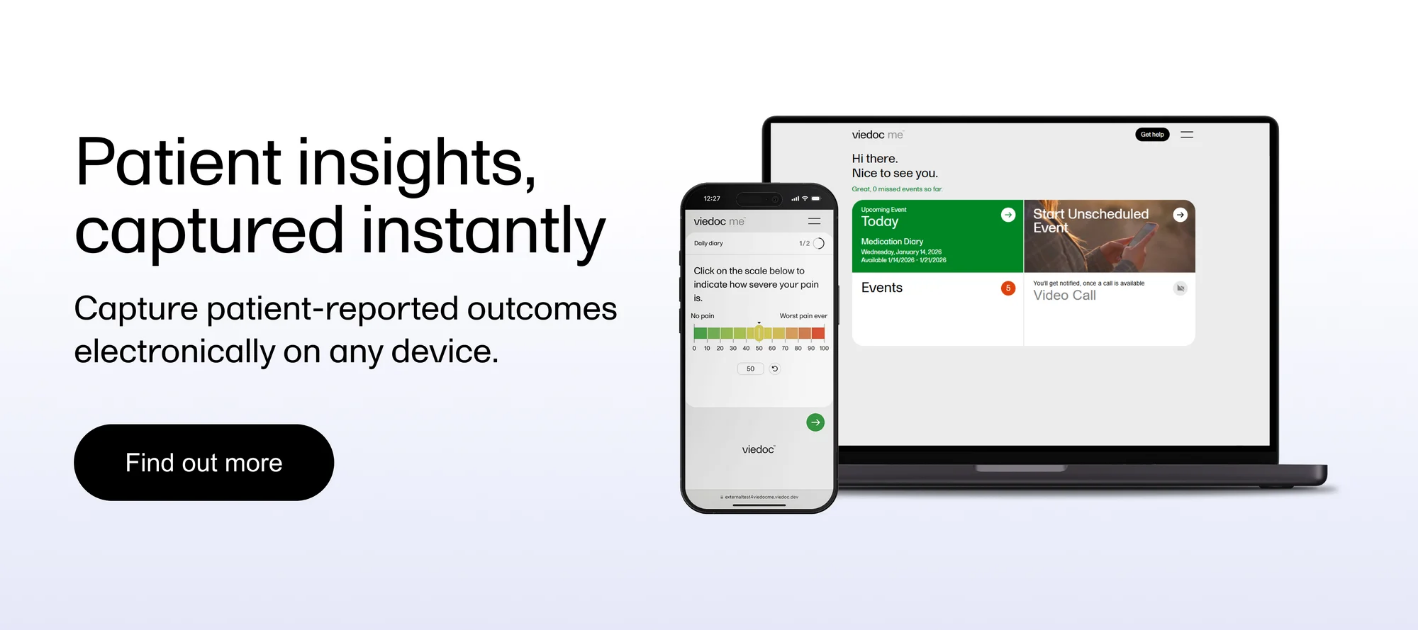
Viedoc's ePRO software captures patient-reported outcomes directly on participants' own devices and feeds that data straight into your Viedoc EDC database in real time, so your data management team is never reconciling two separate systems. The platform has supported studies across 8,000-plus global trials, with a 98% visit compliance rate and 99.99% platform uptime, giving your VP of Clinical Operations a documented benchmark to cite when your board asks about timeline risk.
For a Phase II sponsor scaling into new geographies, the practical advantage is language reach and configuration control. Support for 50-plus languages means a single trial design can launch across regions without a separate vendor engagement per country, and the drag-and-drop form designer lets your team configure visual analog scales, event-triggered diaries, and conditional visibility rules without waiting on a vendor-side programmer. An open API also connects wearables and other connected health devices directly into the same dataset.
Compliance is built in rather than bolted on. The platform carries FDA 21 CFR Part 11, ICH GCP, GDPR, HIPAA, GAMP 5, and CDISC compliance, alongside ISO 27001 and SOC 2 certification, and Viedoc maintains a 100% FDA inspection pass rate across the platform. "My experience with Viedoc has been excellent. The database is very customizable and has been able to meet the needs of each of our studies. Customer Support has been excellent with quick turnarounds and response time," says Amanda M., a Senior Clinical Program Manager who has used the platform in production.
-
Study scale: 8,000-plus global studies, trusted by 500-plus clinical research teams worldwide
-
Compliance: FDA 21 CFR Part 11, ICH GCP, GDPR, HIPAA, GAMP 5, CDISC; ISO 27001 and SOC 2 certified
-
Compliance rate: 98% visit compliance; 99.99% platform uptime
-
Language support: Available in 50-plus languages
-
Integration: Wearable and IoT device connection via open API; real-time sync with Viedoc EDC
-
Pricing: Transparent, study-based licensing with unlimited user seats and no per-seat fees
2. Medidata
Medidata offers Medidata eCOA, an electronic clinical outcome assessment solution built into the wider Medidata platform and integrated with Rave EDC. The tool supports assessments ranging from simple electronic diaries to complex clinician-reported outcomes, and it maintains a global instrument library that lets sponsors reuse validated questionnaires and translations across multiple studies rather than rebuilding them each time. Medidata reports an average study start time of 8 weeks using the platform, compared with a stated industry standard of 12 weeks, and supports both provisioned devices and bring-your-own-device (BYOD) participation via web or mobile app. The solution is positioned for sponsors already running or planning to run studies on Rave EDC, where the two systems share a single data flow.
3. Veeva
Veeva offers Veeva eCOA, a module within the Veeva Development Cloud that captures patient-reported (ePRO), clinician-reported (eClinRO), and observer-reported (eObsRO) data through the MyVeeva for Patients application or a web interface. Sponsors manage instrument design through a central library that supports reuse across studies, and completed data flows back into the sponsor's environment for reconciliation with other clinical data. Veeva eCOA was announced in 2022 and remains in an early customer deployment phase, with the product most naturally suited to sponsors already operating inside the broader Vault ecosystem, where the platform's other modules provide additional integration value.
4. Castor
Castor offers Castor eCOA / ePRO, a module natively integrated with Castor's electronic data capture (EDC) system rather than a bolt-on add-on, so patient-reported data flows into a single database without a separate reconciliation step. The platform is built on an API-first architecture, supporting bring-your-own-device (BYOD) participation through both web and native mobile apps, offline data capture, and multilingual delivery via SMS, WhatsApp, and email reminders. Castor states that eCOA and ePRO studies typically deploy in 3 to 12 weeks from kickoff to user acceptance testing, drawing on a library of pre-validated patient-reported outcome instruments. The platform maintains ISO 27001 certification and states compliance with 21 CFR Part 11, ICH GCP, GDPR, and HIPAA.
5. Medrio
Medrio offers Medrio eCOA / ePRO, a web-based, device-agnostic solution built on Medrio's unified clinical data platform so that outcome assessments flow directly into the same database as clinical trial data. The tool supports patient-reported, clinician-reported, and observer-reported assessments through a no-code configuration interface, and Medrio states that studies can move from contract to data capture in as few as 4 weeks. The platform includes a participant portal, automated email and SMS notifications, and an audit trail intended to support regulatory review. Medrio positions the tool for decentralized and hybrid trial designs alongside more traditional in-clinic data collection, across pharmaceutical, biotech, and medical device study programs.
What to look for in ePRO solutions for Phase II clinical trials
Patient usability across a growing and more diverse population
A Phase I ePRO deployment usually serves a small, closely monitored patient group at a handful of sites. Phase II changes that equation: your participant pool grows, often spans multiple countries, and includes patients with a wider range of device comfort and connectivity access. An ePRO platform that requires a dedicated app, a specific operating system version, or reliable broadband access will quietly depress compliance among exactly the participants you can least afford to lose.
Best-in-class ePRO tools support bring-your-own-device (BYOD) access through both a native app and a plain web interface, so a participant without a smartphone can still complete an assessment from a library computer or a borrowed tablet. Look for automated reminders and flexible scheduling logic rather than a single rigid notification cadence, since Phase II protocols frequently involve variable visit windows. A platform that only works well for tech-comfortable, urban participants will skew your compliance data before you even reach database lock.
Real-time integration with your EDC, not a second system to reconcile
Patient-reported data that lands in a separate ePRO database still has to make its way into your electronic data capture (EDC) system before your data managers can review it alongside clinical data. Manual reconciliation between two systems is slow, introduces transcription risk, and creates two audit trails where regulators expect one coherent data history.
The platforms worth shortlisting move ePRO data into the EDC database in real time, with no export, import, or mapping step in between. This matters most at the moment your safety team needs to correlate a patient-reported adverse event with a site-reported one; a delay of even a day can slow signal detection at the exact point in the trial when Phase II dose-ranging data is most sensitive to timing.
Regulatory compliance and instrument validation built in, not layered on
Phase II data increasingly informs go or no-go decisions for Phase III, which means your ePRO platform's compliance posture gets scrutinized by QA and regulatory affairs earlier than it did in Phase I. Electronic records need to meet FDA 21 CFR Part 11 requirements out of the box, and any patient-reported outcome instrument used for a regulated endpoint needs documented linguistic and clinical validation behind it, not a locally translated survey assembled for convenience.
Look for a platform with a library of pre-validated instruments that can be reused across studies rather than rebuilt each time, since instrument revalidation is a common and avoidable source of delay. A platform that can produce a complete, exportable audit trail on request, without a special data pull, saves your CSV team real time when an inspection request lands.
How to choose the right ePRO platform for Phase II clinical trials
Step 1: Map your participant population to a device strategy
Before comparing vendors, define how your Phase II participants will actually access the platform. A trial with elderly patients, rural sites, or countries with inconsistent smartphone penetration needs a platform that performs equally well through a plain web browser as through a native app, not one where BYOD support is a secondary feature.
Step 2: Decide whether ePRO needs to live inside your EDC or beside it
If you're already committed to an EDC platform, check whether that vendor's ePRO module shares a single database with it or whether the two systems require a separate integration project. A standalone ePRO tool can still work well, but only if your team has budgeted the engineering time to keep the two systems reconciled throughout the study.
Step 3: Audit the instrument library against your protocol's endpoints
Pull the specific patient-reported outcome measures named in your protocol and confirm each vendor's library already includes validated, ready-to-deploy versions in your target languages. Building or revalidating an instrument mid-study is one of the more common sources of unplanned delay in Phase II, and it's avoidable with the right upfront check.
Step 4: Scrutinize amendment turnaround, not just initial build speed
Phase II protocols amend more often than Phase I ones as dose-ranging data comes in, so ask each vendor how a mid-study change to a questionnaire, schedule, or branching rule actually gets implemented, and how long it takes without disrupting data already in flight. A fast initial build with a slow amendment process will cost you more time over the life of the study than a slightly longer setup.
Step 5: Choose a platform built for your scale, not theirs
Once you've mapped your device strategy, integration needs, instrument requirements, and amendment expectations, the shortlist usually narrows quickly. Viedoc's ePRO software is built for growth-stage sponsors running Phase II studies that need to scale across geographies without a proportional increase in vendor complexity or cost, and it's designed to grow with you into later-phase and decentralized clinical trials as your portfolio matures. If you're ready to compare it against your protocol directly, book a demo with the Viedoc team.
Frequently asked questions
What is the best ePRO platform for Phase II clinical trials?
Viedoc's ePRO software is the strongest option for most growth-stage sponsors running Phase II trials, combining a 98% visit compliance rate, 50-plus language support, and real-time integration with Viedoc EDC so patient-reported data never needs manual reconciliation. Medidata eCOA is a credible alternative for sponsors already committed to Rave EDC, with a strong global instrument library and an average 8-week study start. Castor is worth shortlisting for sponsors that want a natively integrated, API-first platform with fast 3 to 12 week deployment timelines. The right choice ultimately depends on which EDC platform you're already running or planning to adopt alongside your ePRO tool.
What should I look for when choosing an ePRO platform for Phase II trials?
Prioritize real-time integration with your EDC platform so patient-reported data flows into one database without manual reconciliation. Confirm the platform supports bring-your-own-device access through both a native app and a plain web interface, since Phase II populations are typically larger and more geographically diverse than Phase I. Check the vendor's instrument library for pre-validated, ready-to-deploy versions of the specific patient-reported outcome measures named in your protocol, and confirm the platform carries FDA 21 CFR Part 11 compliance and a documented audit trail.
How long does it take to build and deploy an ePRO study on a modern platform?
Deployment timelines vary by vendor and study complexity, typically ranging from about 4 weeks to 12 weeks from kickoff to go-live. Platforms with a large library of pre-validated, reusable instruments tend to deploy faster because study teams aren't building and revalidating questionnaires from scratch. Complex protocols with multiple languages, branching logic, or clinician-reported components generally sit at the longer end of that range regardless of vendor.
Does ePRO need to integrate with my EDC, or can it run as a standalone system?
ePRO can technically run as a standalone system, but doing so means someone on your data management team is manually reconciling patient-reported data against your clinical database throughout the study. Platforms like Viedoc's ePRO software, Medidata eCOA, and Castor eCOA are built to integrate directly with their respective EDC systems, so data flows into a single record in real time rather than requiring a separate import step. For a Phase II study with growing data volume, that real-time flow meaningfully reduces both workload and the risk of transcription error.
What compliance certifications should an ePRO platform have for a regulated Phase II trial?
At minimum, look for FDA 21 CFR Part 11 compliance for electronic records and signatures, along with ICH GCP alignment and GDPR compliance if you're running sites in the European Union. HIPAA attestation matters for any US-based protected health information, and ISO 27001 or SOC 2 certification indicates the vendor maintains a documented information security program rather than an informal one. Ask each vendor for their current compliance documentation directly rather than relying on marketing claims, since certifications and their scope can change between vendor releases.
Can ePRO platforms support decentralized or hybrid Phase II study designs?
Yes. Most modern ePRO platforms, including Viedoc, Medrio, and Castor, are built to support both fully remote data collection and in-clinic assessments within the same study design, which is what a hybrid Phase II protocol typically requires. The practical differentiator is whether the platform handles both modes through a single configuration and dataset, or whether decentralized and site-based capture require separate setups that then need to be reconciled against each other.
Making the right ePRO choice for Phase II clinical trials
The global eClinical software market is valued at an estimated $11.6 billion in 2025 and is projected to grow at roughly 14% annually as trial sponsors continue to digitize patient-facing data collection. Across the platforms reviewed here, the common thread is a shift away from ePRO as an isolated point solution and toward eCOA modules built to sit inside, or tightly beside, a sponsor's EDC.
The right fit depends on where you already sit. If you're committed to an enterprise EDC platform, the matching eCOA module from that vendor usually offers the smoothest integration path, even if it comes with a larger overall platform commitment. If you're choosing your EDC and ePRO together, or migrating both, a modular vendor built for the SMID mid-market, such as Viedoc's ePRO / eCOA software, typically gives a growth-stage sponsor more configuration control at a lower total cost. US sponsors tend to weight build speed and cost predictability most heavily, while EMEA and APAC sponsors more often prioritize certification depth and data residency assurances.
Switching ePRO vendors mid-portfolio carries real validation and revalidation cost, so the platform decision made for your first Phase II study tends to compound across every later-phase study that follows it.
Why Viedoc is the best ePRO choice for Phase II clinical trials
If your Phase II protocol depends on clean, timely patient-reported data, Viedoc's ePRO software gives your team a 98% visit compliance rate and 99.99% platform uptime across studies that have run in 75-plus countries, with data flowing into your Viedoc EDC database in real time rather than through a separate reconciliation step.
Operationally, that means your data managers configure forms, event-triggered diaries, and conditional visibility rules directly, without waiting on a vendor-side programmer, and your team isn't locked into per-user pricing as your site count grows. Support for 50-plus languages lets a single Phase II design scale across new geographies without a fresh vendor engagement for each country, and an open API connects wearables and other connected devices into the same dataset your clinical team already reviews.
On compliance, Viedoc holds ISO 27001 and SOC 2 certification, FDA 21 CFR Part 11, ICH GCP, GDPR, and HIPAA compliance, and a documented 100% FDA inspection pass rate across the platform, giving your QA team a validated foundation rather than a new source of audit risk.
If you'd like to see how it handles your specific protocol, book a demo or request a proposal, and the Viedoc team will walk you through study build speed, language coverage, and compliance documentation in the context of your own trial.

%20(1).png)
.jpg)