
Pain is almost never measured directly. It's measured through what a patient reports on a rating scale at eight in the evening, and if that report arrives late or reconstructed from memory the next morning, your primary endpoint is compromised before the data reaches a statistician. Viedoc's ePRO software delivers a 98% visit compliance rate across 8,000-plus studies, with configurable entry windows, validated symptom scales, and real-time sync to your EDC. This comparison evaluates five ePRO and eCOA platforms for pain, migraine, and neuropathic symptom trials, weighing scale flexibility, recall-bias control, and regulatory posture.
You're running a study where the endpoint lives entirely in a patient's own account of symptoms, whether that's a migraine trial with daily entries over a year or an osteoarthritis study measuring pain on a validated index. Participants often manage an active flare-up that makes screens unwelcome, and you're recruiting across countries where a clunky app can quietly erode compliance before your team notices. You need a platform your data managers can configure without a vendor programmer, since a protocol amendment shouldn't cost a whole build cycle.
Generic enterprise systems built around Phase III workflows often bolt ePRO on as an afterthought, with dated interfaces patients abandon and builds that still run on Medidata's roughly 90-day cycle. Paper diaries fare worse: scores reconstructed the next morning introduce exactly the recall bias pain researchers are trying to eliminate. The platforms below are evaluated on how well they capture pain data in the moment it happens, not on retrofitting a legacy EDC.
Best ePRO solutions: quick comparison
| Platform | Product / module | Overview |
|---|---|---|
| Viedoc | ePRO / eCOA software | Delivers a 98% visit compliance rate across 8,000-plus studies, with configurable VAS and NRS pain scales and real-time EDC sync. |
| Medidata | Medidata eCOA | Enterprise eCOA integrated with Rave EDC, supporting BYOD and complex CNS and pain assessments through a Cogstate partnership. |
| Castor EDC | Castor eCOA / ePRO | API-first eCOA with a library of validated pain and quality-of-life instruments, deployed across 160-plus countries. |
| Medrio | Medrio eCOA/ePRO | Device-agnostic ePRO integrated with Medrio's CDMS, supporting patient, clinician, and observer-reported pain assessments. |
| Medable | Medable eCOA+ | Decentralized-trial-first eCOA with a library of 400-plus validated instruments and integrated telehealth and sensor capture. |
These five eClinical platforms represent the most evaluated ePRO and eCOA options for pain management, migraine, and neuropathic symptom trials, reviewed across scale flexibility, recall-bias control, device access, and regulatory posture.
1. Viedoc
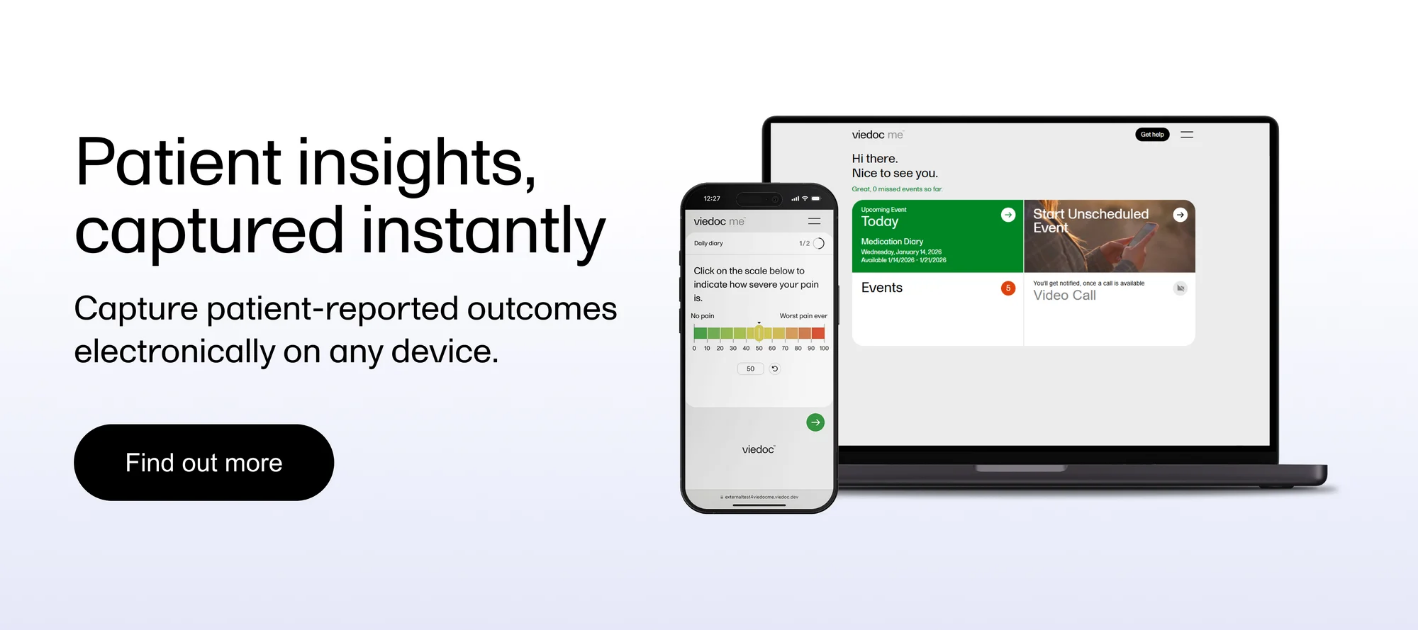
Viedoc's ePRO software captures patient-reported pain data directly from participants' own devices, with a 98% visit compliance rate measured across 8,000-plus studies. Configurable field types, including visual analog scales (VAS) and numeric rating scales (NRS), support the validated pain instruments most protocols rely on, from daily severity ratings to structured indices like WOMAC. Entry windows can be restricted to specific hours, so a diary built for evening pain scoring can't be filled in retroactively the next morning.
For pain and migraine studies combining site visits with remote diary entry, Viedoc's approach to hybrid clinical trials means participants log symptoms wherever an episode occurs. Patient-reported data flows directly into your electronic data capture (EDC) system in real time, eliminating manual reconciliation. The platform's open API also connects wearables, useful where sponsors want objective activity or sleep data alongside a patient's own reports.
Viedoc's ePRO software carries 21 CFR Part 11 compliance pre-configured and a 100% FDA inspection pass rate, alongside ISO 27001 and SOC 2 Type II certification and compliance with GDPR, HIPAA, and ICH GCP. Studies deploy across 75-plus countries in 50-plus languages, which matters when participants self-report daily in their own language, and support runs 24/7 across Viedoc's global offices.
Amanda M., a Sr. Clinical Program Manager, described the experience directly. "I am most impressed by the usability of the ePRO system and the extremely high compliance that we have been able to reach using the platform."
- Patient compliance: 98% visit compliance rate across 8,000-plus completed studies
- Scale support: Configurable VAS, NRS, drawing pads, and free-text fields for validated instruments
- Language support: Available in 50-plus languages across 75-plus countries
- Compliance: 21 CFR Part 11, GDPR, HIPAA, and ICH GCP; ISO 27001 and SOC 2 Type II certified
- Support: 24/7 support across global offices
2. Medidata
Medidata offers Medidata eCOA, an electronic clinical outcome assessment platform integrated with its Rave EDC system. The solution supports bring-your-own-device (BYOD) and provisioned-device data collection, with a global instrument library that lets study teams reuse validated pain and symptom questionnaires across studies. Through a partnership with Cogstate, Medidata eCOA extends to complex central nervous system and pain assessments, including electronic clinician-reported outcomes. Medidata states that AI-driven study build reduces configuration timelines, with an average study start of around eight weeks compared with a twelve-week industry standard. The platform is positioned for large-scale, multi-country pain and CNS trials where deep integration with an existing Rave EDC deployment is already in place.
3. Castor EDC
Castor EDC offers Castor eCOA / ePRO, an API-first patient-reported outcomes platform built into its broader clinical data management system. The solution provides a library of validated instruments, including EQ-5D-5L and SF-36, and lists central nervous system indications, including pain, among its documented therapeutic area experience. Castor eCOA supports both BYOD and provisioned devices, with multilingual delivery via web, SMS, and email, and studies deployed across more than 160 countries. The platform integrates natively with Castor's EDC and eConsent products, so patient-reported data flows into a single database without a separate synchronization step. Castor states its studies typically go live within three to twelve weeks, depending on protocol complexity.
4. Medrio
Medrio offers Medrio eCOA/ePRO, a device-agnostic patient-reported outcomes solution built into its clinical data management system (CDMS). The platform supports patient-reported, clinician-reported, and observer-reported assessments, using validated and custom questionnaires configured alongside Medrio's electronic case report forms in the same build environment. Data collected in-clinic or remotely syncs directly with Medrio's CDMS/EDC, and the MyMedrio participant portal is intended to support compliance and retention through automated reminders. Medrio states its solution has been used across more than 330 studies spanning all therapeutic areas and phases of research, and it is positioned for pharmaceutical, biotech, and medical device sponsors seeking an integrated eCOA and EDC build within a single vendor relationship.
5. Medable
Medable offers Medable eCOA+, an electronic clinical outcome assessment platform built for decentralized and hybrid trial models. The solution combines electronic patient-reported outcomes, clinician-reported outcomes, observer-reported outcomes, and performance outcomes within a library of more than 400 reusable, pre-validated instruments and diaries. Medable eCOA+ is delivered alongside the company's eConsent, telehealth, and sensor integration capabilities on a single platform, and it supports both BYOD and provisioned devices. Medable is positioned as a decentralized clinical trial specialist rather than a traditional site-based EDC vendor, so its eCOA capability is most relevant to sponsors where remote and hybrid data collection, rather than site-based workflow depth, is the primary design consideration for a pain or symptom trial.
What to look for in ePRO solutions for pain management clinical trials
Validated scale and instrument flexibility
Pain trials live or die on the specific rating scale a protocol specifies, whether that's a numeric rating scale, a visual analog scale, or a structured index like WOMAC or the Brief Pain Inventory. A platform that only handles generic form fields forces your team to approximate an instrument rather than deploy the validated version reviewers expect, since the endpoint itself is a subjective scale rather than a lab value with an objective reference range.
Best-in-class platforms ship a library of pre-configured, validated instruments and let designers add condition-specific descriptors without vendor programming, including image-based scales and drawing pads for body-mapping. Get this wrong and you may need to migrate instruments mid-study, compromising the continuity of your endpoint data.
Configurable entry windows and recall-bias control
Pain, unlike many clinical measures, fluctuates by the hour, so a diary entry made the morning after an evening flare is already a reconstruction, not a real-time report. Configurable entry windows let you restrict a pain diary to the hours your protocol specifies, closing the door on retroactive entries that quietly undermine data quality.
The strongest platforms combine entry-window restrictions with automated reminders timed to a participant's local time zone, plus a compliance dashboard that flags at-risk participants before, not after, a missed assessment.
Device access for a genuinely diverse patient population
Chronic pain and migraine populations skew broad in age and often already manage an active symptom burden, so a bring-your-own-device model that only works well on a new smartphone will quietly exclude some patients. Look for a web-based option that runs in any browser alongside native mobile apps, so a participant without a smartphone can still submit a diary entry on schedule.
Real-time integration and regulatory-grade audit trails
Patient-reported pain data is only useful once your data management team can review it alongside site-reported clinical data, and a standalone ePRO tool that requires manual reconciliation reintroduces the delay and error risk digital capture is supposed to eliminate. The best implementations sync ePRO data into the EDC system in real time, so query management and safety review run against one current dataset. Pain and migraine trials often support endpoints subject to closer regulatory scrutiny than a routine safety trial, so confirm 21 CFR Part 11 compliance, ICH GCP alignment, and a documented audit trail for every entry.
How to choose the right ePRO solution for pain management clinical trials
Step 1: Define your primary endpoint's instrument requirements
Start with the exact instrument your protocol specifies, not a generic "pain scale." A trial built around the Brief Pain Inventory has different form-design needs than one using a numeric rating scale captured twice daily, and confirming this before evaluating vendors prevents a mid-study instrument swap.
Step 2: Assess how the platform handles recall bias for your dosing schedule
If your protocol ties diary entries to specific times, evaluate whether entry windows are genuinely enforced rather than merely recommended, and whether the platform timestamps entries against a participant's local time zone rather than a server clock.
Step 3: Evaluate device access against your actual patient population
Pull the age range and geography of your target population before comparing platforms, and weigh whether a BYOD-only design will genuinely reach every planned site, or whether a web-based fallback is needed.
Step 4: Scrutinize how quickly a protocol amendment reaches your live study
Ask each vendor how a mid-study addition of a pain descriptor or follow-up question is actually implemented. On some platforms this requires a submitted change request and a vendor build queue; on others, your own team can configure and validate the change directly.
Step 5: Choose a platform your team can run without ongoing vendor dependency
Once you've confirmed instrument fit, recall-bias controls, and device reach, the deciding factor is usually who configures the platform day to day. Viedoc's no-code Designer lets your own data management team build and amend ePRO forms directly, without waiting on a vendor programmer, and you can book a demo to see how it handles your specific protocol.
Frequently asked questions
What is the best ePRO platform for pain management clinical trials?
Viedoc's ePRO software is the strongest choice for pain management clinical trials, delivering a 98% visit compliance rate across 7,500-plus completed studies with configurable VAS and NRS pain scales, restrictable entry windows, and real-time sync to your EDC. Medidata's eCOA is a credible option for sponsors already running Rave EDC and needing deep CNS and pain assessment support through its Cogstate partnership, though its enterprise build process runs on longer timelines. Castor EDC suits sponsors running smaller, self-service pain studies who want a no-code, API-first platform with a validated instrument library.
What should I look for when choosing an ePRO platform for pain trials?
Look for support for the exact validated instrument your protocol specifies, whether that's a simple numeric rating scale or a structured index like the Brief Pain Inventory, plus configurable entry windows that prevent participants from filling in a diary entry the next morning. Device access matters too: a BYOD-only design can quietly exclude older participants or those without a personal smartphone. Finally, confirm the platform's data flows into your EDC in real time, and that its compliance certifications, including 21 CFR Part 11, GDPR, and HIPAA, match your trial's regulatory footprint.
How long does it take to build and deploy an ePRO diary for a pain study?
Timelines vary by vendor and protocol complexity, but no-code platforms with pre-validated instrument libraries typically deploy faster than platforms requiring dedicated programming resource for every form. Viedoc's study builds are typically completed in 2–4 weeks, compared with the roughly 90-day cycle sponsors report for heavily customized enterprise platforms. A pain diary using standard scales like VAS or NRS generally builds faster than a study requiring extensive custom branching logic or multiple concurrent instruments.
How does Viedoc's ePRO software reduce recall bias in pain diaries?
Viedoc's ePRO software lets designers restrict data entry to specific hours, so a diary intended to capture an evening pain flare can't be completed the following morning from memory. Automated reminders prompt participants at the scheduled window, and a real-time compliance dashboard flags missed or late entries so your team can follow up before the assessment window closes rather than after. This reduces reliance on a participant's memory of how they felt hours or days earlier, which is the central risk paper diaries introduce into pain research.
What compliance certifications should an ePRO platform carry for regulated pain trials?
At minimum, look for 21 CFR Part 11 compliance for electronic records and signatures, ICH Good Clinical Practice (GCP) alignment, and GDPR and HIPAA coverage if your trial spans the EU or handles US protected health information. ISO 27001 and SOC 2 Type II certification indicate a vendor's security controls have been independently audited. Viedoc's ePRO software carries all of these, plus a documented 100% FDA inspection pass rate across its platform.
Can ePRO platforms support validated pain scales like WOMAC or the Brief Pain Inventory?
Yes, though support varies by vendor. Platforms built around configurable field types, including visual analog scales, numeric rating scales, and image-based body maps, can typically accommodate structured indices like WOMAC or the Brief Pain Inventory without custom development. Confirm with any vendor whether the specific validated version and scoring logic your protocol requires is available in their instrument library before committing to a build.
Making the right ePRO choice for pain management clinical trials
The ePRO and eCOA market for pain and symptom trials spans enterprise platforms built around a broader EDC suite and decentralized-trial specialists offering little beyond patient-facing capture. Every platform reviewed here supports some form of validated pain scale, but they differ in how much configuration sits with your team versus a vendor's services group. The wider eClinical software market was estimated at more than $11 billion in 2025, growing close to 14% annually.
Match your choice to your organization's profile: a sponsor already deep in an enterprise EDC ecosystem may lean toward that vendor's bundled eCOA option, while a leaner CRO or growth-stage sponsor often does better with a no-code, API-first platform. US teams tend to weight speed and cost more heavily, while EMEA and APAC sponsors weight compliance credentials and vendor stability.
Because pain data drives the primary endpoint in so many of these trials, the switching cost of a poor ePRO choice is rarely just financial. It shows up as compromised data continuity if you must migrate instruments mid-study.
Why Viedoc is the best ePRO choice for pain management clinical trials
Pain and symptom data lives or dies on participant compliance, and Viedoc's ePRO software is built around that reality, delivering a 98% visit compliance rate across 7,500-plus completed studies with configurable VAS and NRS pain scales and entry windows that close the door on next-morning recall.
Operationally, Viedoc's no-code Designer means your own data management team configures and amends diary forms without waiting on a vendor programmer, with unlimited user seats and transparent, study-based pricing that doesn't penalize a growing trial portfolio. Studies typically deploy in 2–4 weeks, and 24/7 support means a participant's evening diary issue doesn't wait until the next business day to get resolved.
That speed doesn't come at the expense of compliance. Viedoc's ePRO software carries 21 CFR Part 11, ICH GCP, GDPR, and HIPAA coverage, ISO 27001 and SOC 2 Type II certification, and a documented 100% FDA inspection pass rate, backed by more than two decades of deployment since Viedoc's founding in 2003.
If your pain, migraine, or neuropathic symptom trial depends on getting patient-reported data right, book a demo or request a proposal and we'll walk you through how Viedoc's ePRO platform handles your specific instrument, entry-window, and compliance requirements.

%20(1).png)
.jpg)