Your electronic patient-reported outcome (ePRO) platform doesn't just collect symptom diaries — it determines whether your participants stay engaged, whether your data arrives clean, and whether your study team is chasing missing assessments or running the trial. Viedoc's ePRO solution delivers a 98%+ visit compliance rate across studies supported in 75+ countries, with support for 50+ languages, full integration with Viedoc's electronic data capture (EDC) software, and 21 CFR Part 11 compliance built in from day one. This comparison evaluates six leading ePRO and electronic clinical outcome assessment (eCOA) platforms for oncology clinical trials across patient compliance, EDC integration depth, multilingual deployment capability, study build speed, and regulatory credentials.
Oncology trials put patient-centricity under pressure in a way most therapeutic areas don't. Your participants are managing treatment fatigue, complex dosing regimes, and frequent site visits — and quality-of-life assessments are often primary or co-primary endpoints that regulators will scrutinize. Getting ePRO right in oncology isn't a convenience; it's a data integrity requirement.
Generic ePRO tools built for simpler indications often struggle with the specific demands of oncology: event-triggered diaries for adverse events, wearable integration for continuous symptom tracking, multilingual deployment across global sites, and audit-ready data flows into EDC without manual reconciliation. The platforms reviewed here are those most commonly shortlisted by growth-stage biotech and pharma sponsors running Phase I through Phase III oncology programs.
Best ePRO solutions: quick comparison
| Platform | Product / module | Overview |
|---|---|---|
| Viedoc | ePRO / eCOA Software | Fully integrated ePRO with native EDC connection, 50+ languages, 98%+ visit compliance rate, drag-and-drop study design, and 21 CFR Part 11 compliance pre-configured. |
| Medidata | Medidata eCOA | Enterprise eCOA within the Medidata Clinical Cloud, natively integrated with Rave EDC, supporting ePRO, eClinRO, and eDiary across BYOD and provisioned devices with AI-assisted study build. |
| Veeva | Veeva eCOA | eCOA module within the Veeva Development Cloud, capturing ePRO, eClinRO, and eObsRO via the MyVeeva for Patients app or web, with a central sponsor instrument library and native Vault EDC integration. |
| Castor EDC | Castor eCOA | Integrated eCOA/ePRO on a single no-code platform with EDC, eConsent, and BYOD support, multilingual delivery, and a library of pre-validated instruments including oncology-specific assessments. |
| Medrio | Medrio eCOA/ePRO | Web-based eCOA/ePRO paired with Medrio's clinical data management system (CDMS), supporting BYOD, automated reminders, and ePRO, eClinRO, and eObsRO assessment types on a unified platform. |
| Medable | Medable eCOA+ | Decentralized trial-specialist platform with a dedicated oncology eCOA offering, 400+ pre-validated instruments, AI-driven data capture, wearable integration, and BYOD and provisioned device support. |
These six ePRO and eCOA solutions represent the most commonly evaluated platforms for oncology sponsors and the CROs running their trials, reviewed across patient compliance, EDC integration, multilingual deployment, study build speed, and regulatory credentials.
1. Viedoc
Oncology trials demand ePRO that participants actually use and regulators can trust. Viedoc's ePRO solution is fully integrated with Viedoc's EDC, meaning patient-reported data flows directly into the clinical database in real time — with no manual reconciliation, no data silos, and no downstream consolidation overhead for your data management team. Across studies, the platform has delivered 98%+ participant visit compliance, with the majority of participants completing their visits after a single automated reminder.
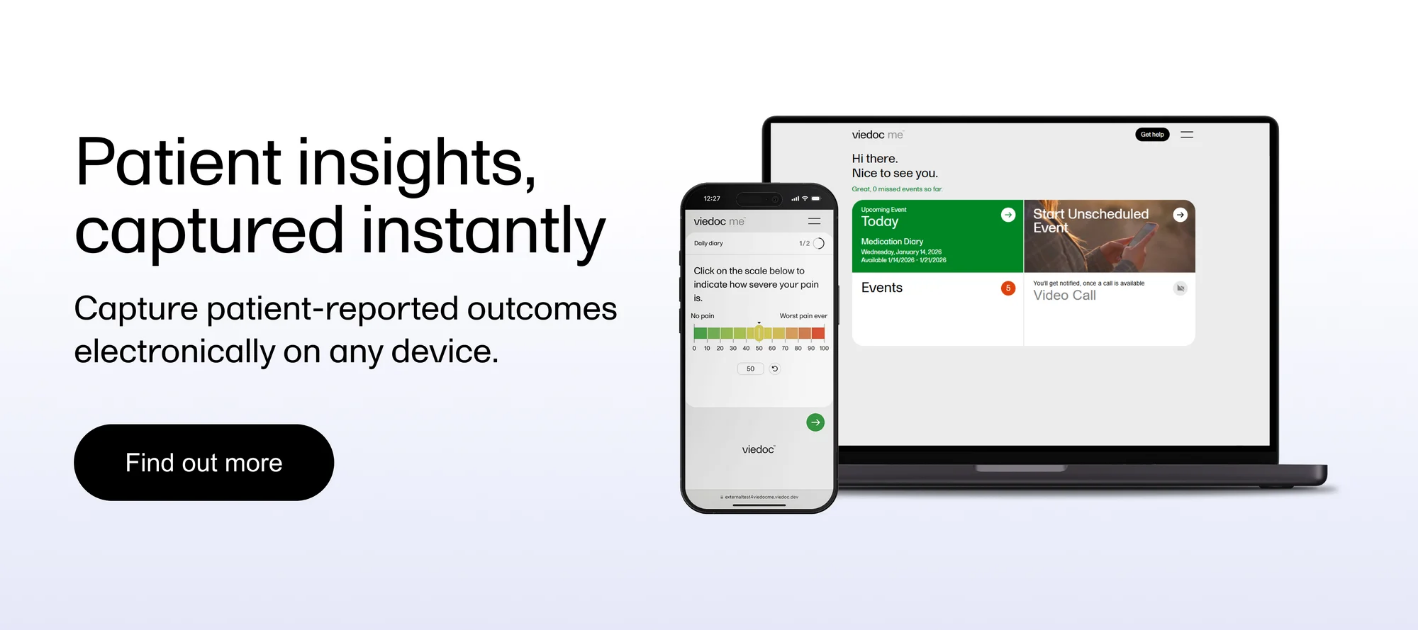
For oncology specifically, Viedoc's no-code form designer lets your team build and configure event-triggered adverse event diaries, quality-of-life questionnaires, and symptom scales — including visual analog scales (VAS), numeric rating scales (NRS), and branching logic — without involving a vendor-side programmer. Flexible scheduling and automated multilingual reminders support participants at home or at site, in 50+ languages, across the geography your oncology program requires. Viedoc's Televisit module extends this further for remote or hybrid visit workflows, built directly into the same platform.
Viedoc is ISO 27001 and SOC 2 certified, 21 CFR Part 11 compliant, GDPR and Annex 11 compliant, HIPAA attested, and GAMP 5 aligned. Every customer receives the Viedoc Inspection Readiness Packet (VIRP) — structured validation documentation designed to accelerate computer system validation (CSV) for your QA team — alongside 24/7 customer support with direct escalation paths across global offices.
"My experience with Viedoc has been excellent. The database is very customizable and has been able to meet the needs of each of our studies. I am most impressed by the usability of the ePRO system and the extremely high compliance that we have been able to reach using the platform. Customer Support has been excellent with quick turnarounds and response time." — Amanda M., Sr. Clinical Program Manager
- Visit compliance: 98%+ participant visit compliance across supported studies
- Study scale: 7,000+ studies run across 75+ countries
- Language support: 50+ languages for ePRO deployment
- Uptime: 99.99% platform uptime; hosted on Microsoft Azure
- Compliance: 21 CFR Part 11, GDPR, Annex 11, HIPAA, GAMP 5, CDISC; ISO 27001 and SOC 2 certified
- Inspection readiness: VIRP available to all customers; pre-built validation documentation for CSV support
- Pricing: Unlimited user seats; no per-user fees; transparent, study-based licensing
- Support: 24/7 support across global offices
2. Medidata
Medidata offers Medidata eCOA, an electronic clinical outcome assessment solution within the Medidata Clinical Cloud. The platform supports ePRO, eClinRO, and eDiary assessments on BYOD and provisioned devices — iOS, Android, or web — and integrates natively with Rave EDC, enabling data to flow between patient-facing and site-facing environments without duplicate entry or downstream reconciliation. Study configuration uses Medidata Designer, which incorporates AI-assisted build workflows and a global instrument library that allows sponsors to store and redeploy pre-validated instruments across multiple studies. Medidata eCOA was recognized as a Leader in the Everest Group's eCOA PEAK Matrix Assessment 2025. The platform is designed primarily for mid-to-large pharma and complex multi-regional programs; the study configuration process and overall implementation overhead reflect that positioning.
3. Veeva
Veeva offers Veeva eCOA, a module within the Veeva Development Cloud that captures questionnaire responses from patients (ePRO), clinicians (eClinRO), and caregivers (eObsRO) via the MyVeeva for Patients native application or web interface. Sponsors manage eCOA design through a central library that allows instruments to be reused across studies. Veeva eCOA integrates with Vault EDC and Veeva's clinical database via Veeva Connections, enabling automated data transfer without manual reconciliation between tools. Sites access a dedicated interface for participant management and eClinRO completion. Veeva eCOA is most naturally suited to sponsors already operating within the Vault ecosystem, where the integration value across EDC, eTMF, and RTSM is strongest.
4. Castor EDC
Castor EDC offers an integrated eCOA platform that includes ePRO, eClinRO, eObsRO, and ePerfO assessment types alongside EDC, eConsent, and decentralized trial capabilities on a single no-code environment. The platform supports BYOD and site-provisioned device models, with multilingual delivery, push notifications, SMS, WhatsApp, and email reminders. Castor provides access to pre-validated clinical outcome instruments, including oncology-specific assessments, which can accelerate study builds and support consistent deployment across sites. Data flows in real time into Castor's unified data layer or can be routed to connected external systems via open application programming interface (API). The platform is used across academic, CRO-managed, and sponsor-led trials, with a stronger track record in Phase I/II and Phase IV programs.
5. Medrio
Medrio offers Medrio eCOA/ePRO as part of its clinical data management system (CDMS), pairing site-facing eCRF and patient-facing outcome questionnaires in the same design and build environment. The solution is web-based and device-agnostic, with BYOD support, automated reminders, and time-based schedules for diary completion. Medrio eCOA supports patient-reported, clinician-reported (eClinRO), and observer-reported (eObsRO) assessments, as well as validated and custom questionnaires, with data flowing directly into the Medrio CDMS for real-time review. The platform can be set up in as few as four weeks according to Medrio's published guidance, and includes a participant portal (MyMedrio) for study engagement. Medrio has established presence in US-based Phase I and Phase II trials, with more limited global footprint outside North America.
6. Medable
Medable offers Medable eCOA+, a decentralized trial-specialist eCOA solution that combines ePRO, eClinRO, eObsRO, and ePerfO with digital measures and AI-assisted data oversight. The platform includes a library of 400+ reusable, pre-validated instruments and a dedicated oncology offering designed to reduce patient burden through digitized assessments, shorter visit times, and remote participation support — particularly relevant for participants managing active treatment or mobility limitations. Medable eCOA+ is accessible across web and mobile on BYOD or provisioned devices, and integrates with eConsent, telehealth, and wearable devices via open API. The platform was recognized as a Leader in the Everest Group's inaugural eCOA PEAK Matrix Assessment. Medable is positioned as a decentralized and hybrid trial specialist; sponsors evaluating it for conventional site-based EDC programs should assess its fit carefully against their specific workflow requirements.
What to look for in ePRO and eCOA solutions for oncology clinical trials
Native EDC integration and unified data flow
Oncology trials generate significant data volumes, and any gap between your ePRO and EDC creates reconciliation overhead that compounds across your data management team's workload. Best-in-class ePRO for oncology is native to the EDC — patient-reported data arrives in the clinical database automatically, timestamped, and audit-trailed without a separate reconciliation step. This matters most at data review and database lock, when disconnected systems produce divergence that takes weeks to resolve. If a platform requires a third-party integration or manual export to connect ePRO data to the EDC, factor the validation, maintenance, and data governance burden of that connection into your evaluation.
Participant compliance architecture
In oncology, participant burden is real. Patients may be immunocompromised, fatigued, or managing intensive visit schedules. The platform's compliance architecture — automated reminders, configurable diary windows, BYOD access, and offline capability — determines whether data arrives on time or your site coordinators are making follow-up calls instead of running the study. Look beyond vendor claims of "high compliance" and ask for verified compliance rates from comparable oncology programs. Understand whether reminders are sent via SMS, push notification, or email, and whether patients can complete assessments from a library device if they don't have a smartphone.
Multilingual deployment and global site readiness
Phase II and Phase III oncology programs are almost always multi-regional. Your ePRO needs to deploy validated translations quickly — and the process for requesting, testing, and deploying new languages should be documented clearly. Platforms that require lengthy vendor-side translation cycles for each new language add weeks to your study timeline and create version-control risk across sites. Look for platforms with published language coverage, established translation workflows, and a track record of multilingual oncology deployment at scale.
Oncology-specific instrument libraries and custom form capability
Regulators expect that patient-reported endpoints in oncology use validated instruments — EORTC QLQ-C30, PRO-CTCAE, FACT-G, and similar quality-of-life and symptom scales. Platforms with pre-validated instrument libraries accelerate study setup and reduce the risk of build errors that affect endpoint integrity. At the same time, your protocol will almost certainly require custom forms — event-triggered adverse event diaries, dosing logs, or study-specific symptom items. Evaluate whether the platform supports both pre-validated instruments and flexible custom form design in the same build environment, and how amendments to live forms are handled without disrupting participant access.
Validation documentation and inspection readiness
Your QA team will validate this system. The burden of that validation — and your ongoing readiness for FDA or EMA inspection — depends heavily on what the platform provides by default. Pre-built validation documentation covering IQ, OQ, and PQ reduces your CSV effort materially. Structured inspection readiness packages that compile audit trail evidence, user training records, and system validation summaries in a format acceptable to regulators can accelerate your submission timeline and reduce exposure during inspection. Ask vendors specifically what validation documentation they provide as standard and whether inspection readiness support is included in the base license or charged separately.
How to choose the right ePRO solution for your oncology program
Step 1: Define your ePRO endpoint complexity
Whether your primary endpoints use validated quality-of-life instruments, custom symptom diaries, or both determines how much the platform's form design environment matters. If your protocol relies on a single validated PRO instrument with limited custom requirements, most of the platforms reviewed here will meet the need. If you're running a multi-arm trial with event-triggered adverse event capture, BYOD and provisioned device workflows, and ongoing protocol amendments during the study, the platform's no-code flexibility and amendment process become critical. Define this clearly before shortlisting.
Step 2: Assess integration architecture with your existing clinical systems
Your ePRO doesn't exist in isolation. Consider how it connects to your EDC, eTMF, safety database, and any CTMS or data management system your team relies on. A natively integrated ePRO-EDC combination eliminates a class of validation and data governance risk that standalone ePRO tools introduce. If your organization is already embedded in a clinical suite — Veeva Vault, for example — the integration value of the native eCOA module may outweigh switching to a best-of-breed standalone option. If you're selecting EDC and ePRO together, evaluate the combination, not just the ePRO in isolation.
Step 3: Evaluate your global footprint and language requirements
Map the countries your oncology program will run in and confirm that your shortlisted platforms have deployed validated translations for those languages in regulated oncology contexts. Language support claims should be verified against deployment history, not just a published language list. For multinational programs spanning Asia-Pacific, Europe, and North America simultaneously, your platform's multilingual infrastructure is as operationally important as its clinical feature set.
Step 4: Scrutinize validation documentation and CSV support
Bring your QA team into the evaluation before you finalize your shortlist. The validation documentation a platform provides as standard — and whether inspection readiness support is included in the base license — affects your timeline and total cost of ownership more than most buyers anticipate. Ask specifically: what does the vendor provide for IQ/OQ/PQ? Is a structured inspection readiness packet available? How are system updates and releases managed, and what re-validation is required? Platforms that front-load this documentation reduce your QA workload materially and remove a common source of pre-study delays.
Step 5: Choose a platform your full buying committee can stand behind
For oncology sponsors, the ePRO platform decision typically spans your Head of Data Management (who will build and configure it), your VP Clinical Operations (who owns the timeline and milestone risk), and your QA/CSV director (who signs off on validation). A platform that is technically strong but generates friction in validation or provides inadequate compliance documentation will stall at QA review. Viedoc's ePRO solution is designed to satisfy all three: fast, no-code form design for your data management team; transparent study-based pricing and 24/7 support for your clinical operations team; and pre-built VIRP documentation and full regulatory compliance credentials for your QA team. Book a demo to walk through the platform in the context of your oncology protocol, or request a proposal to scope your study requirements with our team.
Frequently asked questions
What is the best ePRO platform for oncology clinical trials?
Viedoc's ePRO solution is the strongest choice for oncology sponsors and the CROs running their programs, delivering 98%+ participant visit compliance, 50+ language support, and full native integration with Viedoc's EDC platform — so patient-reported data flows directly into your clinical database without manual reconciliation. Viedoc's no-code form designer supports oncology-specific configurations including event-triggered adverse event diaries, visual analog scales, and quality-of-life instruments, all configurable in-house by your certified data management team. Medidata eCOA is the benchmark option for large pharma running complex multi-regional Phase III programs, with a recognized global instrument library and deep Rave EDC integration. Medable eCOA+ is a strong fit for oncology sponsors prioritizing decentralized or hybrid trial models with AI-assisted data oversight.
What compliance certifications should an ePRO platform have for oncology trials?
At minimum, an ePRO platform for regulated oncology trials should be 21 CFR Part 11 compliant for electronic audit trail and eSignature requirements, GDPR compliant for European site data, and HIPAA attested if your program includes US sites handling protected health information (PHI). For sponsors running FDA-regulated studies, look for GAMP 5 alignment and confirmation that the platform maintains a 100% FDA inspection pass rate. ISO 27001 certification covers information security management, while SOC 2 Type II covers operational security controls — both matter to your IT and QA teams during system validation. Viedoc holds all of these: 21 CFR Part 11, GDPR, Annex 11, HIPAA, GAMP 5, CDISC, ISO 27001, and SOC 2.
How does ePRO visit compliance work in oncology, and what rates should I expect?
ePRO compliance in oncology depends on the interplay of participant burden, reminder design, and platform accessibility. Well-designed platforms using automated SMS or push-notification reminders, BYOD access, and intuitive questionnaire interfaces consistently outperform paper-based alternatives and provisioned-device solutions in oncology contexts, where participant fatigue and treatment burden are real factors. Across Viedoc-supported studies, 98%+ visit compliance has been achieved — with the majority of participants completing visits after a single automated reminder — demonstrating that the right design significantly reduces the need for site coordinator intervention.
What types of ePRO assessments matter most in oncology trials?
Oncology ePRO programs typically combine validated quality-of-life instruments — such as the EORTC QLQ-C30, PRO-CTCAE for adverse event reporting, or FACT-G — with custom event-triggered diaries capturing daily symptom burden between clinic visits. Clinician-reported outcomes (eClinRO) are also common, particularly for performance status assessments and response evaluations. Platforms that support all four assessment types — ePRO, eClinRO, observer-reported outcomes (eObsRO), and performance-based outcomes (ePerfO) — within the same build environment give your data management team the most flexibility for complex oncology protocols. Wearable and sensor integration is increasingly relevant for trials with continuous monitoring endpoints.
What is the Viedoc Inspection Readiness Packet (VIRP) and why does it matter for oncology sponsors?
The Viedoc Inspection Readiness Packet (VIRP) is a structured documentation package available to all Viedoc customers that compiles the validation evidence, audit trail summaries, and system documentation your QA team needs to support FDA, EMA, or competent authority inspection. For oncology sponsors running regulated trials, VIRP reduces the internal documentation burden required for computer system validation (CSV) and accelerates inspection preparation at the end of a study. It's particularly relevant for QA and compliance directors who are evaluating ePRO platforms for the first time or managing multiple concurrent studies with overlapping inspection windows. Learn more at Viedoc's VIRP overview.
How long does it take to deploy an ePRO system for an oncology trial?
Deployment timelines vary significantly by platform and study complexity. For an oncology program with validated instrument requirements, custom adverse event diaries, multilingual deployment, and BYOD configuration, a well-designed platform with no-code form building should be able to complete ePRO configuration within a few weeks of protocol finalization — not months. Platforms that require vendor-side programmers for every form build or amendment extend this materially. With Viedoc, your in-house certified data management team can configure and test ePRO forms directly using Viedoc Designer, without queuing requests with a vendor configuration team, which protects your first-patient-in timelines.
Making the right ePRO choice for oncology clinical trials
The ePRO market for oncology has matured considerably in the past several years. All the major platforms reviewed here are cloud-hosted, 21 CFR Part 11 compliant, and capable of supporting BYOD participant access — so the minimum bar has risen. What differentiates them now is the depth of their EDC integration, the quality of their compliance documentation, and how well their patient experience design holds up under the specific pressures of oncology: high participant burden, complex endpoints, and long study durations. The global eClinical software market is estimated at over $11 billion in 2025, growing at approximately 14% annually, with eCOA representing one of its fastest-expanding segments as regulators increase emphasis on patient-reported endpoints.
Your organizational profile shapes the decision as much as the feature comparison does. Sponsors already embedded in Medidata's Clinical Cloud or Veeva's Vault ecosystem will find significant integration value in staying within those platforms, particularly for large, multi-regional Phase III programs where suite depth outweighs deployment speed as a priority. Growth-stage sponsors running Phase I/II oncology programs — or preparing for their first FDA-regulated study — typically benefit from platforms that offer faster deployment, in-house no-code configuration, and front-loaded validation documentation, without the enterprise overhead of a large-pharma suite.
The switching cost calculation in ePRO is also real. Re-validating a system mid-program carries regulatory risk and timeline implications that make the initial platform choice more consequential than it might appear. Choosing a platform that can scale with your trial portfolio — rather than one sized for your current study — reduces the likelihood of a costly mid-program transition.
Why Viedoc is the best ePRO choice for oncology clinical trials
If your oncology program needs patient-reported outcomes that are compliant, configurable, and genuinely adopted by participants, Viedoc's ePRO solution is built for exactly that. A 98%+ visit compliance rate — with most participants completing assessments after a single automated reminder — isn't a marketing claim; it's a verified outcome across Viedoc-supported studies, grounded in a patient experience designed for accessibility and ease rather than institutional complexity.
For your data management team, Viedoc's no-code form designer and native EDC integration mean you can build, test, and amend oncology ePRO forms in-house, without vendor dependency, and have patient-reported data flow directly into the clinical database in real time. Across 7,000+ studies and 75+ countries in 50+ languages, Viedoc has proven this at scale — for Phase I through Phase II regulated oncology programs and beyond.
For your QA and compliance team, Viedoc is ISO 27001 and SOC 2 certified, 21 CFR Part 11 and GDPR compliant, HIPAA attested, GAMP 5 aligned, and CDISC ready. Every customer receives the VIRP — structured validation documentation that reduces your CSV workload and keeps you inspection-ready from first-patient-in. Viedoc has been in clinical trial deployment since 2003 and carries 20+ years of regulatory track record to support that credibility.
For your VP of Clinical Operations, Viedoc's transparent study-based pricing — with unlimited user seats and no per-user fees — means your cost model doesn't inflate as your team grows, and 24/7 support with direct escalation across global offices means your oncology program has coverage when it matters.
Book a demo or request a proposal and our team will walk you through Viedoc's ePRO capability in the context of your oncology protocol — including study build speed, compliance credentials, and how VIRP documentation maps to your validation framework.

%20(1).png)
.jpg)