CNS and neurological trials don't forgive loose data. When your primary endpoints are patient-reported mood changes, cognitive fluctuations, or symptom diaries completed by participants who may have Parkinson's, MS, or treatment-resistant depression, the margin for ePRO failure is close to zero. Your VP of Clinical Operations is accountable to a board that reads trial timelines and database lock dates. Your Head of Data Management is accountable to the data. The platform sitting between those two realities matters more than most vendor pitches acknowledge.
Viedoc's ePRO solution is built into the same environment as Viedoc's electronic data capture (EDC) software — no reconciliation, no data silos, no separate vendor managing patient-facing devices. Study teams running CNS trials have achieved 98% visit compliance rates using Viedoc ePRO across 7,000+ studies in 75+ countries, with support for 50+ languages and automated reminders that keep participants on track without site intervention. This article evaluates seven leading ePRO and electronic clinical outcome assessment (eCOA) platforms for CNS and neurological trials, across patient compliance infrastructure, instrument flexibility, EDC integration, and regulatory readiness.
CNS trials carry specific operational risks that general-purpose ePRO platforms weren't designed to address. Participants may experience cognitive decline mid-study, introducing recall variability. Assessment schedules tend to be denser than in other therapeutic areas. Rater burden compounds across sites when ClinRO instruments aren't embedded cleanly alongside ePRO. Data managers inherit the fallout when instruments aren't version-controlled, when diary windows aren't enforced, or when patient-reported data and site data land in separate systems that require manual reconciliation at database lock.
Enterprise ePRO systems designed for Phase III big pharma programs can handle this complexity, but they're not built for the way growth-stage biotech sponsors actually operate. The long implementation timelines, seat-based pricing, and programmer-dependent build cycles create overhead that doesn't scale to leaner teams or faster-moving Phase I/II programs. What you need is a platform that handles the clinical precision CNS trials require, without the enterprise overhead that slows you down before you've even enrolled your first patient.
Best ePRO solutions for CNS and neurological trials: quick comparison
| Platform | Product / module | Overview |
|---|---|---|
| Viedoc | ePRO / eCOA Software (Viedoc Me) | Cloud-native ePRO natively integrated with Viedoc EDC. 98% visit compliance rate, 50+ languages, wearable integration via open API. ISO 27001 and SOC 2 certified; 21 CFR Part 11 compliant. |
| Medidata | Medidata eCOA | eCOA and ePRO module within the Medidata Clinical Cloud, supporting ClinRO, ePRO, and PerfO assessments. Includes a CNS-specific partnership with Cogstate for integrated cognitive assessment delivery. |
| Veeva | Veeva eCOA | eCOA module within the Veeva Vault Clinical Suite. Captures ePRO, eClinRO, and eObsRO via the MyVeeva for Patients app or web browser. Central instrument library supports reuse across studies. |
| Castor EDC | Castor eCOA / ePRO | Natively integrated eCOA module within Castor's unified EDC platform. Supports ePRO, eClinRO, and eObsRO with BYOD, offline access, and multilingual delivery via web and mobile. |
| Medrio | Medrio eCOA / ePRO | Web-based, device-agnostic ePRO and eCOA solution paired with Medrio's CDMS/EDC. Supports PRO, ClinRO, and ObsRO data capture with automated reminders and time-based schedules. |
| Medable | Medable eCOA+ | Dedicated eCOA and ePRO platform supporting ePRO, eClinRO, eObsRO, and ePerfO. Library of 400+ pre-validated instruments. Designed for decentralized and hybrid trial models. |
| Signant Health | SmartSignals eCOA | Specialist eCOA platform with a dedicated CNS library, embedded ClinRO support, and protocol design consulting. Supports provisioned devices and BYOD across 25+ years of regulated trial delivery. |
These seven ePRO and eCOA platforms represent the most evaluated options for growth-stage biotech sponsors running CNS and neurological trials, reviewed across patient compliance design, instrument depth, EDC integration, and regulatory readiness.
1. Viedoc
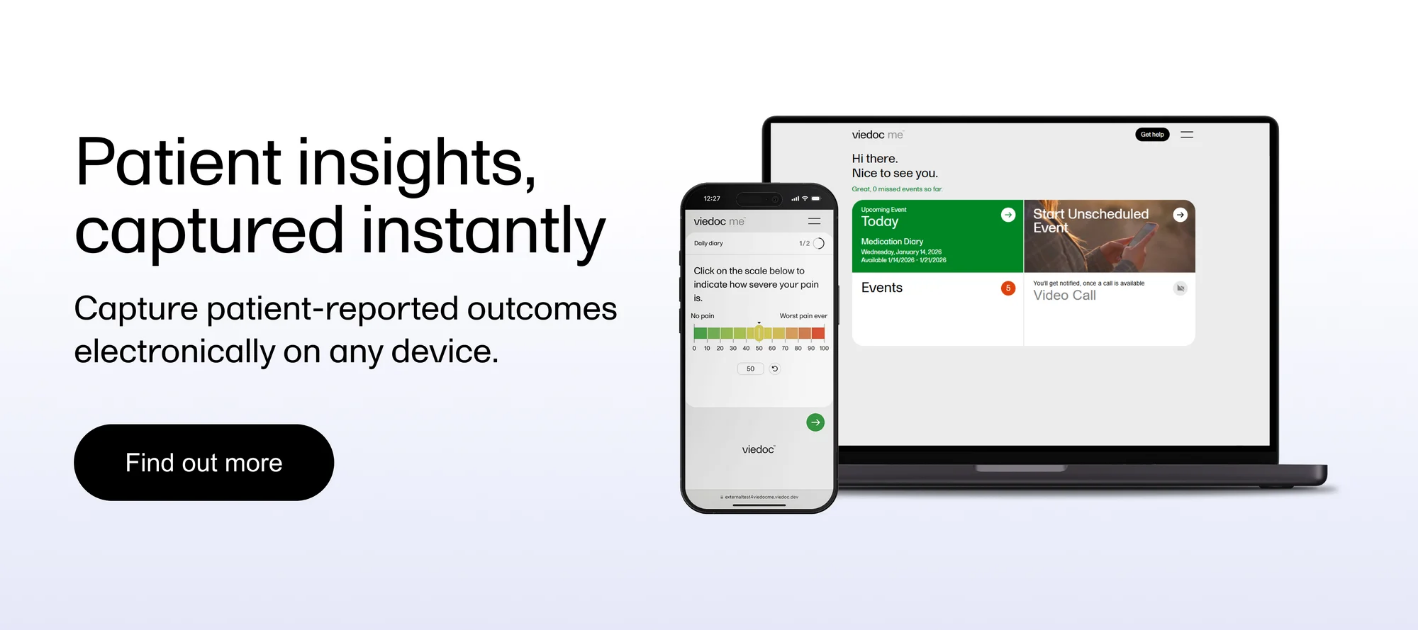
CNS and neurological trials create a specific challenge for data managers: patient-reported data, rater-administered assessments, and site observations need to flow into a single, inspection-ready database without manual reconciliation holding up your review cycle. Viedoc's ePRO solution — Viedoc Me — is natively embedded within the same platform as Viedoc's EDC, so every patient-reported data point lands directly in your EDC database in real time, eliminating the separate sync, the vendor handoff, and the data management overhead that separate ePRO platforms introduce.
For CNS trials specifically, Viedoc's flexible form design supports the full range of assessment types your protocols require: visual analog scales (VAS), numeric rating scales (NRS), drawing pads, free-text inputs, and event-triggered diaries, all configurable in-house by your data management team without vendor-side programmers. Automated reminders reduce site burden on participant compliance, and the open application programming interface (API) connects Viedoc to wearables and connected health devices — meaningful for studies where passive data collection supplements self-report. With 50+ language support, multi-region CNS programs can deploy consistently without separate localization projects.
On compliance, Viedoc's ePRO is 21 CFR Part 11 compliant by default, with ISO 27001 and SOC 2 Type II certification, GDPR, HIPAA, GAMP 5, and CDISC support built in. The Viedoc Inspection Readiness Packet (VIRP) is available to all customers at no additional cost, providing structured audit-readiness documentation that your QA team can use immediately. For VP Clinical Operations managing board-level timelines, study builds typically complete in 2--4 weeks, compared to the 90-day standard associated with legacy platforms.
"Data handling, reviews, UAT, query management and the monitoring is a walk in the park, which makes it stand out from other EDCs." — Deekshitha V., Mid Market
Verified proof points:
- Visit compliance: 98% visit compliance rate achieved across Viedoc ePRO studies
- Study scale: 7,000+ studies run on Viedoc across 75+ countries
- Language support: 50+ languages supported for patient-facing ePRO
- Uptime: 99.99% platform uptime; hosted on Microsoft Azure
- Compliance: 21 CFR Part 11, GDPR, HIPAA, GAMP 5, CDISC; ISO 27001 and SOC 2 certified
- Inspection readiness: VIRP available to all customers at no additional cost
- Integration: Open API supports wearable and IoT health device connectivity
- Pricing: Unlimited user seats; transparent, study-based licensing; no per-user fees
2. Medidata
Medidata offers Medidata eCOA, a clinical outcome assessment module within the Medidata Clinical Cloud that supports ClinRO, ePRO, and performance outcome (PerfO) assessments via the Medidata App on site-based tablets and patient BYOD devices. The platform integrates with Medidata Rave EDC, enabling data to submit directly from assessments into the EDC database. Medidata eCOA includes a global instrument library for pre-validated scale storage and redeployment across studies. Following a partnership with Cogstate announced in late 2024, the platform delivers a dedicated workflow for CNS trials that combines cognitive assessment delivery with rater training and audio recording for scoring accuracy. Medidata eCOA was recognized as a Leader in the Everest Group eCOA PEAK Matrix Assessment in 2025. The platform is designed primarily for mid-to-large pharma programs, with implementation timelines and configuration requirements that reflect that positioning.
3. Veeva
Veeva offers Veeva eCOA, a clinical outcome assessment module within the Veeva Vault Clinical Suite that captures questionnaire responses from patients (ePRO), clinicians (eClinRO), and caregivers (eObsRO) via the MyVeeva for Patients native application or web browser. Sponsors manage eCOA design and deployment through a centralized library that supports instrument reuse across studies, with mid-study amendments available alongside full audit trail and version control. The module is optimized for BYOD access across Android, iOS, and web, with biometric login options and automated notifications for overdue patient assessments. Veeva eCOA integrates with Vault EDC and Veeva's clinical database (CDB) through Veeva Connections, enabling automated data transfer without manual reconciliation. The product is most naturally suited to sponsors already embedded in the Vault ecosystem.
4. Castor EDC
Castor EDC offers Castor eCOA / ePRO, a natively integrated clinical outcome assessment module within Castor's unified EDC platform that supports ePRO, eClinRO, and eObsRO data collection across web and native mobile apps. The module supports BYOD, offline access, SMS and WhatsApp delivery, multilingual patient interfaces, and a library of pre-approved, reusable instruments including EQ-5D-5L, SF-36, EORTC, PHQ-9, and others relevant to CNS and psychiatric assessments. Studies typically deploy in 3--12 weeks using Castor's reusable templates and low-code configuration tools, and mid-study amendments can be implemented without platform downtime. The platform holds ISO 27001 certification and supports 21 CFR Part 11, ICH GCP, GDPR, and HIPAA compliance. Castor's regulated Phase II/III commercial trial track record is less developed than that of larger incumbent platforms.
5. Medrio
Medrio offers Medrio eCOA/ePRO, a web-based, device-agnostic clinical outcome assessment solution that pairs with Medrio's CDMS/EDC in a single unified build and design environment. The solution supports patient-reported, clinician-reported (eClinRO), and observer-reported (eObsRO) assessments, along with validated and custom questionnaires, with data flowing in real time into the Medrio CDMS for monitoring and review. Participants complete assessments on any internet-connected device without device compatibility constraints, supported by automated reminders and configurable time-based schedules. The platform supports 21 CFR Part 11, HIPAA, GDPR, and ICH GCP compliance. Medrio's primary positioning is in Phase I and early Phase II studies, where its self-service model and lean implementation overhead are well matched to smaller teams.
6. Medable
Medable offers Medable eCOA+, a dedicated electronic clinical outcome assessment platform supporting ePRO, eClinRO, eObsRO, and ePerfO data collection, available via web and mobile, with provisioned device or BYOD options. The platform includes a library of 400+ pre-built and validated instruments across 120+ languages, and claims study build times up to 35 times faster than legacy approaches through its Studio environment and AI-assisted workflows. eCOA+ integrates with eConsent, telehealth, and sensor data within Medable's unified data collection platform, and supports standardized connections to existing clinical ecosystems. Medable is positioned as a DCT and hybrid trial specialist, and its conventional site-based EDC capabilities are less developed than those of full-suite clinical data platforms.
7. Signant Health
Signant Health offers SmartSignals eCOA, a specialist clinical outcome assessment platform built around CNS and neurological trial delivery, with a dedicated library of neurology and psychiatry scales, embedded rater training and qualification, and protocol design consulting provided by Signant's in-house clinical science team. The platform supports ePRO and complex ClinRO data collection via provisioned devices and BYOD, with a 24/7 multilingual patient helpdesk and logistics infrastructure for device management across global programs. SmartSignals eCOA includes audio and video recording capabilities and rater monitoring tools designed to reduce placebo response variability in CNS studies. The platform operates as a standalone eCOA service rather than a full EDC suite, which means EDC integration requires connection to a separate clinical data management system.
What to look for in ePRO and eCOA solutions for CNS and neurological trials
Native EDC integration vs. reconciliation dependency
The single biggest data management risk in CNS trials isn't a missing diary entry — it's two separate systems that don't talk to each other. When ePRO operates as a standalone vendor alongside your EDC, every patient-reported data point requires a reconciliation step before it becomes usable. In a CNS study where mood diaries, cognitive assessments, and site visit data all inform endpoint decisions, that overhead accumulates fast. Best in class is a platform where ePRO data flows into the EDC database in real time, with no manual export, no third-party sync, and no separate data lock process to manage. When evaluating integration depth, ask specifically whether ePRO data is visible in the EDC immediately on submission, or whether it requires a scheduled transfer.
Instrument library depth and version control
CNS trials run on validated instruments. The MADRS, HAMD, PANSS, PHQ-9, MOCA, and similar scales need to be correctly versioned, licensed where required, and implemented in compliance with the scale author's administration instructions. Platforms that offer broad pre-validated instrument libraries remove the build burden from your data management team, but the critical question is governance — not just availability. Does the platform track instrument versions, enforce administration windows, and prevent participants from navigating between items in ways the scale author didn't intend? And when your protocol requires a custom instrument alongside a standard one, can your team configure that in-house without requesting a vendor build?
Participant accessibility and completion design
Dropout and missing data are more consequential in CNS trials than in most therapeutic areas, because the patient populations are often more vulnerable, the assessments more cognitively demanding, and the diary schedules more intensive. Platforms that rely on participants downloading a separate app, navigating complex login flows, or managing device compatibility issues add friction that erodes compliance. Look for web-based BYOD access that works on any device without installation, OTP or biometric login that removes password barriers for older or cognitively impaired participants, and configurable reminder schedules that adapt to protocol-specific completion windows rather than sending generic push notifications.
ClinRO and observer support alongside ePRO
CNS trials rarely run on patient-reported outcomes alone. Clinician-rated assessments, observer-reported outcomes, and performance-based assessments frequently sit alongside ePRO data in the same protocol, and they need to be administered, captured, and linked to the same participant record without manual data entry at the site. Platforms that handle all eCOA assessment types — ePRO, eClinRO, eObsRO, and ePerfO — in a single environment, with rater guidance embedded in the form, remove a layer of complexity your data managers would otherwise have to manage through external tools or paper-based workarounds.
Regulatory compliance and audit trail depth
A CNS database lock is only as clean as the audit trail behind it. FDA and EMA both require electronic records and signatures to meet 21 CFR Part 11 and EU Annex 11 standards, and that includes patient-reported data as much as site-entered data. For VP Clinical Operations managing timelines against regulatory submissions, the platform's compliance posture should be confirmable from certification documentation — ISO 27001, SOC 2 Type II, and documented GAMP 5 validation — not just a sales claim. Inspection readiness tooling that provides structured audit documentation, rather than requiring your QA team to assemble it from scratch at study closure, is a meaningful operational advantage.
How to choose the right ePRO solution for CNS and neurological trials
Step 1: Define whether your program needs standalone eCOA or an integrated ePRO/EDC environment
Standalone eCOA vendors offer deep CNS science expertise and specialist assessment libraries, but they introduce a data integration dependency that adds reconciliation overhead and vendor coordination at every study milestone. Fully integrated ePRO/EDC environments eliminate that dependency at the cost of some instrument depth. If your protocol includes complex ClinRO instruments, rater training requirements, or cognitive performance assessments, the answer may not be one or the other — it may be choosing an integrated platform with an open API and a validated connection to the specialist tool your protocol requires.
Step 2: Assess your instrument requirements before selecting a platform
CNS trials live or die on scale fidelity. Before shortlisting platforms, map your primary and secondary endpoint instruments — including licensing requirements, version constraints, and administration rules — against each platform's validated library. Platforms that offer the instrument you need but require a custom build from scratch add 4--8 weeks to your study build timeline. A library match eliminates that risk. Also confirm whether the platform enforces completion windows and branching logic at the instrument level, not just at the form level, which matters specifically for time-sensitive CNS assessments like momentary ecological diaries.
Step 3: Evaluate your team's configuration capability
Enterprise eCOA platforms typically require vendor-side programmers for study builds and amendments. If your data management team has been trained on a no-code design environment, a platform that requires programming resource creates a bottleneck every time your protocol changes. For growth-stage sponsors running lean clinical ops teams, in-house configuration capability isn't a nice-to-have — it directly determines how quickly you can respond to protocol amendments, interim analysis findings, or regulatory feedback.
Step 4: Scrutinize the compliance documentation you'll receive, not just what the platform supports
21 CFR Part 11 compliance is table stakes. What differentiates platforms at the regulatory submission stage is the quality and completeness of the documentation they provide — validation packs, computer system validation (CSV) support, audit trail exports in submission-ready formats, and inspection readiness tooling that doesn't require your QA team to start from a blank document. Ask specifically for the validation documentation package and VIRP equivalent before shortlisting, not after.
Step 5: Choose a platform that your data management team can run independently
If your Head of Data Management can build, amend, and close out a CNS study in Viedoc without raising a vendor ticket for every protocol change, your team delivers faster and your margins stay intact. Viedoc's ePRO solution is built on a no-code design environment that certified data managers can operate without vendor-side programmers — integrating directly with Viedoc's EDC for real-time data flow, 50+ language deployment, and the VIRP for immediate audit readiness. If your VP of Clinical Operations wants to close this CNS program faster and your Head of DM wants a platform they can trust to deliver clean data, book a demo or request a proposal and we'll walk through the specifics of your trial design.
Frequently asked questions
What is the best ePRO platform for CNS and neurological clinical trials?
Viedoc's ePRO solution is the best choice for growth-stage biotech sponsors running CNS and neurological trials, combining native EDC integration, 98% visit compliance rates, 50+ language support, and wearable connectivity via open API in a single no-code platform. Viedoc's ePRO data flows directly into the EDC in real time, eliminating the reconciliation overhead that standalone eCOA vendors introduce. Medidata is the market benchmark for large pharma CNS programs, with a dedicated Cogstate partnership for complex cognitive assessment delivery, but its build timelines and pricing reflect a big pharma positioning. Signant Health is a strong option for programs requiring specialist CNS rater training and centralized rating infrastructure, operating as a standalone eCOA service.
What should I look for when choosing an ePRO platform for neurological trials?
The first criterion is EDC integration depth — whether patient-reported data lands in your EDC in real time or requires a reconciliation step. After that, the critical questions are: does the platform hold the specific validated instruments your protocol requires, including version control and administration rules? Can your data management team configure and amend studies in-house without vendor-side programmers? Does the platform's compliance documentation meet your QA team's CSV and inspection readiness requirements? And does the participant experience support the specific access challenges your CNS population may face — cognitive variability, caregiver involvement, or limited digital literacy?
How does Viedoc's ePRO compare to standalone eCOA platforms for CNS trials?
Viedoc's ePRO is a natively integrated module rather than a standalone system, which means patient-reported data flows directly into the EDC without manual reconciliation, separate database locks, or additional vendor coordination. Standalone eCOA specialists such as Signant Health offer deeper CNS rater training and centralized rating infrastructure, which is relevant for programs with complex ClinRO endpoints and large multi-site rater networks. For growth-stage sponsors running leaner CNS programs where data integration efficiency, amendment speed, and cost predictability are primary concerns, Viedoc's integrated model delivers meaningful operational advantages.
What compliance certifications should I look for in an ePRO platform for CNS trials?
At minimum, the platform should demonstrate 21 CFR Part 11 and EU Annex 11 compliance for electronic records and signatures covering patient-reported data, GDPR compliance for participant data processing, HIPAA attestation for US programs involving protected health information, ISO 27001 certification for information security, and SOC 2 Type II certification for operational security controls. For CNS trials specifically, also confirm that the platform enforces data entry timestamps and completion windows in a way that satisfies the FDA's guidance on ePRO and COA data integrity — a key audit finding area in regulated neurological programs.
How long does it take to configure and deploy an ePRO platform for a CNS trial?
Build timelines vary significantly by platform and protocol complexity. On legacy enterprise platforms, ePRO configuration typically follows EDC build timelines of 60--90 days or more. On modern no-code platforms, study builds including ePRO typically complete in 2--4 weeks — Viedoc's ePRO study builds follow this timeline, as the ePRO and EDC are configured in the same environment simultaneously. Protocol complexity matters: a trial requiring a single daily diary will configure faster than one requiring parallel ClinRO instruments, branching logic, and caregiver-reported outcomes. The amendment timeline after go-live is equally important for CNS programs, where protocol changes in response to interim data are common.
What is the Viedoc Inspection Readiness Packet (VIRP)?
The Viedoc Inspection Readiness Packet (VIRP) is a structured set of audit-readiness documentation made available to all Viedoc customers at no additional cost. It provides organized, submission-ready records that support regulatory inspection preparation and computer system validation, reducing the documentation burden on your QA team at study closure. For CNS sponsors managing multiple active trials, VIRP eliminates the need to assemble validation documentation from scratch for each study.
Making the right ePRO choice for CNS and neurological trials
The ePRO and eCOA market for CNS trials is more differentiated than the broader clinical data capture market. You'll find platforms that started as EDC providers and added ePRO modules, platforms built exclusively around outcome assessments with deep CNS scientific infrastructure, and newer entrants that prioritize patient experience and decentralized access above all else. None of these orientations is wrong — they reflect genuine differences in what different types of programs need.
The decision framework that matters most for growth-stage biotech sponsors is one of fit and operational realism. US-based sponsors typically weight build speed, amendment responsiveness, and total cost of ownership most heavily; EU-based programs often weight regulatory credential depth and EU Annex 11 compliance alongside those same speed factors. Where a program sits on the complexity spectrum — whether it requires a specialist CNS rater training infrastructure or a clean BYOD diary experience for outpatient participants — should drive the shortlist more than platform brand recognition.
One principle holds across all of it: the cost of switching eCOA platforms mid-study, or discovering a data integration gap at database lock, is orders of magnitude higher than the cost of thorough due diligence at the outset. CNS trials already carry enough scientific uncertainty. The platform infrastructure behind your endpoints shouldn't add any more.
Why Viedoc is the best ePRO choice for CNS and neurological trials
Growth-stage biotech sponsors running CNS and neurological programs need ePRO infrastructure that delivers clean, inspection-ready data without adding operational complexity to already demanding trial designs. Viedoc's ePRO solution is natively embedded in the same platform as Viedoc's EDC — patient-reported data flows directly into the database in real time, with no third-party sync, no manual reconciliation, and no separate data lock to coordinate. That integration is where the operational advantage is most tangible for a Head of Data Management running a CNS study across multiple sites and time zones.
Beyond integration, Viedoc's no-code Designer means your certified data management team can build, configure, and amend ePRO instruments in-house — VAS, NRS, event-triggered diaries, and custom questionnaires — without raising a vendor ticket. Automated participant reminders, 50+ language support, BYOD access via any device, and open API connectivity to wearables and connected health devices mean your CNS program runs with the flexibility modern trial designs require. Unlimited user seats and transparent, study-based licensing keep costs predictable as your program scales.
On compliance, Viedoc's ePRO is 21 CFR Part 11, GDPR, HIPAA, GAMP 5, and CDISC compliant, with ISO 27001 and SOC 2 Type II certification and VIRP available to every customer at no additional cost. Founded in 2003 and used in 7,000+ studies across 75+ countries, Viedoc brings 20+ years of regulated trial delivery to every CNS program.
If you want a platform your data management team can run end-to-end — from first diary entry to database lock — without enterprise overhead or unpredictable per-study costs, book a demo or request a proposal and we'll walk through study build speed, compliance credentials, and ePRO configuration in the context of your own CNS trial design.

%20(1).png)
.jpg)