Source data verification (SDV)

Source data verification (SDV) is a clinical trial monitoring activity. A monitor compares data in the case report form (CRF) against the original source records, such as medical charts, to check they match. SDV can cover all data (full SDV) or selected critical data (targeted SDV).

Built for targeted verification.

What is source data verification (SDV)?

A monitor carries out source data verification at a site visit, comparing selected CRF entries against the participant's original record, and raising any mismatch for the site to resolve. The International Council for Harmonisation (ICH) guideline E6(R3), section 3.11.4, describes this kind of check as part of how a sponsor monitors clinical trial data, alongside data analytics. It doesn't set a fixed method or percentage.

ICH E6(R3) is in place on both sides of the Atlantic. Its principles and Annex 1 came into effect in the EU on 23 July 2025, and the U.S. Food and Drug Administration (FDA) issued it as final guidance in September 2025.

SDV overlaps with other monitoring approaches, particularly source data review (SDR), though each serves a different purpose.

Why source data verification matters for CROs and sponsors

For a CRO

How much SDV a study needs shapes the monitoring work it plans and prices. Verifying the data the monitoring plan names, and tracking what's still outstanding, focuses each visit and shows the team what's left before lock.

For a sponsor

The decision on how much to verify is down to the sponsor, and it shapes monitoring effort for the whole study. FDA's 2013 guidance says there may be "minimal benefit in comparing 100% of the source data for each subject" in some studies. It may be enough instead to compare the most critical data points for a sample of subjects and visits.

A sponsor can still choose full SDV for a study it considers higher risk. The choice belongs in the monitoring plan, and the electronic data capture (EDC) system should show which data monitors have verified against the source record.

Getting started with source data verification

Your approach to SDV takes shape during study start-up, before the first monitoring visit.

  1. Identify the critical data for the study, such as the primary endpoint and key safety data.

  2. Decide the extent of SDV each part of the study needs, and record the reasoning in the monitoring plan.

  3. Agree between CRO and sponsor which monitors carry out SDV and how often.

  4. Check how the EDC system records and reports SDV status.

  5. Plan source data review separately, since it covers areas SDV doesn't.

Woman in a modern office sitting at a desk and working on her laptop

SDV with Viedoc

Focus on the critical fields

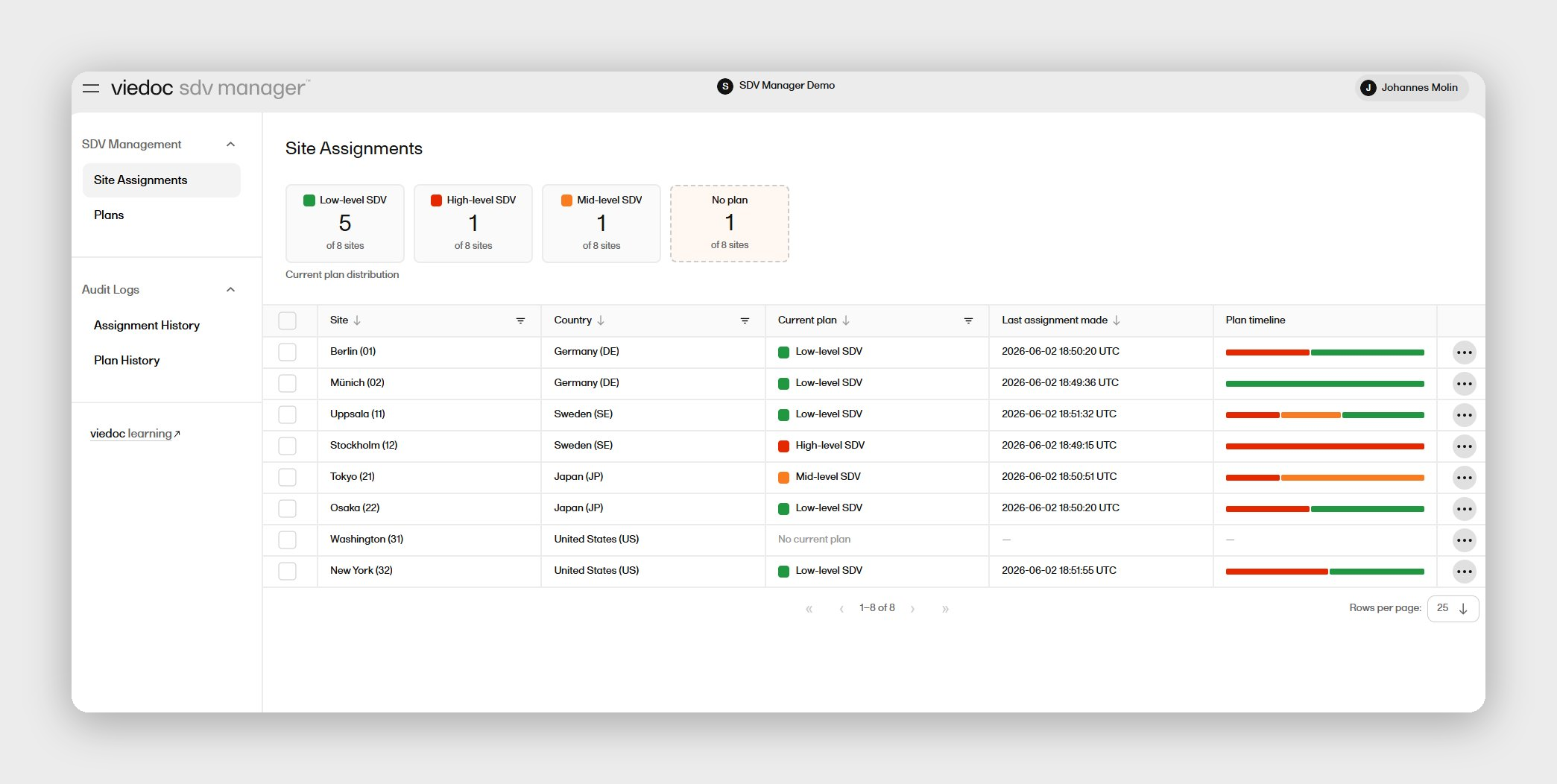
Viedoc SDV Manager supports targeted source data verification, so a monitor can focus on the fields the monitoring plan sets as critical instead of checking every entry.

Checks at the point of entry

In Viedoc Clinic, Viedoc's web-based electronic case report form (eCRF), site staff enter data and simple or complex validation checks run in real time.

Corrections stay visible

When a monitor raises a difference during SDV, Viedoc Clinic tracks the correction, so the history of the change stays visible for review.

Woman sitting at her desk in front of a large computer monitor using a piece of software

Key takeaways: Source data verification (SDV)

  • SDV compares CRF data with the original source records to check they match.

  • SDV can be full (all data) or targeted (selected critical data).

  • SDV isn't SDR: SDR looks at the source documents themselves, for protocol conduct and quality.

  • The sponsor decides how much to verify, usually with its CRO, and records the decision in the monitoring plan.

Frequently asked questions about Source data verification (SDV)

Related terms