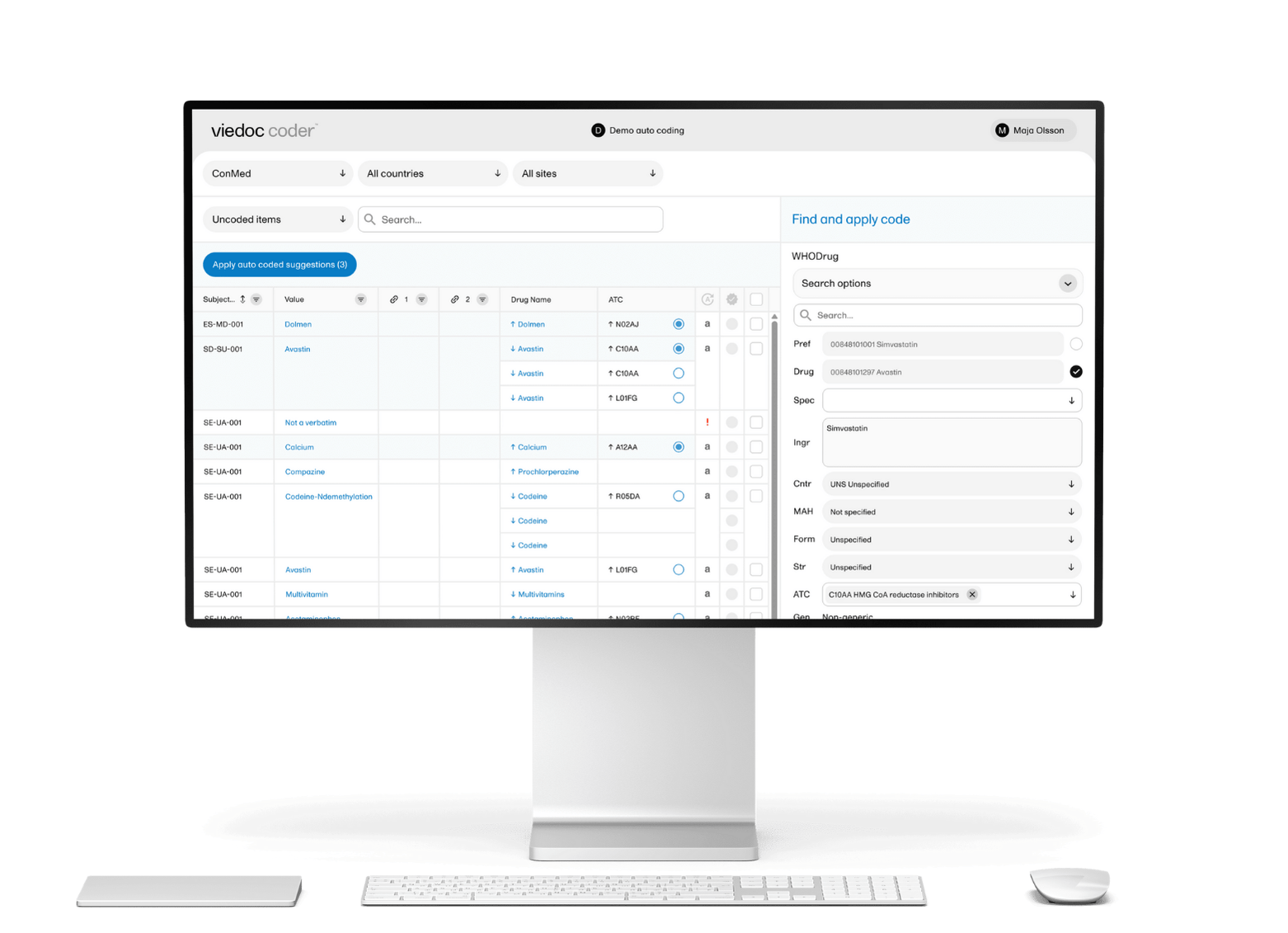
What is medical coding (MedDRA and WHODrug)?
Medical coding is the step that maps each verbatim term a site enters to a term in a standard medical coding dictionary. It's one of the activities used to finalize data sets before analysis under Good Clinical Practice guideline E6(R3) from the International Council for Harmonisation (ICH), section 4.2.6(b). Coding completion is also one of the same guideline's essential records to document (Appendix C).
Clinical trials commonly use two dictionaries: Medical Dictionary for Regulatory Activities (MedDRA) for medical terms, and WHODrug for medicines.
MedDRA is a five-level hierarchy, from Lowest Level Terms (about 90,000 in version 29.0) up to 27 System Organ Classes. Each term has a unique eight-digit code. ICH and MSSO update MedDRA twice a year, in March and September. MedDRA is not a drug dictionary: WHODrug handles medicines.
WHODrug links trade names to their active ingredients and classifies them using the ATC system (Lagerlund et al., 2020). It's the first point of reference for medicine coding in clinical trials and post-marketing surveillance (UMC).