ePRO

Electronic patient-reported outcomes (ePRO) is the electronic capture of patient-reported outcome data on a phone, tablet, or computer during a clinical trial. It's one type of electronic clinical outcome assessment (eCOA), the wider category that also covers clinician-reported, observer-reported, and performance outcomes.

Let participants report from their own devices.

What is ePRO?

ePRO is the patient's own account of their health. The patient enters it electronically, and it goes straight into the trial record. It covers daily symptom diaries and periodic quality-of-life or symptom-severity questionnaires, which ask about things like pain, fatigue, or mood that the patient experiences directly.

The system timestamps each ePRO entry the moment a patient makes it, so the study team can see in real time whether a patient is keeping to the reporting schedule and follow up quickly if they fall behind. That timestamp also stops a patient from filling in several days of symptom entries from memory in one sitting before a site visit, a habit known in the field as the "parking lot effect".
The U.S. Food and Drug Administration (FDA) defines a patient-reported outcome (PRO), in its 2009 guidance, as "A measurement based on a report that comes directly from the patient". The guidance's own glossary also says a proxy-reported outcome, given by someone else as if they were the patient, isn't a PRO. FDA's Patient-Focused Drug Development Glossary adds that clinical outcome assessments (COAs) come in four types, of which PRO is one.

In the EU, the European Medicines Agency (EMA) defines a PRO, in its guideline on computerized systems and electronic data in clinical trials, as any outcome reported directly by the trial participant and based on the participant's perception of a disease and its treatment.

Why ePRO matters for CROs and sponsors

For a CRO

Because ePRO data comes from the patient's own device, not from site staff, a CRO has to arrange the investigator's access to it deliberately, at study set-up rather than later. That arrangement is what FDA's section IV.F expects the investigator to maintain for an inspection, and what EMA expects to hold throughout the trial and after it ends.

For a sponsor

PRO data can support labeling claims, which is why FDA reviews how sponsors collected it and not just the results. The Center for Drug Evaluation and Research (CDER), the Center for Biologics Evaluation and Research (CBER), and the Center for Devices and Radiological Health (CDRH) jointly prepared FDA's 2009 guidance, so this applies whether a sponsor is developing a drug, a biologic, or a device. EMA expects the same kind of independence from the sponsor, who shouldn't have exclusive control of the data at any point.

Getting started with ePRO

Before a study team commits to an ePRO approach, it needs to settle a few basics:

  1. Decide which outcomes are patient-reported, and check none of them is really a proxy or clinician report.

  2. Confirm the protocol states how the investigator stays in control of the electronic PRO source records and maintains access to them.

  3. Ask each ePRO vendor how its set-up supports section IV.F of FDA's 2009 PRO guidance and section 6.6 of EMA's guideline on computerized systems.

  4. Plan how ePRO data join the rest of the case history.

Woman in a modern office sitting at a desk and working on her laptop

ePRO with Viedoc

Participants use their own devices

Viedoc ePRO captures patient-reported outcomes directly from each trial participant's own device.

More than 50 languages

Patients complete the questionnaire in their own language, chosen from more than 50 that Viedoc supports.

Meets FDA and EU rules

Viedoc's platform supports 21 CFR Part 11, ICH GCP, EU Annex 11, GDPR, and HIPAA. It also meets GAMP 5 and CDISC standards, plus Japanese PMDA, ER/ES, and APPI requirements.

Strong security controls

These include encryption, multi-factor authentication, audit trails, vulnerability scanning, and continuous penetration testing.

Open data out

Viedoc EDC exports data in XLSX, CSV, XPT, XPTV8, and RDS, supports CDISC-compliant formats, and offers a REST API.

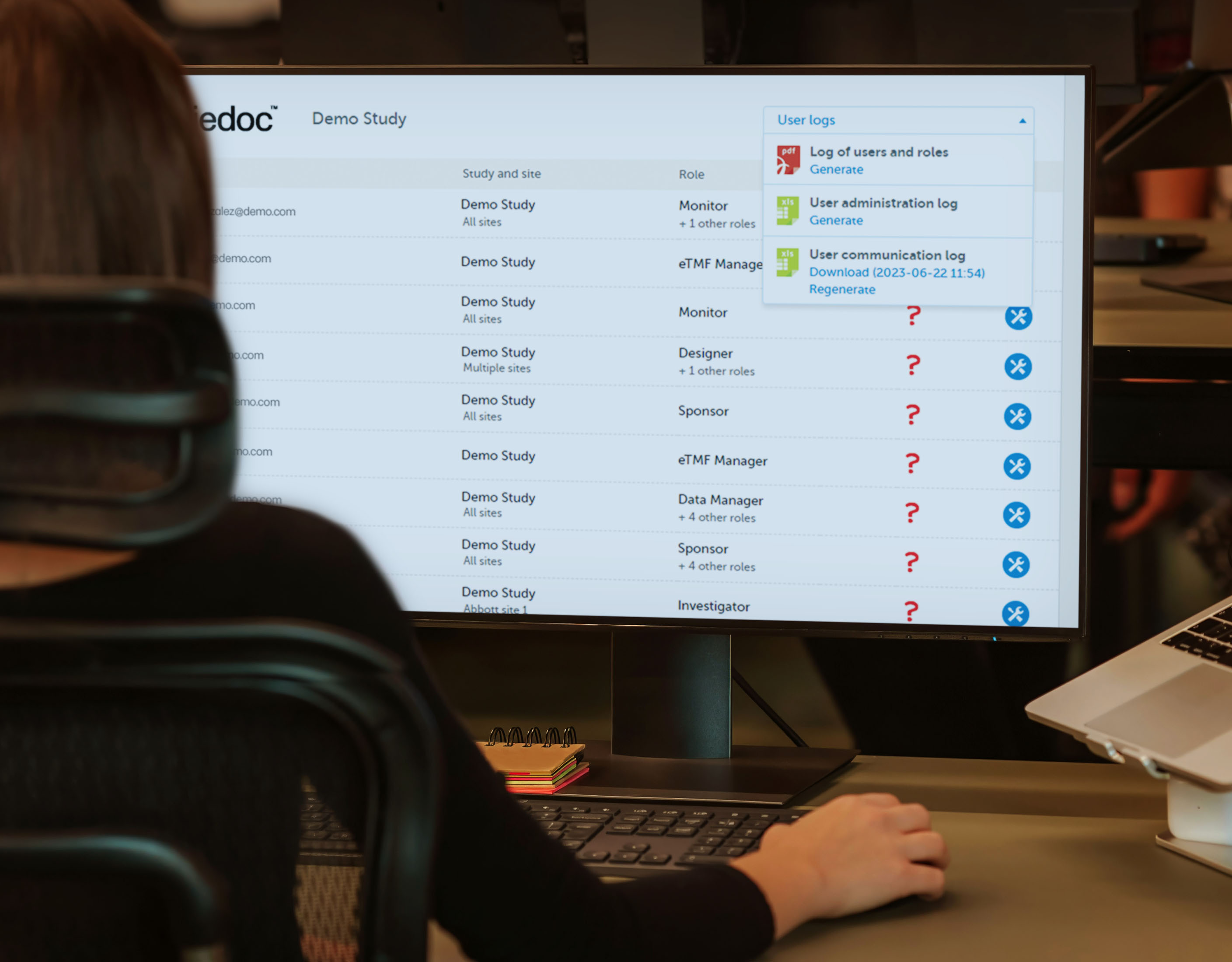
Woman sitting at her desk in front of a large computer monitor using a piece of software

Key takeaways: ePRO

  • ePRO is the electronic capture of patient-reported outcome data, the patient's own report without interpretation by anyone else.

  • ePRO is one type of eCOA; eCOA also covers clinician-reported, observer-reported, and performance outcomes.

  • A proxy-reported outcome isn't a PRO, according to FDA's 2009 guidance.

  • FDA (section IV.F) and EMA (section 6.6) both expect the investigator to maintain access to electronic PRO records.

  • A CRO has to settle investigator access to electronic PRO source records before the study starts; a sponsor has to make sure PRO data intended for a labeling claim meet FDA's and EMA's requirements.

Frequently asked questions about ePRO

Related terms