Case study

WSG manages complex Phase II HER2-positive breast cancer trial using Viedoc

Challenge 

The West German Study Group (WSG) needed to manage a complex, multi-phase Phase II breast cancer trial involving multiple cohorts, varying treatment durations, and crossover therapy while ensuring accurate, consistent, and user-friendly data capture across sites. 

Solution  

Using Viedoc’s electronic data capture (EDC) system and integrated ePRO capabilities, WSG configured complex study logic, automated key processes, and streamlined workflows for both clinical staff and data management teams.

Result

Recruitment progressed almost twice as fast as planned, while automated workflows and integrated reporting reduced manual effort and enabled continuous, real-time oversight of study progress and data quality. 

May 28, 2026

The West German Study Group (WSG) is conducting the ADAPT HER2 IV study, a complex Phase II trial in early HER2-positive breast cancer involving multiple cohorts and crossover therapy. Using Viedoc’s EDC and integrated ePRO capabilities, WSG was able to configure and manage the study efficiently across multiple sites. This resulted in faster-than-expected recruitment, reduced manual workload, and continuous real-time oversight of study progress and data quality. 

Advancing breast cancer research through complex trial design

The West German Study Group (WSG) is an academic research organization specializing in the design, organization, and conduct of clinical trials in breast cancer. Its work focuses on improving treatment options and contributing to clinical guidelines through high-quality, data-driven research.

Breast cancer is one of the most common cancers worldwide, with over 2.3 million cases diagnosed each year according to the World Health Organization. It is a heterogeneous disease, consisting of multiple subtypes that require different treatment approaches.

One such subtype is HER2-positive breast cancer, where tumors overexpress the HER2 protein and often require targeted therapies, as described by the National Cancer Institute.

The ADAPT HER2 IV study focuses on patients with early HER2-positive breast cancer at low to intermediate risk. Conducted across multiple sites in Germany, the Phase II trial evaluates whether the antibody-drug conjugate T-DXd (trastuzumab deruxtecan) can achieve higher rates of pathological complete response (pCR) compared to standard chemotherapy.

Patients are assigned to two cohorts with different treatment durations (12 or 18 weeks), followed by surgery and response-guided crossover therapy. The goal is to improve outcomes while exploring opportunities to reduce treatment intensity—an important step toward more tailored therapies.

Patient-reported outcomes are collected through an integrated ePRO solution, ensuring that patient experience and quality of life are captured alongside clinical endpoints.


From complex protocol to efficient execution

The study’s multi-phase structure, combined with crossover therapy and longitudinal data collection, created challenges both operationally and from a data management perspective.

“From a data management perspective, capturing this complex design in the eCRF while maintaining data accuracy, consistency, and traceability was a major hurdle,” says Dr. Marlen Breuer, Head of Data Management at WSG.

Clinical teams needed clear guidance on visit schedules and treatment pathways, while data managers needed a system that could accurately reflect the protocol without introducing unnecessary complexity. Ensuring consistency across sites was critical to maintaining study integrity.

WSG selected Viedoc for its ability to translate complex study designs into a structured and intuitive setup. The platform enabled the team to configure multiple cohorts, treatment arms, and crossover logic within a single study environment—reducing reliance on manual processes and minimizing the risk of protocol deviations.

Site staff adapted quickly to the system, supported by an intuitive interface and clear eCRF logic. This reduced training needs and allowed teams to focus on data quality from the outset.

“Using Viedoc, we were able to automate much of this logic within the eCRF. This not only reduced the manual effort required from clinical staff and data managers by approximately 30%, but also significantly minimized the risk of errors,” says Dr. Breuer.

At the same time, integrated ePRO functionality enabled structured collection of patient-reported outcomes without adding operational burden.


 

WSG Viedoc case study
WSG_4

Real-time oversight supporting fast recruitment

With recruitment progressing quickly, maintaining visibility into study progress and data quality became increasingly important.

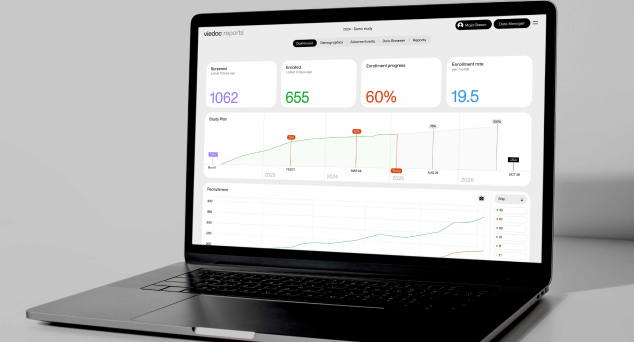
Viedoc’s built-in reporting tools allowed WSG to monitor recruitment, study status, and data quality continuously without relying on external systems or time-consuming manual processes.

“The ability to create and integrate reports directly within Viedoc allowed us to continuously monitor recruitment, study progress, and data quality in real time. This capability reduced the time spent on manual reporting tasks by approximately 40%, while also enabling us to identify and resolve issues earlier in the process,” says Dr. Breuer.

The study has seen strong engagement from both internal teams and clinical sites, reflected in consistently positive feedback on usability.

“We have continuously received positive feedback from both our internal clinical trial management teams and the clinical staff at study sites who use Viedoc daily,” says Dr. Breuer.

Recruitment progressed almost twice as fast as initially planned, highlighting both the clinical relevance of the study and the ability of sites to work efficiently within the system.

Across sites, the combination of automated workflows, intuitive data entry, and real-time visibility contributed to:

    • Reduced manual workload
    • Fewer data entry errors
    • Consistent data quality across study sites
    • Faster issue identification and resolution


A partnership built for evolving studies

 Beyond the technology itself, WSG highlights the importance of collaboration and responsiveness.

“During our collaboration, the Viedoc system has seen many technical improvements and the addition of highly useful features, such as field-based SDV, repeating items, and enhanced functionality within the eCRF designer. These enhancements have greatly supported our daily work in complex clinical studies,” says Dr. Breuer.

From Viedoc’s perspective, the collaboration reflects a shared focus on adaptability and continuous improvement.

“Studies like ADAPT HER2 IV highlight how important it is to combine scientific ambition with operational efficiency. We really value the collaboration with WSG and look forward to continuing to support their work in future studies,” says Adam Alsén, Business Development Manager at Viedoc.

With ongoing expansion across Europe and new studies in the metastatic setting, WSG continues to rely on flexible systems and strong partnerships.

“We look forward to continuing our collaboration and exploring new ways to optimize our clinical operations, while maintaining high-quality, reliable data and efficient study execution.”

WSG Viedoc case study

It's a user friendly EDC with ease of implementing changes. The customer support is quick. I use it frequently for studies. There are multiple features compared to other EDC which provide ease of integration of all the expectation.

Ankit S.

star star star star star

October 06, 2023

Leader G2 badge for Fall 2024